The Customer Demand Curve: Why Your Average Customer Is a Statistical Fiction

Your average customer doesn't exist.
Not as a real person, anyway. The "average customer" is a modeling convenience, a number that emerges from aggregating wildly different behaviors into a single, tidy figure. Marketers build strategies around this fiction, then wonder why their campaigns underperform.
Classical economics plots the demand curve as price against quantity demanded, sloping neatly downward. Useful as a baseline. Dangerously misleading as a strategy tool. Because the moment you aggregate individual buyers into a single curve, you flatten the variation that actually determines whether your brand grows or shrinks.
That's not a minor academic quibble. It's the foundation of one of the most persistent and expensive mistakes in marketing.
The Average Is Not the Typical
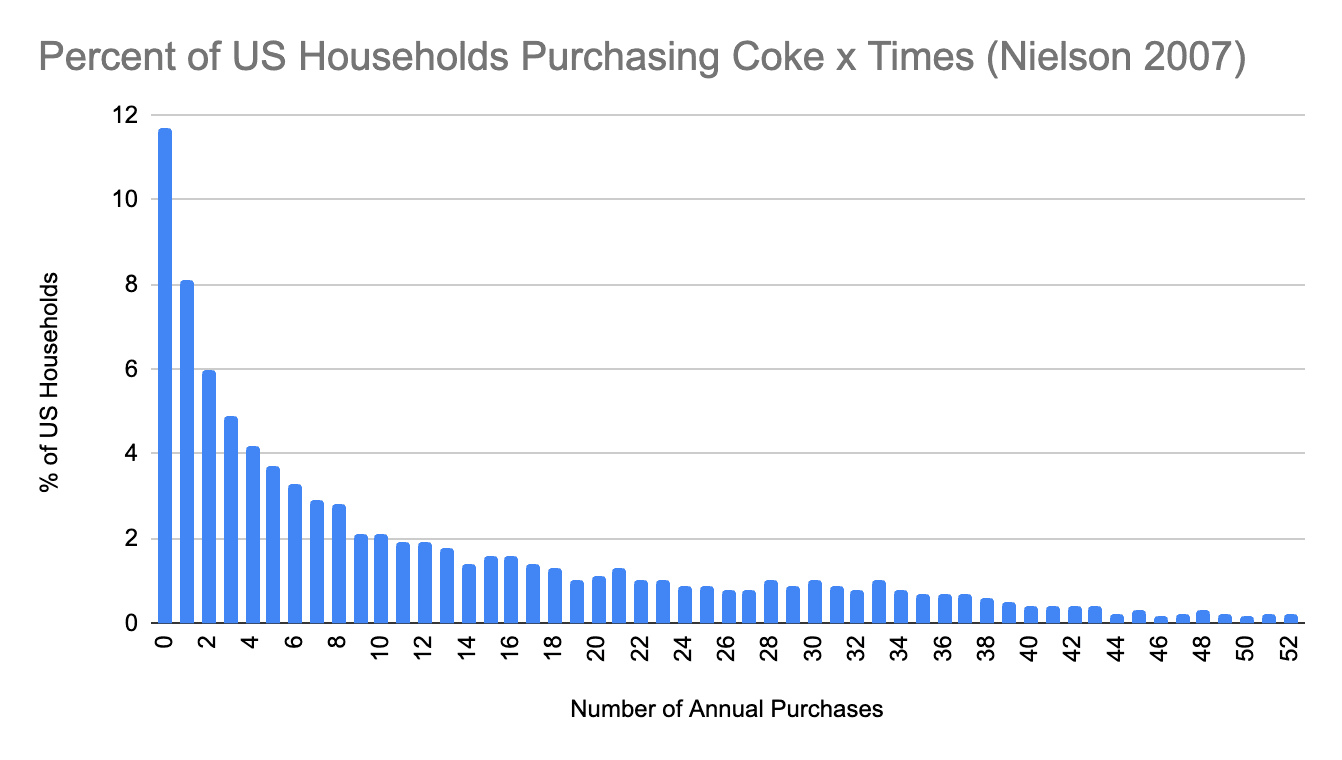
Consider Coca-Cola. The average Coke buyer purchases 12 times a year. That sounds like a reasonably engaged customer base. Monthly purchases. Reliable volume.
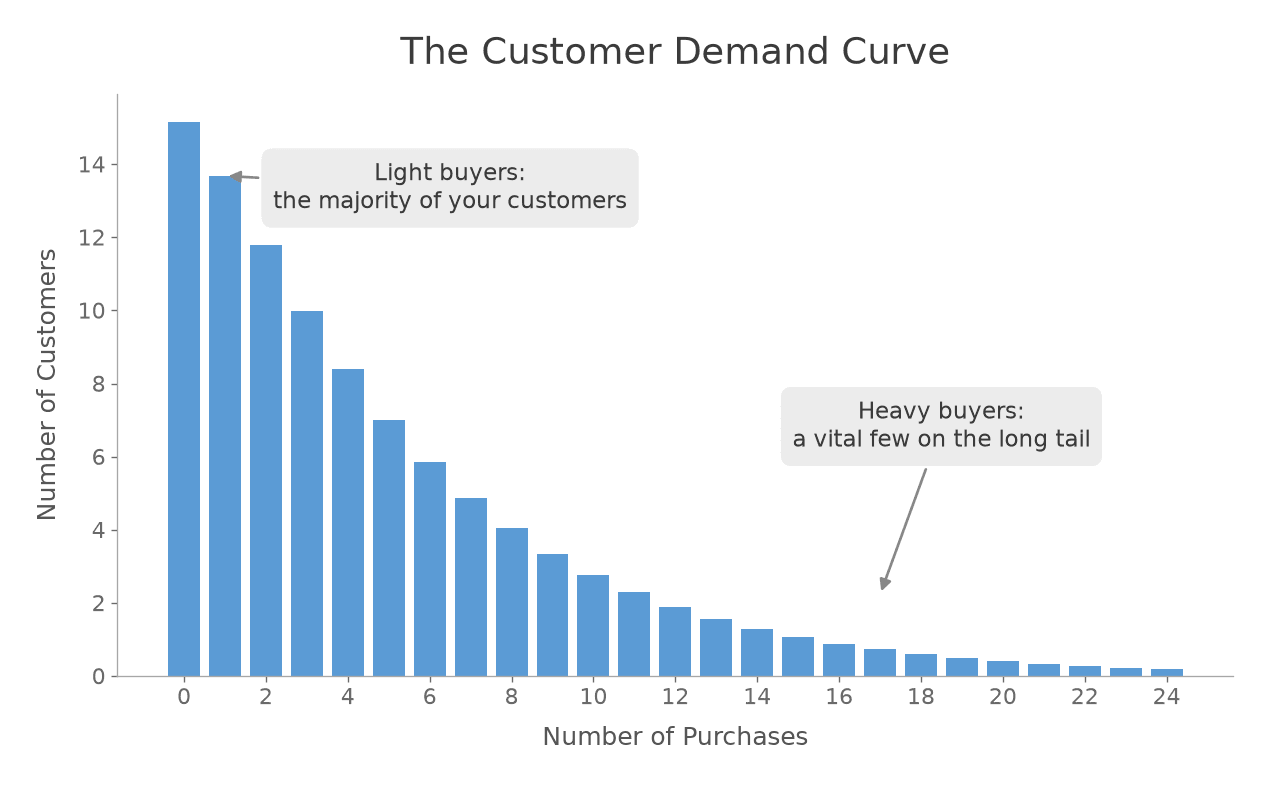
Except the average is not typical. As Patrick Gilbert covers in Never Always, Never Never, the purchase frequency distribution for Coke looks nothing like a bell curve centered on 12. More than half of Coca-Cola customers buy just once or twice a year. Buyers purchasing three or four times annually are already considered heavy buyers. A small number of genuine fanatics buy dozens of times a year, which pulls the average up and makes the customer base look far more engaged than it actually is.
Purchase behavior follows the negative binomial distribution, a statistical pattern that Byron Sharp and the Ehrenberg-Bass Institute have documented across dozens of product categories. Purchase behavior isn't evenly distributed. It's heavily skewed toward light, infrequent buyers who make up the vast majority of any brand's customer base.
Aggregating these buyers into a single demand curve obscures all of this. It treats the once-a-year buyer and the twice-a-week buyer as the same entity. They are not.
Why Heterogeneous Demand Changes Everything
Economists have a term for the reality hiding behind the average curve: heterogeneous demand. Different buyers have different price sensitivities, different willingness to pay, and different responsiveness to advertising. Aggregating all of that into a single slope loses the signal.
Price elasticity is the sharpest example. Elasticity measures how much quantity demanded changes when price changes. If elasticity differs across your customer base, and it almost certainly does, then a single average elasticity is a poor decision rule. You might be underpricing for buyers who would happily pay more, while simultaneously overpricing for the light buyers whose occasional purchases represent your largest growth opportunity.
With U.S. CPI-U running 4.2% higher year over year according to the Bureau of Labor Statistics, this isn't a theoretical concern. Real purchasing power is shifting. Buyers who were price-insensitive eighteen months ago may now be shopping differently. An aggregate demand curve won't tell you that. A granular view of your customer base might.
Targeting suffers from the same faulty logic. The myth of the buyer persona is built on the same faulty logic: find your best customer, build a detailed profile, and target people who match. The problem is that the best customer is often just the heavy buyer, and heavy buyers are already buying as much as they're likely to. You've found the people least likely to respond to your advertising.
The Light Buyers Curve Is Where Growth Lives
Here's the counterintuitive truth that the average customer myth obscures: buyers who purchase infrequently, the ones your demand curve barely registers, are the primary engine of brand growth.
Ehrenberg-Bass Institute research shows that for growing brands, a significant share of revenue comes from the top customers, but a substantial portion also comes from light buyers. There are so many of them that even small shifts in their behavior produce large changes in total volume.
Byron Sharp describes this dynamic in How Brands Grow: heavy buyers will keep purchasing at high volumes until something momentous causes them to downgrade or quit the category, and that event is usually outside the brand's control. Light buyers, by contrast, fluctuate. Bob buys one can of Coke this year. Next year he hosts a summer party and buys five. Claire drops from four to two after her new office starts stocking free drinks. These small shifts, multiplied across millions of light buyers, determine whether a brand grows or contracts.
The Law of Buyer Moderation describes this precisely: heavy buyers regress toward the mean over time, and light buyers represent the upside. Brands don't grow by extracting more from their most loyal customers. They grow by winning incremental purchases from people who barely think about them.
This reframes what the demand curve should actually represent. You're not trying to move one average customer down a single price-quantity curve. You're trying to nudge millions of light buyers to make one more purchase, and to slightly increase the probability that your brand is what they reach for when they do.
Satisficing and the Probability of Purchase
Herbert Simon's concept of satisficing explains the mechanism. Buyers don't optimize their choices. They find something good enough and move on. In categories where products are functionally similar, whether that's rental cars, shampoo, or pet insurance, familiarity and availability matter far more than brand loyalty.
A brain scan study by Michael Plassmann and colleagues found that when participants chose between well-known and lesser-known brands, brain activity was measurably lower when selecting the familiar option. Choosing a known brand is a literal cognitive shortcut. That's not love. That's friction reduction.
Changing the advertising problem entirely follows from this insight. For the average Coke drinker, there's roughly a 1-in-300 chance they'll buy a Coke on any given day. Coca-Cola doesn't advertise to make everyone want Coke daily. It advertises to nudge that probability slightly upward, to tilt the odds in its favor across millions of buying moments throughout the year. If that probability moves from 1-in-300 to 2-in-300, revenue doubles. Most buyers wouldn't notice any change in their own behavior.
A probabilistic view of advertising is what makes mental availability so commercially important, and it's exactly what the average customer myth obscures. You're not selling to one person with one demand curve. You're building presence in millions of minds so that when a purchase occasion arrives, you're the first brand that surfaces.
Google's Messy Middle research reinforces how fluid this really is. Researchers asked in-market shoppers across dozens of categories to name their preferred brand, then asked the same question later with no intervening marketing. In the SUV category, a significant share of shoppers switched their stated preference. For car insurance, an even larger share switched. Even among smartphone buyers, who appear to be fiercely loyal, a meaningful proportion changed their preferred brand with no outside influence at all. Across every category studied, at least one in five customers flipped their preference for no apparent reason.
Customers don't belong to brands. They share them. The messy middle between initial consideration and final purchase is far messier than any demand curve suggests.
The LTV Trap
Closely related to the average customer myth is the LTV trap.
Lifetime value calculations are built on averages. Average purchase frequency, average order value, average retention rate. Stack enough averages together and you get a number that tells you what your customer is worth over time. Then you build acquisition strategies around that number, set bid targets in your ad platforms, and make budget decisions based on the arithmetic.
LTV distributions, like purchase frequency distributions, are heavily skewed. A small number of high-value customers inflate the average. Your median customer is worth considerably less than your mean customer. If you're bidding to acquire the average LTV customer, you're either overpaying for most new customers or underinvesting in the acquisition of the rare high-value ones.
More importantly, optimizing for high-LTV lookalikes means spending most of your budget chasing a profile that represents a minority of your actual market. Light buyers who make up the bulk of your category, and who represent most of your realistic growth opportunity, don't match that profile. Your targeting excludes them by design.
In practice, the 95-5 rule makes this concrete: at any given moment, roughly 95% of your potential buyers aren't actively in-market. Most of them are light buyers or non-buyers who may eventually enter a purchase occasion. Spending almost exclusively on the 5% who are actively shopping, and specifically the high-LTV lookalikes within that 5%, leaves an enormous amount of growth on the table.
At AdVenture Media, this pattern shows up consistently in how brands structure their campaigns, heavy targeting toward the best existing customers, while dramatically under-investing in the broader market.
What the Demand Curve Should Actually Tell You
None of this makes the demand curve useless. It's a starting framework, not an ending one.
Measuring demand at multiple points, rather than inferring it from a single average conversion rate, is the right application. Different buyers respond differently to different prices, different messages, and different channels. An aggregate curve is the floor, the minimum viable model. Actual work means understanding the variation beneath it.
Three practical implications follow from this.
First, reach matters more than depth. Because light buyers drive so much of category volume, broad reach advertising that keeps your brand mentally available, as opposed to deep engagement with existing heavy buyers, is the higher-return activity for most brands. Les Binet and Peter Field's analysis of the IPA DataBank consistently shows that campaigns optimizing for brand building versus direct response tend to produce larger long-term effects.
Second, the purchase probability frame is more useful than the loyalty frame. You're not trying to build relationships. You're trying to slightly increase the odds that a light buyer chooses you at the moment they enter the category. Distinctive brand assets and mental availability are the mechanisms. Emotional advertising and consistent creative execution are the tools.
Third, your measurement needs to account for the full distribution, not just the average. Measuring only your best customers, or building attribution models around your highest-frequency buyers, systematically undervalues the marketing activities that reach light buyers. Those activities, which are often brand-level investments, generate returns that show up slowly and diffusely across millions of transactions.
Structural consequences follow from getting this wrong. As the double jeopardy law shows, smaller brands suffer twice, with both fewer buyers and lower purchase frequency among those buyers. Penetration, reaching more light buyers, is the path out, not loyalty, squeezing more from the ones you already have.
Stop Building Strategy for a Customer Who Doesn't Exist
As an abstraction for introductory economics, the average customer has its uses. As a foundation for marketing strategy, it fails.
Your customer base is a distribution, not a person. Most buyers in that distribution are light buyers who purchase infrequently, satisfice rather than optimize, and share their category spend across several brands without much thought. They are not disloyal. They are just busy people making quick decisions based on what's familiar, available, and easy.
Returning to this insight repeatedly is what makes Never Always, Never Never so useful: brands grow by making themselves easy to notice, easy to choose, and easy to buy, not by deepening relationships with the small fraction of customers who would choose them anyway.
Stop designing campaigns for the customers you wish you had. Start designing them for the customers you actually have: millions of light buyers, most of whom barely think about your brand, all of whom represent an incremental growth opportunity if you remain present when they do.
One line cannot capture a distribution. Build your strategy accordingly.
 Patrick Gilbert
Patrick Gilbert is the CEO of AdVenture Media and author of Never Always, Never Never and the bestselling Join or Die. He has been ranked among the top 5 PPC experts worldwide and has delivered keynotes at Google events across three continents.
More about Patrick →Enjoyed this?
Subscribe for more articles on strategy, AI, and what's actually working in marketing.
No spam. Unsubscribe anytime.