The Stanley Cup Craze: What Light Buyers Actually Look Like at Scale

Stanley went from approximately $73 million in annual sales in 2019 to a projected $750 million in 2023. A 110-year-old thermos brand. One hero product. No fundamental change to what the product does.
Most brand case studies frame this as a loyalty story. Passionate fans, community, word-of-mouth. But that framing misses what actually happened. Stanley's growth wasn't built on devotion. It was built on the purchasing behavior of tens of millions of people who rarely thought about Stanley at all, until suddenly they did.
In short, it's light buyers marketing in its most visible form.
The Loyalty Story Marketers Want to Tell
When a brand grows tenfold in four years, the instinct is to credit some deep emotional connection between brand and customer. Stanley earned its fans. The Quencher tumbler generated approximately 700 million views of #StanleyTumbler on TikTok, according to a Stanley executive cited by Retail Dive. The Stanley x Starbucks limited-edition collaboration resold on eBay for $200 to $500 per cup within days of release. The brand generated 106 million organic video views and 10.5 million organic engagements from a single campaign, per the Shorty Awards case summary.
Those are extraordinary numbers. But they describe reach, not loyalty.
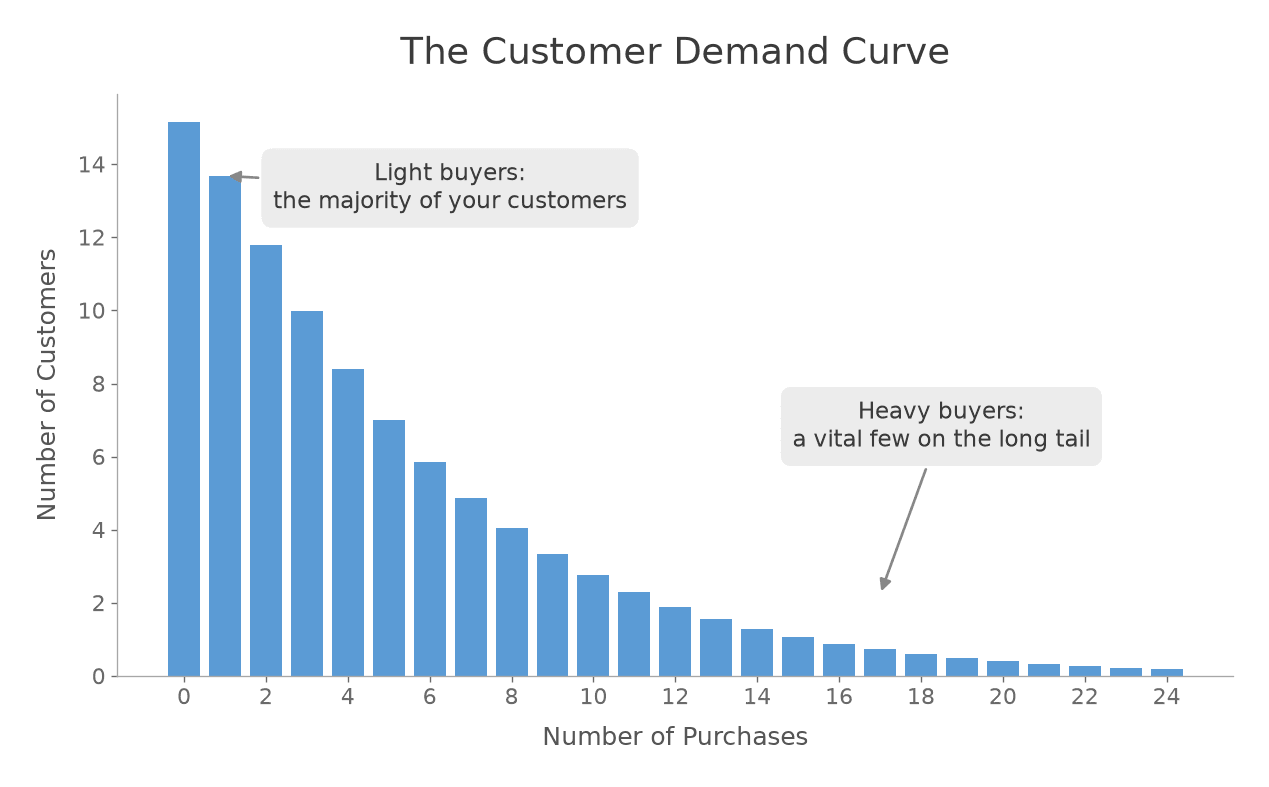
People driving those 700 million TikTok views were not predominantly die-hard Stanley customers. Most of them had barely considered the brand before the algorithm surfaced it. They saw the cup, wanted it, bought it once, and moved on. That is the textbook definition of a light buyer: someone who purchases occasionally, often without much deliberation, and whose next purchase could just as easily go somewhere else.
Never Always, Never Never by Patrick Gilbert covers the Ehrenberg-Bass Institute's research on this exact pattern in Chapter 9. What consistently surprises marketers is that the majority of any brand's revenue comes from people who buy infrequently. The top 20% of customers account for roughly 50 to 60% of revenue, not the 80% that Pareto's Principle would predict. The remaining 40 to 50% comes from light buyers. And because there are so many of them, they are the ones who determine whether a brand grows.
Revenue data makes this concrete. You do not go from $73 million to $750 million by squeezing more purchases out of existing fans. You get there by reaching an enormous number of people who had never bought a Stanley product before, nudging them toward one purchase, and repeating that across a massive audience.
How Scarcity Manufactures Light Buyer Moments
Stanley's specific mechanism for reaching light buyers was a creator-amplified, scarcity-driven demand loop.
Limited-edition drops, retail exclusives at Target, and high-profile collaborations like the Stanley x Starbucks release manufactured urgency. When a product sells out and secondary-market prices hit $200 to $500 on eBay, that scarcity becomes its own content. People who had no prior interest in the brand suddenly have a reason to pay attention.
Quencher sales grew 275% year-over-year during the period cited by Retail Dive. Hydration as a category grew 215% in the same period. Those numbers reflect category-wide behavior, not the habits of a loyal customer base deepening their commitment. They reflect a large number of new, occasional buyers entering the category for the first time.
What Stanley actually built matters here. They did not cultivate a tribe. They built a machine for generating mental availability at scale, one limited drop at a time, and each drop recruited a fresh wave of light buyers into a single purchase.
As Byron Sharp has written, heavy buyers are already purchasing as much as they likely will. Growth comes not from intensity among existing fans, but from breadth across the population of people who might buy once.
Mental Availability: The Real Product Stanley Was Selling
Quencher tumblers are good products. But they are not so functionally superior to a Yeti or a Hydro Flask that product quality alone explains the growth trajectory. What Stanley actually sold, particularly in 2021 through 2023, was brand salience.
Mental availability is the probability that a brand comes to mind when a buying situation arises. Chapter 10 of the book describes how brands build this through memory structures: repeated associations between a brand and the situations where someone might buy it. More cues linking back to your brand means a higher likelihood of recall when a relevant moment occurs.
Stanley's TikTok presence created an enormous web of these cues. A video of someone's morning routine. A car cup holder shot. A "what's in my bag" post. A colorway drop announcement. Each piece of content added another thread to the associative network connecting Stanley to everyday hydration moments. The brand did not have to script this. Content was largely user-generated, and Stanley's role was to amplify and respond to organic activity rather than lead with paid media.
Jenni Romaniuk calls the triggers that bring a category to mind category entry points. For Stanley, those entry points multiplied rapidly: getting ready in the morning, going to the gym, commuting, posting an aesthetically composed desk setup. Stanley colonized a huge number of everyday situations in the minds of people who had never owned one of its products.
When those people entered a Target and saw the Quencher on the shelf, they had already been primed. That is not loyalty. That is mental availability doing exactly what it is supposed to do.
Physical Availability Was Half the Story
Mental availability gets you thought of. Physical availability gets you bought.
Stanley's retail strategy was deliberate. A Target exclusive partnership put the product in one of the highest-traffic general merchandise retailers in the United States, at a price point accessible to a broad audience. The Stanley x Starbucks collaboration extended physical availability into a retail environment where Stanley's target buyer already spent time every morning.
Both needles were threaded simultaneously: build mental availability through social-first content and earned media, then make the product easy to find through retail distribution and high-profile exclusives. What resulted was a near-frictionless path from awareness to purchase for exactly the kind of light buyer who might spend $45 on a trendy tumbler once and never think about the brand again.
At AdVenture Media, the brands that consistently outperform are the ones treating physical and mental availability as a connected system rather than separate problems.
The Harder Question: What Happens After the Craze?
Ad Age reported that Stanley's strategy was actively evolving beyond viral TikTok moments, with the company working to build a broader, more durable marketing platform. That strategic shift is exactly the right move. It is also a tacit acknowledgment of the underlying challenge.
A brand built on light buyer acquisition through scarcity drops is structurally dependent on the next drop performing. If the drops become predictable, the scarcity narrative collapses. If TikTok's algorithm shifts away from the content formats that drove Stanley's growth, the pipeline of new light buyers dries up. Stanley grew by converting attention into first-time purchases at scale. Sustaining that requires either continuously expanding reach to new audiences or converting some portion of those light buyers into people who think of Stanley across a wider range of situations.
This is where the light buyers vs loyal customers question gets complicated. Ehrenberg-Bass Institute research, as discussed in the book, shows that heavy buyers tend to regress toward the mean over time. Someone who bought a Stanley cup multiple times because the drops were exciting may buy far less once the novelty has faded. That is not brand failure. That is the natural ebb and flow of buyer behavior that Byron Sharp calls the Law of Buyer Moderation.
Sustained growth requires broadening category entry points, not deepening loyalty among the existing base. Stanley needs to become associated with more buying situations across more parts of the population, consistently, over time. Not just "the cup everyone wanted in 2022."
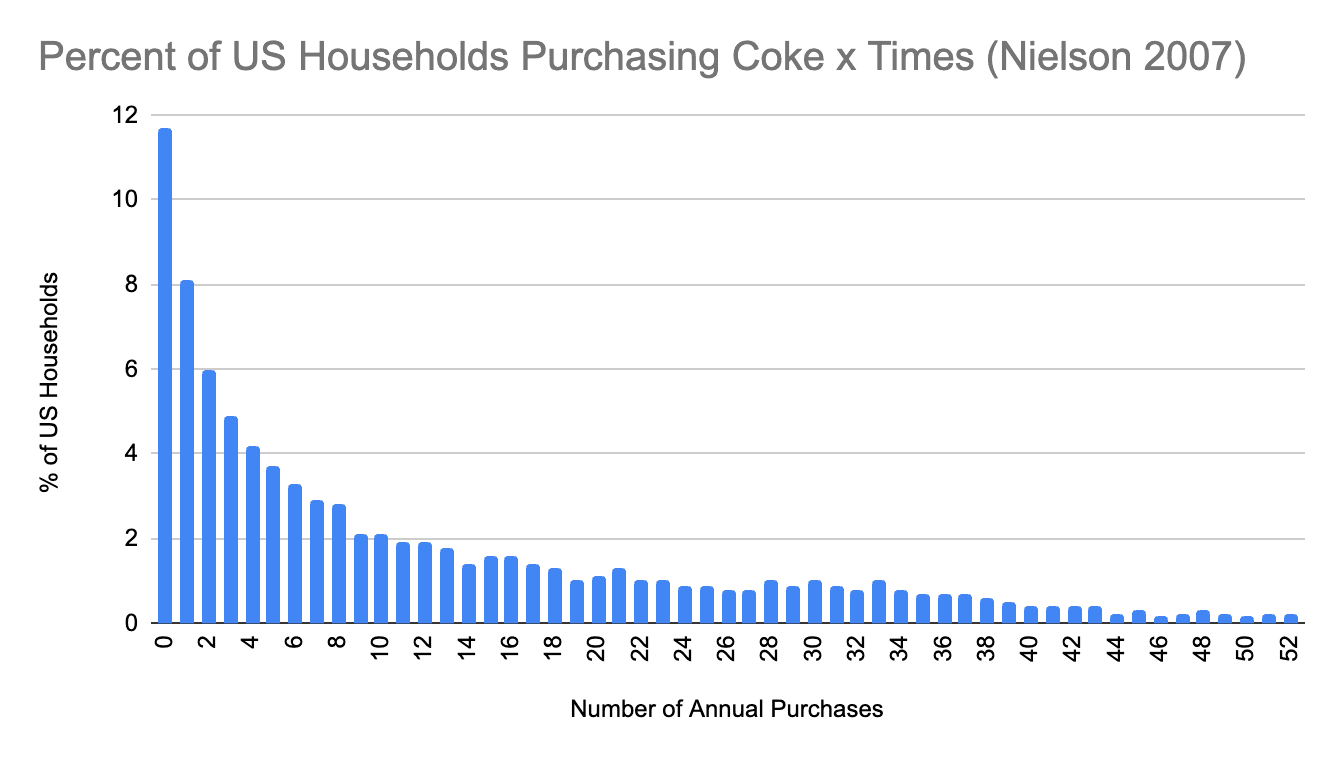
Coca-Cola's example from Chapter 9 is instructive here. Average Coke buyers purchase roughly 12 times a year, but that average masks the reality that more than half of buyers purchase just once or twice. Coca-Cola spends heavily not to drive up purchase frequency among heavy buyers, but to very slightly increase the probability that a light buyer chooses Coke on any given day. Across billions of potential purchase moments, a tiny shift in probability at the individual level becomes a massive revenue impact at scale.
That same discipline is what Stanley does not yet have behind it. Scarcity-and-social strategy worked brilliantly to generate initial mental availability. Sustaining it requires the less glamorous work of building durable memory structures that survive beyond whatever TikTok trend cycle launched the brand into the mainstream.
What Marketers Should Take From This
Stanley is not a story about finding the right audience and cultivating them. It is a story about reaching an enormous number of people who were not thinking about Stanley, making the product easy to want through scarcity and social proof, making it easy to buy through smart retail placement, and converting that awareness into a single purchase at massive scale.
That is the light buyer growth model working exactly as the Ehrenberg-Bass Institute would predict.
A contrarian read, which Never Always, Never Never would push marketers toward, is this: brands most likely to misread Stanley's success are the ones who attribute it to passionate community and try to replicate that. Brands most likely to actually learn from it are the ones who look at the mechanics underneath: broad reach, multiple entry points, frictionless purchase paths, and a product that is easy to want for five minutes.
Scarcity drops are a tactic. Mental and physical availability are the strategy. Stanley nailed the tactic first. The strategy is still being built.
For brands looking to apply these ideas, the question is not "how do we create a viral moment?" It is "how do we show up for the maximum number of people in the maximum number of buying situations, consistently, over time?" That question does not have a TikTok answer. It has a marketing science answer.
A similar dynamic appears in the analysis of how Celsius grew by understanding light buyers, where category expansion rather than loyalty deepening drove the growth curve. The pattern repeats across categories: brands that grow are the ones who reach more people, not the ones who lock in the people they already have.
 Patrick Gilbert
Patrick Gilbert is the CEO of AdVenture Media and author of Never Always, Never Never and the bestselling Join or Die. He has been ranked among the top 5 PPC experts worldwide and has delivered keynotes at Google events across three continents.
More about Patrick →Enjoyed this?
Subscribe for more articles on strategy, AI, and what's actually working in marketing.
No spam. Unsubscribe anytime.