About the Book
Never Always,
Never Never.
Strategic Marketing in an AI World
Most marketing today is stuck in a cycle of short-termism. Marketers chase ROAS targets, optimize campaigns in isolation, and treat every platform update like a fire to put out. The result is a lot of motion without much direction. Meanwhile, AI is accelerating everything around them.
This book is about putting strategy back at the center of marketing and understanding how AI changes who gets to be effective at it.
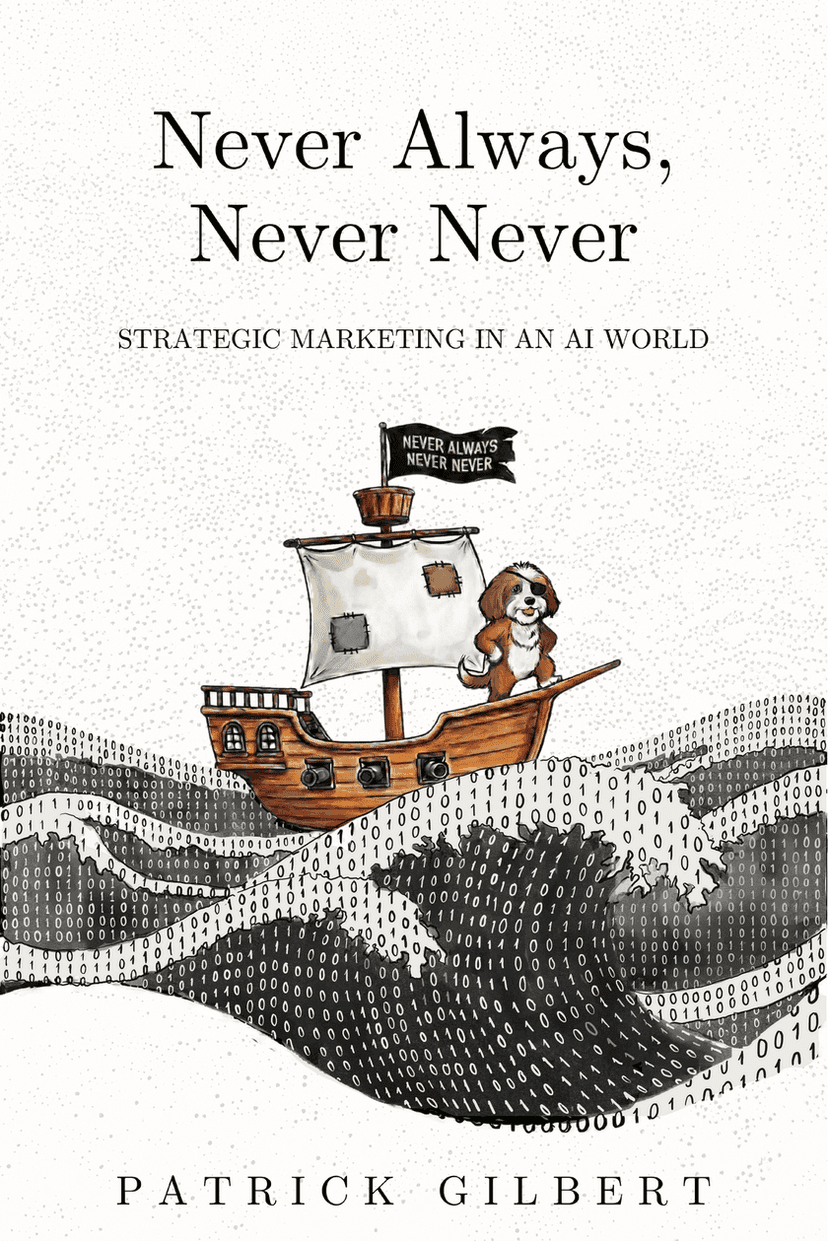
What this book is about
For the last decade, digital marketers have been rewarded for one thing: finding underpriced attention and exploiting it before everyone else caught on. Cheap clicks on Google. Underpriced Facebook inventory. Long-tail keywords no competitor had discovered yet. It worked brilliantly until it didn't.
Today, every arbitrage window closes faster than the last. Platforms have automated the tactics that once justified entire teams. And AI is accelerating the cycle, making it trivially easy to replicate whatever worked last quarter.
Never Always, Never Never argues that the marketers and businesses who thrive from here won't be the ones with the best tools or the fastest optimizations. They'll be the ones with the clearest strategic thinking.
Patrick Gilbert, CEO of AdVenture Media and author of the bestselling Join or Die: Digital Advertising in the Age of Automation, draws on over a decade of experience managing paid media for brands ranging from scrappy DTC startups to publicly traded companies. He traces the rise and fall of the tactics that once drove easy growth, explains why they've stopped working, and offers a practical framework for what comes next.
Along the way, Gilbert challenges some of the most deeply held assumptions in modern marketing. Drawing on research from the Ehrenberg-Bass Institute, Byron Sharp, and Les Binet & Peter Field, he makes the case that most of what marketers believe about loyalty, targeting, and funnel optimization is either incomplete or flat-out wrong.
The final third of the book explores how AI fits into this picture: not as a shortcut or a replacement for thinking, but as an amplifier of whatever you bring to the table. Gilbert explains how AI actually works in plain language, how ad platform algorithms learn, how AI-driven search is reshaping visibility, and how marketing teams can build an AI-first culture without losing the strategic foundation that makes the technology useful.
Chapter Outline
33 chapters across five parts, tracing the arc from broken playbooks to evidence-based strategy to the AI era.
Part 1
Put Yourself Out Of Business
Why the question every marketer should be asking is not 'how do I optimize?' but 'what would put me out of business?'
Ch 1
The Strategy Problem
Most businesses operate without a real marketing strategy, optimizing channels before clarifying actual business objectives. Gary Vaynerchuk's 'put yourself out of business' challenge becomes the lens for the book's transformation.
Ch 2
A New Agency Model
The 'lever-pulling' culture that consumed digital marketing for a decade is breaking down. AI is forcing agencies and in-house teams to stop measuring value by activity and start measuring it by strategic thinking.
Part 2
These Times, They Are A-Changin'
How digital marketing went from land grab to commodity, and why the tactics that built most careers have stopped working.
Ch 3
The Traditional Marketing Funnel
The classic Awareness-Consideration-Conversion funnel and how it functioned in the mass-media era. Establishes the historical baseline before explaining why that model no longer holds.
Ch 4
The Messy Middle
How the internet shattered the clean, linear funnel and created a chaotic loop of exploration and evaluation. Introduces 'Digital Advertising 1.0' as the industry's attempt to retrofit old thinking onto a new medium.
Ch 5
Day Trading Digital Arbitrage
The golden era of cheap digital traffic, when Google AdWords and early Facebook Ads were wildly underpriced. An entire generation of marketers built careers on exploiting those inefficiencies rather than doing real marketing.
Ch 6
The Long Tail
Chris Anderson's Long Tail thesis meets mid-2010s performance marketing: finding underserved audience segments and long-tail keywords before competitors arrived.
Ch 7
The End of the Arbitrage Era
Every arbitrage opportunity eventually gets discovered, copied, and competed away. What felt like a marketing strategy was really just a timing advantage.
Part 3
Marketing
Evidence-based marketing principles that challenge deeply held assumptions about loyalty, targeting, and funnel optimization.
Ch 8
No One Cares About Your Brand
Pushes back on inbound marketing romanticism. Introduces 'satisficing' and makes the uncomfortable case that most consumers don't want a relationship with your brand.
Ch 9
Focus on Light Buyers
Ehrenberg-Bass research shows that a brand's customers are mostly infrequent, low-engagement buyers. Growing a brand means reaching more of them, not deepening loyalty among existing superfans.
Ch 10
Mental Availability
Byron Sharp's concept of mental availability: being the brand that surfaces in a consumer's mind at the moment of need. Brand salience as neural links between a category need and a brand name.
Ch 11
Physical Availability
The other half of Sharp's framework: being easy to find and easy to buy. Coca-Cola's 'within arm's reach of desire' shows that distribution and digital presence are strategic decisions.
Ch 12
The Attention Spectrum
Kahneman's System 1 and System 2 thinking applied to advertising. Most marketing fails by demanding too much cognitive effort from distracted, indifferent audiences.
Ch 13
The Halo Effect
Binet and Field's IPA Databank research proves that emotionally-driven campaigns produce better long-term results than rational, direct-response advertising. Introduces the 95/5 rule.
Ch 15
The Emotional Edge
What 'emotional advertising' actually means in practice. It doesn't require tearjerker moments. Small, specific feelings build lasting brand memory.
Ch 16
Brand vs. Performance: The Wilt Chamberlain Effect
The split between brand and performance marketing is a liability. Brand campaigns drive direct sales; performance campaigns build brand equity. They're the same fight.
Part 4
Strategy
Practical frameworks for building a real marketing strategy, from goal-setting to measurement to product-market fit.
Ch 17
Strategy vs. Tactics
Defining the line between strategic decisions and tactical ones. The arbitrage era made this distinction feel unnecessary. Its absence is now a serious liability.
Ch 18
How To Build a Marketing Strategy
A five-step framework: Define Goals and Guardrails, Assess the Gap, and more. Goals defined as business outcomes (not ROAS targets); guardrails as the non-negotiables.
Ch 19
Goal Setting
Binet and Field's two-timescale model in practice: short-term activation goals balanced against long-term brand-building goals. The Balanced Scorecard approach.
Ch 20
Accountability and the Illusion of Control
Marketing's fragmentation into specialized agencies and siloed teams has created a false sense of control through dashboards while destroying real accountability.
Ch 21
Measurement: Scoreboards vs. The Film Room
Reframes Marketing Mix Modeling, attribution, and incrementality testing as learning tools, not verdict-rendering scoreboards. Treating measurement as a final score distorts incentives.
Ch 22
Buyer Personas vs. Product Market Fit
Product-market fit isn't a startup concept. It's a strategic prerequisite for marketing to function at all. Uses the history of chocolate to show how mass-market success rarely looks like what founders expect.
Ch 23
Never Always, Never Never (In Practice)
A former client's call leads to a lab-grown diamond brand launch that becomes a compressed masterclass in marketing strategy. The Grown Brilliance case study.
Part 5
The AI Era
How AI actually works, how it changes the economics of marketing, and how to build an organization that uses it without losing strategic foundation.
Ch 24
Post-Arbitrage Purgatory
Where most brands are stuck: aware that old playbooks are broken but unable to afford the infrastructure a real marketing program requires.
Ch 25
The Great AI Scramble
AI tools don't level the playing field between skilled and unskilled practitioners. The difference between 'using AI tools' and building genuine AI capability.
Ch 26
How AI Works
Major machine learning paradigms explained in plain language, connected to tools marketers use daily. The foundational technical literacy most marketers are missing.
Ch 27
The AI Answer Stack
A restaurant analogy explains the layered architecture behind any AI response: base model knowledge, prompt context, and retrieval layers. Why the same question yields different answers.
Ch 28
How Ad Platform AI Learns
How Smart Bidding and Lookalike Audiences work under the hood. What structured and unstructured machine learning means for how advertisers should feed their campaigns.
Ch 29
The Future of AI-Driven Search
AI has expanded the total search universe rather than just redistributing a fixed pie. Zero-click search, new query behaviors, and what this means for advertisers.
Ch 30
Building an AI-First Culture
The AI Double Helix framework: Internal Efficiency (automating low-value work) and External Value (delivering capabilities that weren't previously accessible).
Ch 31
Vibe Coding
AI-assisted coding has shifted the bottleneck from syntax to the ability to clearly articulate what you want built. Moving from scripts-as-party-tricks to functional marketing tools.
Ch 32
The Resource Gap
The structural problem keeping most brands from executing real marketing programs: the gap between what marketing should look like and what teams can afford to build. AI as force multiplier.
Ch 33
The Second Strand
Returns to the Double Helix framework to close the book: using AI to build strategic infrastructure that was previously available only to large holding companies.
Who this book is for
Marketers who sense something has shifted but aren't sure what to do about it
Agency leaders managing teams through the AI transition
Business owners who want to understand what good marketing actually looks like now
Anyone tired of easy answers and looking for honest, practical frameworks
Who it's not for
Anyone looking for a list of AI tools to plug in tomorrow
Marketers who want hacks without understanding why they work
People who think the old playbook is still fine
What people are saying
“We talk about moats in the age of AI; the protective scaffolding businesses must build to thrive. Refined human intuition is one such moat. So is sophisticated taste, expert judgment, and deep consumer empathy. Patrick's content isn't just AI training — he teaches you how to build your personal and professional moat with the accessibility few authors can match. It's time to fortify your moat, and it starts with this book.”
Isaac Rudansky, CEO, AdVenture Media
“Patrick gets it. "Best practices" are a crutch for the average and the funnel died years ago, we just kept drawing it on whiteboards. Never Always, Never Never finally says it out loud, then does the harder thing: hands you a real playbook for the messy middle of consumer journeys. Light buyers over super-fans, mental availability over vanity metrics, AI as a copilot not an oracle. Plus, a healthy dose of the Buffalo Bills!”
Aaron Levy, Evangelist, Optmyzr
“Perfectly timed for the AI era, Patrick Gilbert offers a breath of reason while challenging us to shed outdated assumptions about how we reach our customers. It is a deeply researched dive into the fundamentals that still matter and a guide to using AI for long-term strategic growth. A vital read for any marketer who refuses to rest on yesterday’s wins.”
Ginny Marvin, Google Ads Product Liaison
“I hope my direct competition never finds this book — because I don't want them to discover the same value I did. This is one of those truly paradigm-shifting reads: exceptional at tying the past to the future of digital marketing. Patrick doesn't leave the reader in the theoretical; he dives into the practical with specific things to implement and real-life case studies. This book will help shape the future of our industry.”
Kirk Williams, Owner, ZATO Marketing; World's 3rd Most Influential PPC Expert