Buyer Personas vs Product Market Fit: Why Detailed Customer Profiles Often Mislead
Quick Answer: buyer personas vs product market fit
Buyer personas often mislead marketers because they collapse a wide range of motivations and behaviors into single fictional profiles, implying uniform behavior where none exists. Product market fit is contextual and discovered through narrow use cases before scaling. The adoption curve explains why the same persona behaves differently across categories. Visionaries buy promises while pragmatists need proof, requiring different marketing approaches at different stages. Success comes from understanding variance within audiences rather than creating more detailed persona descriptions.
Definition
The tension between detailed buyer persona creation and true product market fit discovery, where personas often mask the variance in customer behavior that actually drives adoption patterns.
Why Product Must Come First
Most marketing conversations revolve around three of the Four Ps: price, place, and promotion. Product is usually assumed. That assumption creates a fundamental strategic error. As Patrick Gilbert argues in Never Always, Never Never, product is not just another input alongside price or promotion. It is the foundation the other three depend on. If product market fit is weak, no amount of promotional sophistication will compensate for it. You can rent attention, discount aggressively, and flood channels with spend. But you can't scale something people don't truly want, don't understand, or don't feel safe adopting.
During the arbitrage-heavy years of digital advertising, weak product market fit was easier to ignore. Cheap traffic and light competition created enough slack that many products could survive without ever fully confronting whether they truly belonged in the market.
The Four Ps were formalized in the 1960s by Jerome McCarthy, and their order matters more than teams admit. That era trained a generation of marketers to believe that strategy lived downstream in messaging, targeting, and optimization rather than upstream in the product itself. Today, product market fit isn't a nice-to-have insight reserved for founders. It is a strategic requirement for marketing to function at all.
The False Certainty of Buyer Personas
Once marketers accept that product market fit is contextual, the next temptation is to look for certainty in buyer personas. On the surface, personas feel like strategy. They give teams focus, put a face to the customer, and turn an abstract market into someone you can picture and describe. Used properly, they are a helpful creative tool. The problem is that personas are often asked to do far more work than they are capable of doing.
The mistake happens when teams assume that defining a person is the same thing as understanding how adoption happens. Personas collapse a wide range of motivations, risk tolerances, and social contexts into a single fictional profile.
Patrick Gilbert, Never Always, Never Never
A fitness wearable brand might focus on "Busy Dad Dave," a middle manager in his forties with two kids who wants to lose fifteen pounds but hasn't exercised consistently in years. This sketch feels insightful and human. It is also not a go-to-market strategy. The mistake happens when teams assume uniform behavior where none exists. If there are enough Busy Dad Daves to support a business, then by definition those people cannot all behave the same way.
- Over-engineered personas become medical charts rather than market insights
- Teams respond to variance by adding more detail instead of accepting complexity
- Personas push marketers toward overly rational, literal messaging
- Real people respond emotionally, socially, and inconsistently
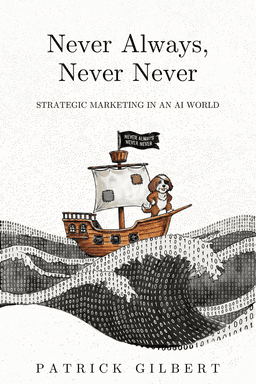
Enjoying this? Never Always, Never Never goes much deeper into the mental models and decision frameworks that shape how we think.
How the Adoption Curve Explains What Personas Cannot
If buyer personas help us imagine who we're talking to, they tell us almost nothing about when or why someone decides to act. The missing piece isn't a more detailed customer profile. It's understanding how adoption actually spreads. This is where the product adoption curve, developed by Everett Rogers and later refined by Geoffrey Moore in Crossing the Chasm, becomes essential.
Adoption begins with innovators, expands to early adopters, then moves into the early majority, late majority, and finally laggards. The key insight is that there is a wide chasm between the early market and the mainstream market. Moore's research found countless examples of companies that faded into obscurity because they failed to recognize how their marketing tactics needed to adjust to appeal to the broader category.
Innovators try things because they exist. Early adopters look for leverage and advantage. The early majority wants proof that something works without requiring heroics. They are not asking "Is this exciting?" They are asking "Is this safe?"
The mistake brands make is assuming that success on the left side of the curve naturally pulls them to the right. It doesn't. The behaviors that drive early adoption actively repel pragmatists. Big promises sound risky. Novelty sounds unstable. Passionate early users sound unrepresentative. This is why so many products feel stuck after an encouraging start.
Variance Within Personas Is the Rule
Once you examine adoption through this lens, something important becomes unavoidable. The problem was never that brands defined the wrong personas. The problem is that they expected those personas to behave consistently. Within any audience large enough to matter, there will be people who are eager, people who are cautious, and people who resist change almost entirely.
Busy Dad Dave is not one buyer type. Some Daves love gadgets and pre-order new devices. Other Daves are overwhelmed by technology and view syncing apps as work they don't have time for. These two people can look identical on paper and behave nothing alike in practice. This is the critical shift that personas obscure.
Pragmatists behave very differently from visionaries, even when they want the same outcome. They do not look forward for validation. They look sideways. They want to see other people like them using the product successfully.
Patrick Gilbert, Never Always, Never Never
Early adoption can be deceptive. When the most visible customers look extreme, overly technical, unusually motivated, or highly vocal, pragmatists often conclude the product isn't for them yet. What excites early users can quietly repel the majority. The chasm isn't crossed by doubling down on those who already agree with you.
The Whole Product: What Pragmatists Actually Buy
If the chasm exists because pragmatists are cautious, then the question becomes what finally convinces them to move. The answer is rarely the core product on its own. This is where Crossing the Chasm introduces one of its most important ideas: the whole product. Visionaries are willing to buy a promise. Pragmatists buy systems, reassurance, and risk removal.
The core product is what you sell. The whole product is everything required for someone to successfully adopt it without feeling exposed. That includes onboarding, customer service, integrations, shipping times, and the confidence that if something goes wrong, they won't be left alone. To a pragmatist, these are not nice-to-haves. They are the product.
Tesla didn't win by selling electric cars harder. They won by building the whole product. Charging infrastructure reduced anxiety. Software updates reduced obsolescence. A simplified buying process removed dealership friction. The decision stopped feeling bold and started feeling reasonable.
This pattern shows up everywhere. Products don't cross the chasm by becoming more impressive. They cross by becoming safer, more predictable, and easier to adopt without pain or regret. Pragmatists are not optimizing for the best possible outcome. They are minimizing downside. A product that integrates cleanly into existing habits will usually outperform a superior product that demands change.
People Don't Sit on One Curve, Categories Do
One of the most common misunderstandings about adoption is the belief that people themselves are innovators, pragmatists, or laggards. In reality, those labels describe behavior within a category, not personality traits. The same person can be cautious in one category and aggressive in another.
According to Patrick Gilbert's analysis, someone might be an early adopter of AI tools and health supplements but wait months before trying a new restaurant in their own town. They might still use the same headphones for years. In some categories, they're early. In others, they're late. In most, they're pragmatic. That isn't inconsistency. It's normal.
- Adoption behavior is shaped by cost, risk, visibility, reversibility, and social proof
- A decision that feels trivial in one category can feel loaded in another
- People move at different speeds depending on their familiarity with the category
- Context matters more than personality when predicting adoption behavior
Key People & Works
Researchers & Authors
- Jerome McCarthy
- Everett Rogers
- Geoffrey Moore
- Byron Sharp
- Patrick Gilbert
Key Works
- Crossing the Chasm by Geoffrey Moore
- Never Always, Never Never by Patrick Gilbert
Practical Applications
- Map your audience across the adoption curve instead of creating detailed personas
- Build whole product experiences that reduce risk for pragmatist buyers
- Design different messaging for early adopters versus mainstream market segments
- Focus on social proof and evidence rather than novelty when targeting pragmatists
- Test product market fit in narrow contexts before scaling broadly
Frequently Asked Questions
Why do buyer personas often mislead marketing teams?
Buyer personas collapse a wide range of motivations and behaviors into single fictional profiles, implying uniform behavior where none exists. They give teams the illusion of understanding while pushing them toward overly rational messaging that doesn't account for how people actually make decisions.
What is the difference between core product and whole product?
The core product is what you sell, while the whole product includes everything required for successful adoption without risk. Visionaries buy promises and tolerate gaps, but pragmatists need complete systems including onboarding, support, integrations, and confidence in the entire experience.
How does the adoption curve explain customer behavior better than personas?
The adoption curve shows that the same type of person behaves differently at different stages of market maturity. Innovators seek novelty, early adopters want advantage, but pragmatists need proof and safety. Personas miss these crucial timing and risk tolerance differences.
Why do successful products often stall after early growth?
Products stall because what attracts early adopters often repels pragmatists. Big promises sound risky, novelty sounds unstable, and passionate early users seem unrepresentative. Success requires different approaches for different adoption stages, not just amplifying the same message.
Can the same person be an early adopter in one category and a laggard in another?
Yes, adoption behavior is context-dependent, not a personality trait. Someone might eagerly try new technology but be cautious about restaurants, or embrace fitness gadgets but resist changing financial services. Categories have adoption curves, not people.
How should marketers approach the chasm between early adopters and mainstream customers?
Focus on building the whole product experience and providing social proof rather than excitement. Pragmatists need to see people like them using the product successfully, with complete systems that minimize risk and effort.
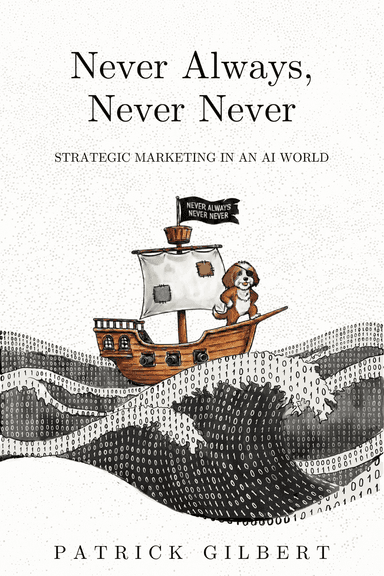
From the Book
Chapter 22 reveals why chocolate's path to mass adoption began with military rations, not indulgence, and how Tesla crossed the chasm not by making better electric cars, but by eliminating the anxiety around owning one. Gilbert shows why product market fit is discovered, not declared, through concrete examples spanning decades of consumer behavior.
This is just a glimpse. The book explores dozens of cognitive biases and decision-making frameworks that change how you think, decide, and act.
Want to go deeper on this topic?
Chat with the AI companion to explore these concepts with the full context of the book.
Chat about this topicRelated Reading
Light Buyers Marketing: Why Occasional Customers Drive Brand Growth
Light buyers, not loyal customers, drive brand growth. Learn why Ehrenberg-Bass research shows occasional purchasers matter more than super-fans.
BlogWhy the Old Playbook Is Broken
The platform tricks and optimization shortcuts that built most digital marketing careers have been commoditized. Here's what actually changed and what to do about it.