Discounts Buy Volume and Rent Loyalty

Slightly over half of U.S. consumers say they'll switch their primary shopping destination for a 20% discount. That number comes from a 2026 University at Buffalo study of 2,011 consumers, and it sounds alarming until you read the next finding: younger shoppers will switch for even less. If that's the loyalty you've been building with your promotional calendar, you don't have loyalty. You have a price-sensitive customer base waiting for someone to undercut you.
This thesis is simple, and the evidence supports it clearly: price promotions work as a volume tool. They do not work as a loyalty engine. That distinction matters more than most marketing teams admit, because the two goals require fundamentally different strategies and produce fundamentally different long-term outcomes.
What Discounts Actually Do
Discounts convert. That's real. A temporary price reduction creates urgency, reduces friction, and pulls forward demand. According to commercial consumer research (treat this directionally, not as gospel), 70% of consumers have made an impulse purchase driven by a deal or coupon, and 80% say a temporary price reduction can push them to consider a new brand.
That last stat is worth sitting with. A discount can get someone to try you. That's valuable. But it also means you've acquired a customer whose primary motivation was price, not preference. When the deal ends, so does their reason to stay.
Academic research increasingly confirms this pattern. Discounts pull demand forward but often leave behind stronger price sensitivity after the promotion ends. You've trained a segment of your customer base to wait for the sale. Every subsequent full-price offer looks worse by comparison.
Promotion design also creates a mechanical problem. A 2026 study on threshold promotions found that while they raise purchase intentions and conversion rates, they may actually reduce purchase amounts compared to capped promotions. You can get more transactions while making less money per transaction. Volume rises, revenue efficiency falls.
The Loyalty Illusion
Conventional promotional wisdom breaks down at a specific assumption. Underneath most loyalty programs and discount strategies is the belief that getting someone to buy once, especially at a lower price, creates a relationship. Data does not support this.
Buffalo Center for Marketing Analysis notes that loyalty is "stickier than expected" and that small discounts are less persuasive than they used to be. At 20% is where behavior actually shifts. Below that, you're spending margin without meaningfully moving the needle on acquisition or retention.
What does move retention? Evidence points away from straight price cuts. A 2025 consumer research paper found that loyalty points and experiential rewards outperformed BOGO offers on loyalty measures. An India-based study found cashback outperforms discounts for repeat purchase intention, and gamified rewards produce the strongest long-term attachment. Tilburg University research on retailers' temporary reward programs found that brand sales rose by an amount comparable to a 22% price discount, but the mechanism was program lock-in, not the discount itself.
Across these findings, a clear through-line emerges: what builds retention is habit, structure, and switching cost. Not a lower price.
The Light Buyer Problem Discounting Ignores
Heavy discount strategies contain a deeper strategic error, one that Patrick Gilbert covers in Never Always, Never Never.
Most brands overestimate the value of converting heavy buyers and underestimate the growth potential sitting in light buyers. In Chapter 9, the book draws on Ehrenberg-Bass Institute research showing that the top 20% of customers typically account for around 50–60% of revenue, not the 80% that Pareto's Principle would predict. The other 40–50% comes from occasional, low-frequency buyers who make up the vast majority of any brand's customer base.
Discounting strategies tend to target in-market, price-sensitive buyers, which skews toward people already close to purchase. That's demand capture, and it's useful. But demand generation, reaching the sea of light buyers who aren't actively considering you, requires mental availability, not a coupon code.
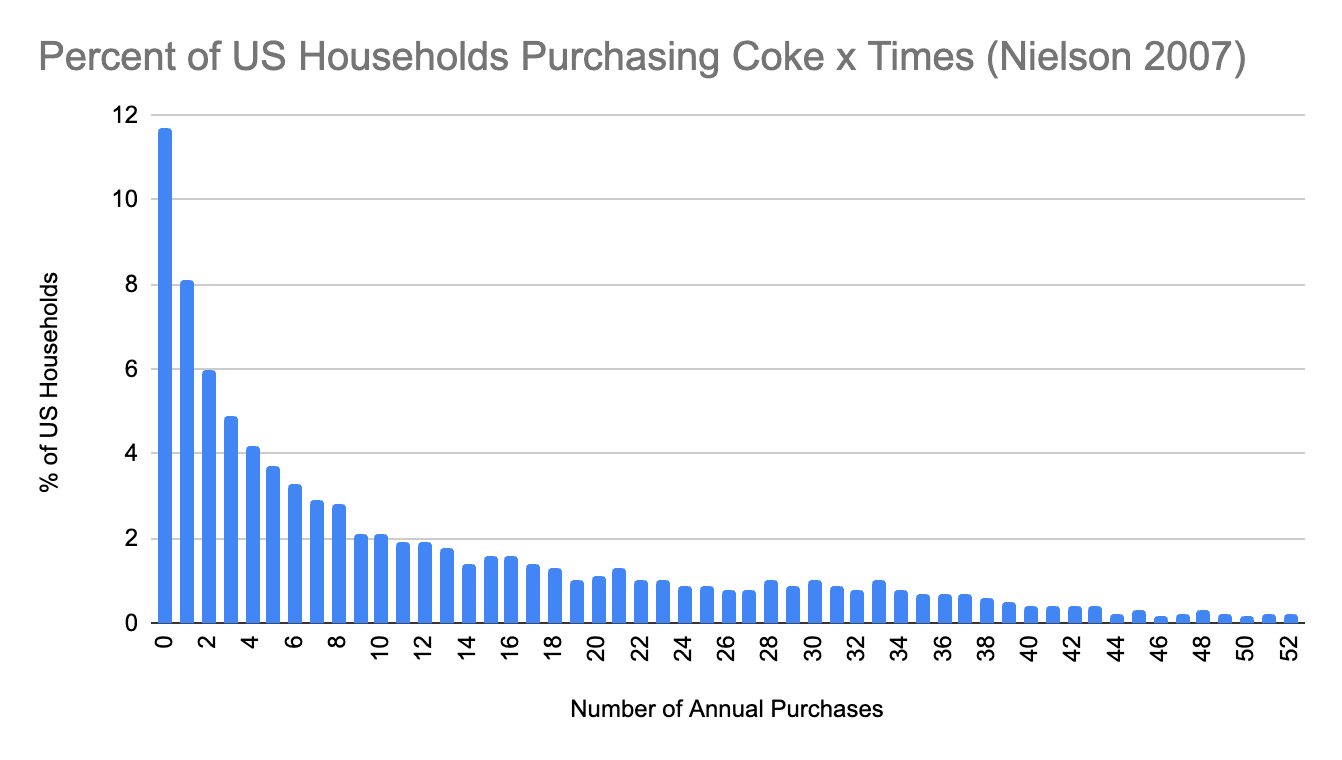
Byron Sharp's work frames advertising as a game of probabilities. For the average Coca-Cola buyer, the probability of buying on any given day is roughly 1 in 300. Advertising nudges that probability slightly higher. If Coke succeeds in doubling that probability, revenue effectively doubles, and most consumers wouldn't even notice the shift in their own behavior.
A flash sale doesn't work this way. It creates a spike and then a trough. The nudge is temporary and price-dependent, not structural. Worse, it may actively undermine the brand equity that makes those probabilistic nudges accumulate over time.
The Long Game Discounting Erodes
Les Binet and Peter Field's work on marketing effectiveness draws a sharp line between short-term sales activation and long-term brand building. Price promotions sit squarely on the activation side: quick spikes in conversion, rapid decay once the campaign ends, and no meaningful carryover into next quarter's growth. Chapter 19 of Never Always, Never Never applies this framework directly to goal setting, noting that short-term activation metrics like ROAS and CPA tell you the pulse, while long-term brand metrics tell you the health.
Over-indexing on promotional pricing damages the long-term scorecard in a specific way. As Binet and Field documented in Effectiveness in Context (2018), over-optimization for short-term efficiency leads to underinvestment in brand, which erodes future demand. Weaker brands convert less efficiently, which creates pressure to discount again. That cycle compounds downward. This is exactly the trap that the 60/40 brand and performance framework is designed to prevent.
For brands that want to understand how these two timescales interact in practice, the brand vs performance marketing analysis on this site covers it in more depth.
Smarter brands are moving toward targeted, structured incentives in their near-term promotional strategy: threshold mechanics, tiered rewards, and lock-in programs that create habit rather than price dependence. Promotions become acquisition tools that feed into retention systems, not standalone revenue levers.
When Discounting Is the Right Call
None of this means discounts are always wrong. There are clear use cases.
New customer acquisition is one. An introductory offer at a 20% discount to convert a light buyer who has never tried the product is defensible if the unit economics work and the post-acquisition experience is strong enough to generate repeat behavior at full price. The discount is the door, not the relationship.
Category entry moments are another. When a consumer is actively evaluating options, a promotional offer can tip the decision. That's a legitimate role for discounting, especially in competitive categories where category entry points are contested.
What discounting is not suited for is growing mental availability among non-buyers, building emotional affinity, or retaining customers who already buy at full price. Using a price cut for those goals is expensive and counterproductive.
At AdVenture Media, the question we ask before recommending any promotional strategy is what job the discount is being hired to do. Volume for a new SKU launch? Defensible. Margin sacrifice to retain someone who would have bought anyway? That's just giving money away.
The Smarter Path Forward
Best-supported by current research: use discounts sparingly, reserve them for genuine conversion moments, and pair them with mechanisms that build habit or lock-in rather than pure price sensitivity.
That means:
- Treating a promotional offer as the beginning of a customer relationship, not the relationship itself
- Investing in loyalty architecture that creates switching costs: points, tiers, experiential rewards, cashback structures
- Measuring promotion effectiveness against long-term repeat purchase rate, not just in-week conversion lift
- Protecting brand investment even when short-term activation numbers look strong
Advertising's probabilistic nature is exactly what makes long-term brand investment easy to undervalue and easy to cut. A flash sale produces a visible spike. Brand campaigns produce compounding, invisible nudges. Marketing teams that only manage what they can see clearly tend to over-promote and under-invest in brand. What follows is a customer base that expects deals, shops on price, and switches the moment a competitor offers 21%.
You can rent loyalty with discounts. Building it requires a different strategy entirely. As the Never Always, Never Never framework puts it: there are no universal playbooks, but the evidence on this particular question is unusually consistent. Discounts buy volume. Volume is not growth.
For a closer look at how loyalty programs fit into this picture, and why they often fail the same test that discounting does, that post covers the structural reasons in detail. And if you're thinking about how to set goals that distinguish activation from brand health, the guide on how to set marketing goals applies the Binet and Field balanced scorecard directly to this problem.
 Patrick Gilbert
Patrick Gilbert is the CEO of AdVenture Media and author of Never Always, Never Never and the bestselling Join or Die. He has been ranked among the top 5 PPC experts worldwide and has delivered keynotes at Google events across three continents.
More about Patrick →Enjoyed this?
Subscribe for more articles on strategy, AI, and what's actually working in marketing.
No spam. Unsubscribe anytime.