Loyalty Programs Don't Build Loyalty

The average American belongs to 17.4 loyalty programs and actively uses fewer than half of them. Consumers leave approximately $10 billion in rewards unclaimed every year. In 2025, 27% of earned loyalty points were never spent.
And yet, 9 in 10 loyalty program owners who measure performance report positive ROI, with an average return of 5.3x.
Both things are true. That's the problem.
Loyalty programs are genuinely profitable for the brands that run them well. But they are not doing what most marketers think they're doing. They are not creating loyalty. They are rewarding existing behavior, and there is a significant difference between those two things.
The Loyalty Program Is Not a Loyalty Machine
When marketers invest in loyalty programs, the implicit theory is: give our best customers a reason to stick around, and they'll become even better customers. It's intuitive. It's also largely unsupported by the behavioral evidence.
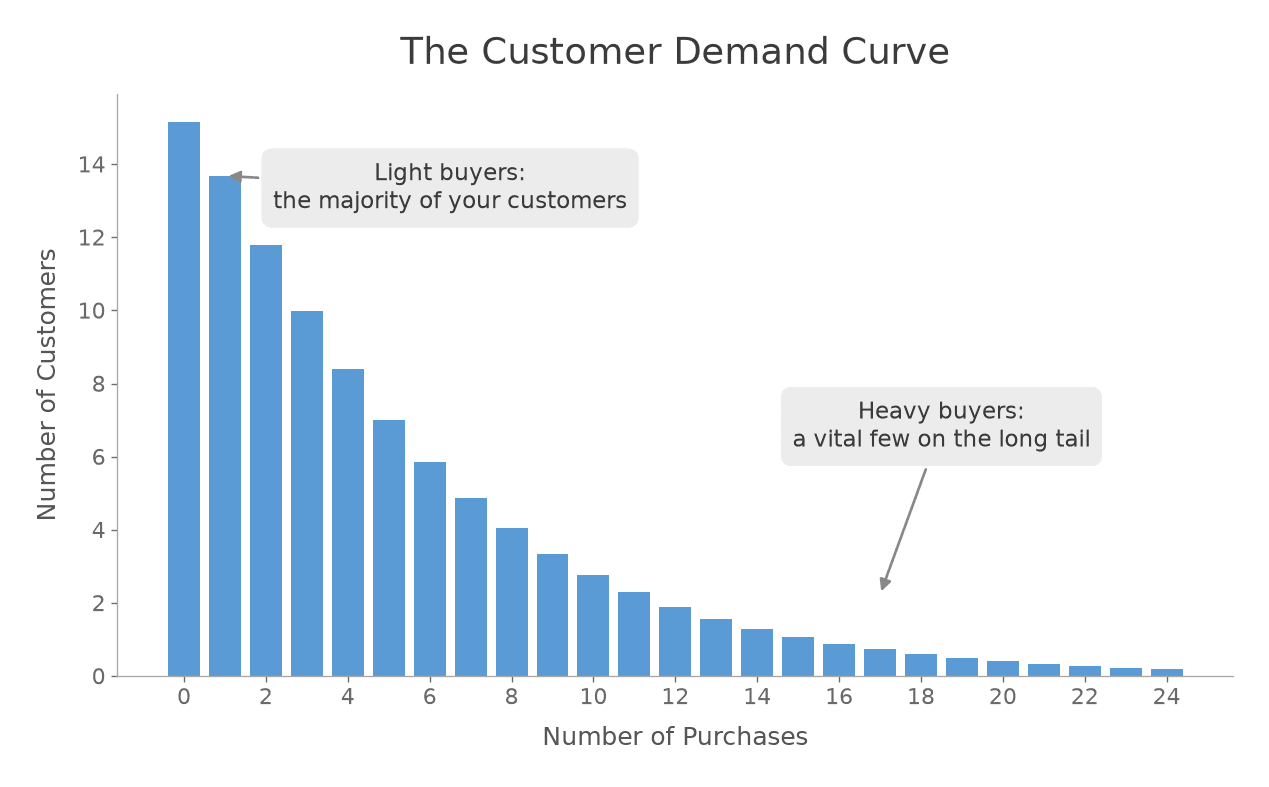
Research on how brand growth actually works points in a different direction. Byron Sharp's work at the Ehrenberg-Bass Institute shows that brands don't grow by extracting more from their heaviest buyers. They grow by winning incremental purchases from the large, diffuse population of light buyers who buy occasionally, without much deliberation, and without any particular sense of commitment to your brand.
The chapter on light buyers in Never Always, Never Never makes this concrete with Coca-Cola. Most Coke buyers purchase just once or twice a year. These are not people who feel loyal to Coke. They're people who, in a given moment, thought of Coke and bought it. Marketing's job is to slightly increase the probability that the next time they're in that moment, Coke comes to mind again.
A loyalty program is built for the opposite customer: someone who buys frequently enough to accumulate points, who tracks their rewards, who adjusts their behavior because of the program. That person exists. But they're a small fraction of any brand's total customer base, and as Sharp argues, they're already buying about as much as they're going to. Heavy buyers eventually regress toward the mean. You don't control when or why.
What Loyalty Programs Actually Do
Strip away the marketing language, and most loyalty programs are three things: a discount mechanism, a data collection system, and a CRM trigger. Those are all valuable. None of them is loyalty.
Antavo's Global Customer Loyalty Report 2026 found that 51.5% of marketing budget among program owners now goes to CRM and loyalty. That's a serious budget commitment. But the same report surfaces a telling detail: 12% of points earned in programs with expiration rules simply expired. Members joined, participated enough to earn, and then couldn't be bothered to redeem. That is not loyalty. That is mild engagement followed by attrition.
Consumer awareness tells a similar story. Eighty-one percent of consumers report awareness of loyalty programs in the e-commerce and consumer product categories they shop. Awareness isn't the problem. Participation isn't even the problem. Awareness and enrollment simply don't translate into the kind of behavioral change that drives real business growth.
When researchers look at what actually improves among loyalty program members, the finding is consistently that purchase frequency goes up more than basket size. Members buy a little more often. They don't buy dramatically more, and they don't become meaningfully more resistant to switching. Programs create transactional stickiness, not genuine preference.
Industry commentary in early 2026 framed the next phase of loyalty as "driving profit, not just participation." That framing is telling. For years, the category chased enrollment numbers and is now being forced to justify whether those members are actually worth more than non-members, net of the cost of the program itself. That question, about incrementality, is the right one. Most programs haven't been able to answer it cleanly.
Why the Theory of Loyalty Doesn't Fit How Buyers Actually Behave
Conventional cases for loyalty programs rest on a version of Pareto's Principle: your top 20% of customers drive most of your revenue, so protect and grow them. It's a compelling idea. It's also empirically weak for most categories.
Ehrenberg-Bass research consistently shows that for growing brands, the top 20% of customers account for roughly 50 to 60% of revenue, not 80%. That still sounds like a strong concentration argument until you flip it: the other 40 to 50% of revenue comes from people who buy infrequently, who probably don't feel loyal, and who almost certainly aren't enrolled in your loyalty program in any meaningful way.
Those light buyers are not a rounding error. They are the growth reservoir. And as Never Always, Never Never covers in the context of Byron Sharp's Law of Buyer Moderation, customers aren't static. Someone who buys once this year might buy five times next year because their life circumstances changed. A heavy buyer who purchases monthly might drop to quarterly after a job change or a move. You rarely cause these shifts, and a loyalty program rarely prevents them.
This is why the light buyers vs loyal customers question matters so much strategically. A program that lavishes investment on your top 10% of buyers, hoping to squeeze more from people who are already at or near their ceiling, is a program that is spending money to defend existing behavior rather than build new occasions.
None of this means loyalty programs are useless. It means most of them are solving the wrong problem.
Mental Availability Is Doing the Heavy Lifting
If loyalty programs aren't building loyalty, what is?
Honestly, it's mental availability: the probability that your brand comes to mind when a buying situation arises. Jenni Romaniuk developed this concept at the Ehrenberg-Bass Institute, and it's central to Never Always, Never Never's treatment of how brands actually grow.
Brands build mental availability by connecting themselves to a wide range of category entry points, the specific triggers that bring a need to mind. Hunger at 2 pm. A road trip that needs snacks. A friend's birthday. A craving that hits mid-afternoon. The more situations your brand is linked to in memory, and the more people it's linked to in, the more likely it is to be chosen when those situations occur.
A loyalty program doesn't build those connections. It doesn't make your brand easier to think of in moments of need. It rewards people who were already thinking of you. Brand building that actually moves brand salience happens through advertising, creative work, distinctive assets, and broad reach, not through a points balance.
At AdVenture Media, we see this pattern play out in account after account: brands that invest heavily in loyalty and CRM without investing in broad-reach brand building eventually find their customer base narrowing. Loyal customers age, churn, or get poached. There's no pipeline of light buyers being converted because no one was reaching them.
The brand vs performance marketing tension is real, and loyalty programs often sit in an awkward middle ground. They feel like brand investment because they carry the word "loyalty," but they function like performance marketing because they target existing customers with direct incentives. That category confusion leads to misallocation.
What Good Programs Actually Do Well
The case against loyalty programs as loyalty builders is strong. The case against loyalty programs entirely is weaker.
Antavo's 2026 data shows average reported ROI of 5.3x among programs that measure performance. That's a real number. The global loyalty management market is valued at approximately $8.6 billion and is growing at 9.2% annually through 2030. Brands are not spending this money irrationally.
An honest framing is that well-designed loyalty programs are valuable as data infrastructure, as CRM triggers, and as a mechanism for making existing customers marginally more likely to choose you over an equivalent competitor in a low-stakes switching moment. That is genuinely worth having. It's just not the same as building a loyal customer base.
Programs that work best share a few characteristics. They are easy to use, which reduces friction and increases actual redemption. They are tied to genuine relevance and personalization rather than generic points accumulation. And they are treated as one component of a broader retention and acquisition strategy, not as a substitute for it.
Programs that waste money are the ones that treat enrollment as a proxy for loyalty, celebrate large points balances without asking whether those points will ever be redeemed, and consume budget that would have been better spent building mental availability with people who aren't yet customers.
The Real Question to Ask Before You Build One
Before building or expanding a loyalty program, the question worth asking is not "will this improve retention?" It's "will this improve retention more than the same budget spent on broad-reach brand building?"
That's an incrementality question, and it's uncomfortable because most program owners haven't answered it. In 2026, industry narrative around loyalty is shifting toward profitability and incremental value precisely because high membership counts and large point liabilities don't tell you whether the program is actually creating behavior that wouldn't have happened otherwise.
Evidence from Byron Sharp, the Ehrenberg-Bass Institute, and the behavioral patterns documented in Never Always, Never Never all point toward the same conclusion: brands grow primarily through penetration, not loyalty depth. More buyers, not more purchases per buyer. Broader mental availability, not tighter emotional bonds with a small percentage of your base.
Loyalty programs have a place, but they should be sized and scoped as what they actually are: a retention and data tool, not a growth engine. Growth still comes from reach, salience, and the small, cumulative probability increases that come from being the brand people think of first.
If your loyalty program is consuming 50% of your marketing budget while brand building gets the rest, the math is probably backward. Not because loyalty programs don't work, but because they're working on the wrong problem.
For a deeper look at why the budget split between brand and performance matters more than most marketers realize, this analysis of how to structure brand vs performance budget allocation is a useful complement to the thinking above.
 Patrick Gilbert
Patrick Gilbert is the CEO of AdVenture Media and author of Never Always, Never Never and the bestselling Join or Die. He has been ranked among the top 5 PPC experts worldwide and has delivered keynotes at Google events across three continents.
More about Patrick →Enjoyed this?
Subscribe for more articles on strategy, AI, and what's actually working in marketing.
No spam. Unsubscribe anytime.