The Marketing Thought Leaders Who Actually Have Evidence

Most "who to follow" lists in marketing are recycled Twitter clout rankings. This one is not. Every person here is included because they have a specific, named body of work that changes how you think about a marketing problem, and because I can tell you exactly what to read first.
Organized by what you are trying to figure out: the evidence on how brands grow, the evidence on marketing effectiveness and measurement, the evidence on attention and media, and the practitioner view. Pick the section that matches your current problem.
Full disclosure: this site is Patrick Gilbert's, so treat his entry and Isaac Rudansky's accordingly. They are here because the list would be dishonest without the people who actually do this work at AdVenture Media, but you should weigh a self-inclusion for exactly what it is.
---
The Brand Growth Evidence
If your mental model of how brands grow still relies on loyalty, emotional connection, and differentiation as the primary levers, this group will force a reckoning. Their work is built on behavioral data across hundreds of categories, not on case studies selected to prove a point.
Byron Sharp
Professor of Marketing Science and Director of the Ehrenberg-Bass Institute, University of South Australia
How Brands Grow (2010) is the book most marketing practitioners have heard of and fewest have actually read all the way through. That gap matters. Sharp's core argument, backed by decades of consumer panel data, is that brands grow primarily by reaching more buyers rather than by deepening loyalty among existing ones. The mechanism is mental availability: being the brand that comes to mind most easily when a purchase occasion arises.
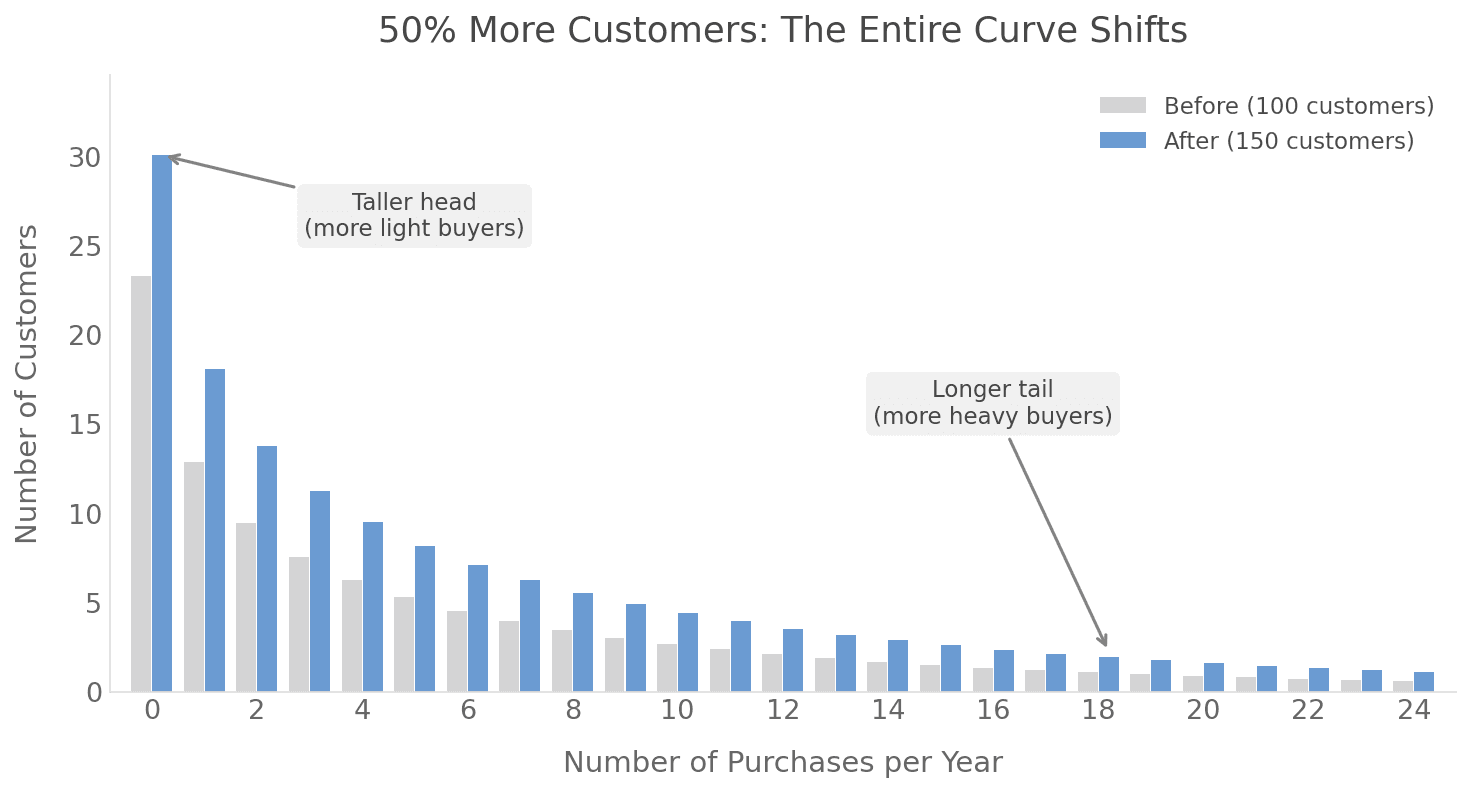
This cuts against a lot of intuitive marketing strategy. Most digital marketing frameworks are built around loyalty, retention, and customer lifetime value. Sharp's data says that light buyers drive category growth, that true loyalty is rare, and that most category buyers purchase your brand occasionally and your competitors' brands the rest of the time. Chapter 8 of Never Always, Never Never covers this directly, drawing on Sharp's research to explain why most customers will never care deeply about your brand and why that is not a failure of your marketing.
How Brands Grow has been translated into more than a dozen languages. Sharp also authored How Brands Grow Part 2 (2015) and Marketing: Theory, Evidence, Practice (2017). Start with the original. The first three chapters alone will change how you read a campaign brief.
Jenni Romaniuk
Research Professor and International Director, Ehrenberg-Bass Institute, University of South Australia
Romaniuk is the person to read when Sharp's framework raises the question: if mental availability is the goal, how do you actually measure and build it? Her book Building Distinctive Brand Assets (2018) is the most rigorous treatment of distinctive brand assets in print. Not differentiation, which is about being better or different in some rational sense. Distinctiveness, which is about building memory structures that make your brand easy to recognize and retrieve.
Her framework around category entry points is particularly useful. These are the specific situations, needs, and moments that prompt a purchase in your category. The question is not whether your brand is memorable in the abstract, but whether it is linked to the right triggers in the right contexts. She also co-authored How Brands Grow Part 2 (2015) with Byron Sharp and has written Better Brand Health: Measures and Metrics in a How Brands Grow World, which extends the measurement side of the research program.
If you are running brand tracking and your metrics feel disconnected from business outcomes, start with her work on brand health measurement before you change your methodology.
Mark Ritson
Marketing commentator, The Drum
Ritson's current institutional role is not something I can verify with confidence, so I will not claim one. What I can say is that his writing on The Drum is some of the most direct, evidence-anchored marketing commentary available. He takes Sharp's and Les Binet and Peter Field's research and applies it to current marketing debates with enough aggression to make practitioners actually pay attention.
He is worth following specifically because he refuses to let the industry celebrate tactics as strategy. His columns have dissected brand purpose washing, the misuse of digital attribution, and the chronic underinvestment in brand building with sourced arguments rather than opinion. That discipline is rarer than it should be.
Read his archive on The Drum. Filter for anything he has written about brand vs performance marketing or marketing effectiveness. The pieces are short and they are not gentle.
---
The Effectiveness and Measurement Evidence
Knowing that brand building matters is one thing. Knowing how to measure it, how to budget for it, and how to defend that budget to a CFO is another. This group has done the most rigorous work on marketing effectiveness measurement.
Les Binet
Author, Consultant and Visiting Professor at Ravensbourne University; Head of Effectiveness at adam&eve DDB; runner of DDB Matrix
Les Binet and Peter Field's collaboration produced The Long and the Short of It (2013), which remains the clearest quantitative case for why brand building and performance marketing need to coexist in a specific ratio. The 60/40 rule, drawn from IPA Databank analysis, is their core contribution: roughly 60% of marketing investment should go to long-term brand building and 40% to short-term activation, though the exact ratio shifts by category.
Binet is also a Fellow of the Royal Society of Arts, a Senior Advisory Board member at the Journal of Advertising Research, and runs DDB Matrix, the DDB network's econometrics consultancy. He co-authored How Not to Plan (2015) with Sarah Carter.
The argument he and Field have made most consistently is that efficiency metrics like ROAS and cost-per-acquisition measure the wrong thing. They capture short-term demand harvesting. They do not capture the brand investment that makes demand harvesting possible in the first place. That argument is central to the strategy vs. tactics distinction in chapter 17 of the book, where the temptation to chase short-term efficiency at the expense of long-term brand equity is one of the defining failure modes of digital-era marketing.
Start with The Long and the Short of It. It is short. Read it twice.
Peter Field
Director, Field Rogers Ltd
Field's contribution is the IPA effectiveness case study methodology itself. As Director of Field Rogers Ltd, he has spent decades analyzing what actually makes advertising campaigns work at a business level, not just a media level. His books include The Long and the Short of It (with Les Binet), Effectiveness in Context, and The 5 Principles of Growth in B2B Marketing.
What makes Field worth reading separately from Binet is his focus on the conditions under which effectiveness principles shift. B2B is different from B2C. Categories with long purchase cycles behave differently from impulse categories. His willingness to qualify the framework rather than oversimplify it is what makes the framework durable.
If you are in B2B marketing and have been told the Binet and Field model does not apply to you, read The 5 Principles of Growth in B2B Marketing before accepting that conclusion.
Koen Pauwels
Distinguished Professor of Marketing and Associate Dean of Research, D'Amore-McKim School of Business, Northeastern University
Pauwels sits at the intersection of marketing science and marketing measurement. His academic work on marketing mix modeling, attribution, and the long-term effects of marketing investment gives the effectiveness conversation a quantitative backbone that practitioners often lack.
If your team is trying to build a business case for long-term brand investment using actual measurement methodology rather than general principles, his published research is where to look. He brings the econometric rigor that gives the Binet/Field arguments their defensible numbers.
---
The Attention and Media Evidence
Reach is not the same as attention. This distinction has large consequences for media planning, creative development, and how you evaluate platform performance.
Karen Nelson-Field
Founder, Amplified Intelligence
Nelson-Field has built the most rigorous empirical case for why attention measurement matters more than reach or impressions. Her company, Amplified Intelligence, develops the measurement tools. Her books, The Attention Economy and How Media Works: Simple Truths for Marketers (2020) and The Attention Economy: A Category Blueprint (2024), both published through Springer Nature, are where the research lives.
Active attention a format generates predicts brand outcomes far better than impression counts. This has direct implications for how you allocate media budgets across channels and how you evaluate creative performance. Platforms that sell reach are not selling attention, and the gap between those two things is where most media budgets leak.
Her 2024 book is the place to start if you are trying to build an attention measurement framework rather than just accept platform-reported metrics. The 2020 book is the theoretical foundation.
---
The Strategy and Practitioner View
Research informs strategy. It does not replace the judgment required to apply it under real business constraints, with real budgets, real clients, and real pressure to show quarterly results.
Rory Sutherland
Vice Chairman, Ogilvy UK; Senior Fellow, Adam Smith Institute; founder of Ogilvy's Behavioural Science Practice
Sutherland's argument is that economics and marketing both systematically undervalue psychological value. A rational model of consumer behavior, which underpins most digital marketing measurement, assumes people optimize for objective outcomes. Sutherland's work, drawn from behavioral science, shows they do not. They satisfice, they use heuristics, and they are moved by signals that have nothing to do with price or product features.
His book Alchemy: The Surprising Power of Ideas That Don't Make Sense (2019) is the most readable entry point. He also co-authored Transport for Humans: Are We Nearly There Yet? (2021). In 2026, he was announced as a Senior Fellow at the Adam Smith Institute.
Sutherland is not a measurement person. He will not give you an econometric framework. What he will do is break the assumption that the rational explanation for consumer behavior is the right one, which is a necessary correction for anyone who has spent too long inside a performance marketing dashboard. He pairs well with Sharp and Binet: read them for what the data says, read Sutherland for why consumers behave that way in the first place.
Tom Roach
VP Brand Strategy, Jellyfish, part of The Brandtech Group
Roach came up through adam&eveDDB, BBH London, Leo Burnett, and AMV BBDO before moving to Jellyfish. His work is most associated with two frameworks he developed with Grace Kite: the "performance plateau," which describes the point at which brands that focus only on search, social, and display see growth flatten, and "Bothism," the argument that brand and performance investment are not alternatives but complements.
His current work at Jellyfish includes the "Share of Model" concept, which addresses how brands earn visibility inside AI-mediated search and discovery. That is a live and unsettled question, and he is one of the few practitioners thinking about it in structural rather than tactical terms.
His work sits at the intersection of the effectiveness research tradition and the AI search transition, which makes him unusually relevant for the current moment. The strategy vs. tactics distinction from chapter 17 of Never Always, Never Never maps directly onto the performance plateau problem: brands that mistake demand harvesting for a growth strategy eventually run out of harvestable demand.
Grace Kite
Econometrician; co-originator of the performance plateau concept and Bothism framework
Kite is an econometrician and co-originator, with Tom Roach, of both the performance plateau concept and the Bothism framework. Her current employer and a canonical publication platform are not verified in the material available to me, so I will not claim either. What the available evidence does support is that her econometric work provides the quantitative underpinning for the frameworks she and Roach have developed together.
Tracking her work is worth the effort specifically if you work on the measurement side of brand vs. performance budget allocation. The performance plateau is not a qualitative argument. It is an econometric finding, and having the person who built the model in your reading diet is worth the effort of finding where she publishes.
Rand Fishkin
CEO and co-founder, SparkToro
Fishkin belongs on a list about evidence-based marketing because SparkToro publishes research on audience behavior, media consumption, and search that challenges platform-reported data. His ongoing work on zero-click search and the gap between what platforms claim their reach delivers and what audiences actually do is some of the most practically useful research available to digital marketers.
His perspective on AI search vs traditional SEO is grounded in behavioral data rather than speculation. If you are trying to understand how AI-mediated discovery changes where your audience actually spends attention, his research at SparkToro is a more reliable starting point than platform announcements. Read the SparkToro blog before you read anything a search platform publishes about its own effectiveness.
Patrick Gilbert
Author, Never Always, Never Never; AdVenture Media
I am including myself because leaving out the person behind this site while recommending others would be a different kind of dishonesty. Treat this entry accordingly.
Never Always, Never Never is a book about strategic marketing in an AI world, organized around the principle that almost no marketing rule is always true or never true. Chapters most relevant to the evidence covered above are chapter 8, which works through the Sharp/Romaniuk research on why customers do not care about your brand the way marketers want them to, and chapter 17, which draws the line between strategy and tactics that most digital marketing practice deliberately blurs.
My practitioner view comes from running campaigns at AdVenture Media, where the gap between what the evidence says and what clients are actually doing is the daily working reality. The book is an attempt to close that gap.
---
How to Use This List
Do not read all of these people at once. Pick the section that matches the problem you are actually holding right now.
If your team is fighting about whether brand investment is worth it, start with Les Binet and Peter Field and read The Long and the Short of It. If you are being asked to justify a media plan and your measurement relies entirely on platform attribution, read Karen Nelson-Field and then look at your marketing mix modeling options. If your growth has plateaued and you have been running the same performance channels harder for two years, read Tom Roach on the performance plateau before you optimize anything else.
Sharp and Romaniuk's body of work from the Ehrenberg-Bass Institute is the foundation everything else builds on. If you have not read How Brands Grow, read it before you read anything else on this list. It is the single most efficient use of reading time in this field.
For more on the AI-era dimensions of brand visibility and search, see our post on how the brand visibility gap inside AI answers is already widening, and if the Binet/Field ratio is new to you, the Airbnb brand vs performance case study shows what happens when a major brand actually commits to it.
 Patrick Gilbert
Patrick Gilbert is the CEO of AdVenture Media and author of Never Always, Never Never and the bestselling Join or Die. He has been ranked among the top 5 PPC experts worldwide and has delivered keynotes at Google events across three continents.
More about Patrick →Enjoyed this?
Subscribe for more articles on strategy, AI, and what's actually working in marketing.
No spam. Unsubscribe anytime.