Strategy vs Tactics in Marketing: Why Most Strategies Are Just Tactical Lists
Quick Answer: strategy vs tactics marketing
Marketing strategy defines the long-term direction and non-negotiable pillars that align marketing efforts with business goals, including positioning, target audiences, and trade-offs. Tactics are the flexible execution methods within that framework, such as campaign structures, bid strategies, and creative variations. Strategy answers why and where to compete, while tactics answer how to execute. The key difference is permanence: strategy remains stable over time, while tactics can change daily. Most organizations confuse the two, creating tactical lists instead of true strategic frameworks, leading to reactive decision-making and chasing short-term opportunities rather than building sustainable competitive advantages.
Definition
Strategy defines the long-term direction and non-negotiable pillars for marketing efforts, while tactics are the flexible execution methods within that strategic framework.
The Most Common Marketing Mistake
One of the most widespread problems in modern marketing is the collapse of strategy and tactics into a single bucket. While these elements are connected, they serve fundamentally different purposes and operate on different timescales. As Patrick Gilbert argues in Never Always, Never Never, this confusion has led to an entire generation of marketers who think they're being strategic when they're actually just rearranging tactical elements.
Strategy represents the long game. It encompasses the few, clear pillars that align a company's marketing efforts with its business goals. These are the decisions that shouldn't shift week to week: your positioning in the market, the audiences you must win, and the trade-offs you're willing to make. Strategy provides direction for the entire organization, creating stability even when the tactical path gets complicated.
Tactics, by contrast, are the specific moves you make within that strategic framework. Campaign structures, bid strategies, creative variations, and budget allocations all fall into this category. Tactics are inherently flexible and should be constantly debated, tested, and refined. A tactic can change tomorrow without derailing the overall mission, provided it still serves the broader strategy.
The Arbitrage Era's Strategic Blind Spot
For the past fifteen years, the distinction between strategy and tactics wasn't critically important for most digital marketers. The entire premise of digital advertising was built on a single, largely unspoken idea: arbitrage. Companies could buy large amounts of website traffic at below-market costs from platforms like Google and Facebook, then quickly convert that traffic into profitable customers.
Whether you were an ecommerce brand, local service provider, or global retailer, the underlying strategy was almost always the same: buy cheap traffic and maximize profitable conversions.
Because this overarching strategic approach was already defined by the nature of digital platforms, most industry attention shifted to tactics. Best practices, playbooks, templates, and checklists dominated the conversation. Every performance discussion centered on a single question: how do we keep acquisition costs low and outmaneuver competitors with better tactical execution?
This tactical focus created a reactive budgeting mindset. Instead of starting with strategic vision and allocating resources toward specific initiatives, digital advertisers began backing into budgets based on what could be acquired under specific return-on-ad-spend (ROAS) thresholds.
When we back into marketing budgets, defined purely by what's profitable in the short term, they stop being strategic investments and become tactical bets.
Patrick Gilbert, Never Always, Never Never
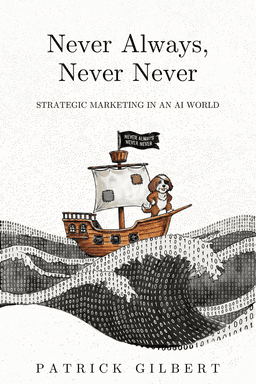
Enjoying this? Never Always, Never Never goes much deeper into the mental models and decision frameworks that shape how we think.
The Litmus Test for Strategic vs Tactical Decisions
A useful framework for distinguishing strategy from tactics involves examining the nature of the decision itself. If a debate is existential, involving questions like whether to enter a new market even if it appears less profitable short-term, that's strategy. If the debate is incremental, such as choosing between broad match or exact match keywords for a campaign, that's tactics.
- Strategic decisions: Market positioning, target audience definition, channel mix philosophy, brand equity investments
- Tactical decisions: Campaign structure, bidding strategies, creative testing, budget allocation between campaigns
- Mixed decisions: Platform selection (can be strategic for new brands, tactical for established ones)
The challenge emerges when organizations treat tactical decisions as strategic ones. Gilbert recounts his early career confusion, thinking Single Keyword Ad Groups represented a strategic breakthrough, or that the choice between automated and manual bidding was inherently strategic. This represents a common pattern: mistaking ingredients for the recipe.
Case Study: From Efficiency to Strategic Growth
The distinction between strategic and tactical thinking becomes clear in practical application. Gilbert describes working with an ecommerce brand in 2025 that had overhauled its business model, expanding from high-margin, in-house manufactured products to include third-party manufactured items with compressed margins.
Initially, the company attempted a tactical response: segmenting campaigns by product type, assigning unique ROAS targets to each group, and micromanaging efficiency metrics. While topline revenue grew, overall profitability plummeted because the tactical approach couldn't address the fundamental strategic shift.
The strategic solution required counterintuitive thinking. Instead of cutting spend when ROAS declined, Gilbert's team increased investment, launched new platform campaigns, expanded reach, and implemented brand strategy changes aligned with the company's new business model vision.
Short-term performance worsened significantly, with ROAS dropping another 50% and profitability falling below break-even. A tactical marketer would have panicked and cut spending.
By mid-summer, the strategic approach paid off. While ROAS remained 60% lower than the previous year, it was no longer the primary success metric. The business posted its highest top-line and bottom-line month in its 15-year history by August, demonstrating how strategic thinking creates sustainable competitive advantages.
Building Strategic Discipline in Tactical Environments
Strategic marketing requires building rather than exploiting. It focuses on creating systems, assets, and brand equity that compound over time rather than deplete with use. This represents a fundamental shift from the extraction mindset that dominated the digital arbitrage era.
Organizations must resist the temptation to make every decision based on immediate efficiency metrics. Strategic initiatives often require short-term performance sacrifices in service of long-term competitive positioning. This demands conviction and alignment across teams, particularly when tactical metrics suggest course corrections.
- Define strategic pillars before launching tactical campaigns
- Separate strategic planning sessions from tactical optimization meetings
- Build measurement frameworks that track strategic progress alongside tactical efficiency
- Create decision-making processes that distinguish between strategic pivots and tactical adjustments
- Establish budget allocation methods based on strategic priorities rather than reactive ROAS thresholds
The Strategic Marketing Imperative
As artificial intelligence commoditizes tactical execution, the ability to think strategically becomes increasingly valuable. Companies that continue treating strategy as a collection of tactics will find themselves perpetually reactive, chasing the next optimization opportunity without building sustainable competitive advantages.
Strategic marketing is about building, not exploiting. It's about creating systems, assets, and brand equity that compound over time rather than deplete with use.
Patrick Gilbert, Never Always, Never Never
The most successful marketing organizations will be those that clearly separate strategic thinking from tactical execution, ensuring that both elements work in harmony toward long-term business objectives rather than short-term efficiency metrics.
Key People & Works
Researchers & Authors
- Patrick Gilbert
Key Works
- Never Always, Never Never by Patrick Gilbert
Practical Applications
- Define strategic pillars before launching new campaigns
- Use the existential vs incremental test to classify decisions
- Build budgets proactively based on strategy rather than reactively based on ROAS
- Separate strategic debates from tactical optimization discussions
- Create measurement frameworks that align with strategic goals rather than just tactical efficiency
Frequently Asked Questions
What is the main difference between marketing strategy and tactics?
Marketing strategy defines the long-term direction and non-negotiable pillars that align marketing efforts with business goals, such as positioning and target audiences. Tactics are the specific, flexible execution methods within that framework, like campaign structures and bidding strategies. Strategy remains stable over time, while tactics can change frequently.
How can I tell if a marketing decision is strategic or tactical?
Use the existential versus incremental test. If the decision is existential and affects fundamental business direction (like entering a new market), it's strategic. If it's incremental and about optimization within existing frameworks (like choosing keyword match types), it's tactical.
Why do most marketing strategies fail to be truly strategic?
Most marketing strategies are actually just lists of tactics because teams focus on execution methods rather than defining clear strategic pillars. This often results from the digital advertising era's emphasis on arbitrage and efficiency optimization, where tactical execution became the primary focus.
How should marketing budgets be set strategically versus tactically?
Strategic budgeting starts with business vision and proactively allocates resources toward strategic initiatives. Tactical budgeting reacts to efficiency metrics, backing into spend levels based on ROAS thresholds. Strategic budgeting treats marketing as an investment in long-term growth, not just short-term acquisition.
Can good tactics compensate for bad strategy?
No, excellent tactical execution cannot compensate for poor strategic direction. Without clear strategic pillars, tactical optimizations become reactive and short-sighted, leading to constant pivoting and missed opportunities for building sustainable competitive advantages.
When should tactics be changed versus strategy?
Tactics should be changed frequently based on performance data, testing results, and market conditions. Strategy should only change when fundamental business conditions shift or when strategic pillars prove fundamentally flawed over extended periods. Strategy provides stability while tactics provide flexibility.
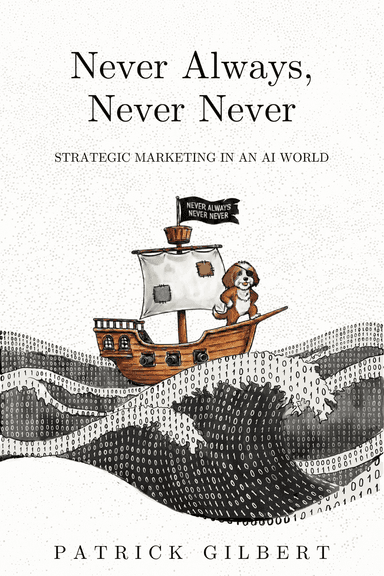
From the Book
Chapter 17 provides a complete framework for distinguishing strategy from tactics, including detailed case studies showing how strategic thinking drives sustainable growth even when tactical metrics suggest otherwise.
This is just a glimpse. The book explores dozens of cognitive biases and decision-making frameworks that change how you think, decide, and act.
Want to go deeper on this topic?
Chat with the AI companion to explore these concepts with the full context of the book.
Chat about this topicRelated Reading
The 60/40 Rule in Marketing: Why Brand and Performance Must Work Together
Discover why the traditional 60/40 brand-to-performance budget split is outdated and how integrated campaigns drive better results.
conceptBrand vs Performance Marketing: Why the Split is Killing Your Growth
The false division between brand and performance marketing is weakening both. Learn why integrated campaigns outperform siloed approaches.
BlogWhy the Old Playbook Is Broken
The platform tricks and optimization shortcuts that built most digital marketing careers have been commoditized. Here's what actually changed and what to do about it.
BlogAI Amplifies Whatever You Bring to the Table
AI isn't a shortcut. It's an amplifier. If you have strong strategy, AI makes you dramatically more effective. If you don't, it helps you execute mediocrity faster.