Black Friday Discounts Rent Customers. They Rarely Keep Them.

Only 4% of customers acquired during Black Friday 2024 made a repeat purchase within the following 12 months. Not 40%. Not 14%. Four percent.
That single number from Ometria's retail cohort analysis should reframe how every brand thinks about its Black Friday marketing strategy. The event works. Orders flow. Revenue spikes. And then the overwhelming majority of those new customers disappear until the next time you offer them a deep enough discount to come back.
This is not customer acquisition. This is renting demand at a premium.
The Evidence Is Harder Than Most Brands Want to Admit
Ometria's data tells a consistent story. Black Friday-acquired customers were six times less likely to return than typical new customers. Of the small fraction who did come back, 75% returned specifically during Black Friday 2025. Not because they loved the brand. Because the sale came around again.
No pattern could be clearer than the annual-sale-customer cycle. You build a large email list. You generate strong first-order revenue. And then you've trained a segment of your customer base to wait, patiently, for the next November.
Academic evidence reinforces it. Research by Michael Lewis, published in the Journal of Marketing Research, found that customers acquired with a 35% discount were worth approximately half as much over the long term as customers acquired without a discount. The discount doesn't just compress margin on the first order. It selects for a type of buyer whose primary relationship is with the deal.
Another layer emerges when you consider that 55% of Black Friday revenue came from existing customers. Brands often celebrate the new-customer spike, but their most commercially valuable Black Friday relationship is with people who already know them. The acquisition story is weaker than the headline numbers suggest.
What You're Actually Measuring (And What You're Missing)
Most brands evaluate Black Friday on blended return on ad spend and total revenue. Both metrics will make the event look like a success. Neither will reveal the retention problem underneath.
Klaviyo's analysis of a 10,000-brand cohort during BFCM 2025 found that repeat-buyer revenue grew 13.6% year over year, compared with 9% growth from new buyers. Existing customers outperformed new ones. That gap matters, and it disappears when you blend the two groups into a single ROAS figure.
A more useful measurement approach separates customers into cohorts:
- Existing customers reactivated during Black Friday
- Genuinely new customers acquired during Black Friday
- Customers acquired through non-promotional campaigns in the same period
Then compare their 30-, 90-, 180-, and 365-day value. If you do this honestly, the Black Friday acquisition cohort will almost certainly look weaker than it did on November 29th. As Patrick Gilbert covers in [Never Always, Never Never](/learn/guides/how-to-measure-marketing-effectiveness), measuring the scoreboard without watching the film gives you an incomplete picture of what's actually driving growth.
Incrementality testing also becomes essential here. Black Friday creates so much noise that attributed revenue often includes customers who would have purchased anyway, existing loyalists who simply moved up their timing, and deal-seekers who will never return. Blended ROAS cannot separate those groups.
The Brand Memory Problem
Retention numbers are striking, but an Attest survey of 2,000 U.S. and U.K. Black Friday shoppers adds something more unsettling. Nearly two-thirds of respondents could not name the brand from which they had bought. Thirty-two percent could not remember what they purchased.
Consider what that means for brand salience. The transaction happened. The revenue was recorded. The customer is in the database. And the brand made essentially no impression.
That outcome is not a small-sample anomaly. It reflects what Byron Sharp's research at the Ehrenberg-Bass Institute describes as the fundamental challenge of building mental availability: being remembered in the moments that drive purchase. A Black Friday transaction buried in a week of promotional clutter, delivered by a brand the buyer had never encountered before, is unlikely to create the memory structures that drive future choice.
Attest's data also showed that 80% of existing customers repurchased from the brand after Black Friday, against 62% of first-time customers. The gap between those two numbers is the value of the relationship that already existed before the sale started.
Not Every Category Has the Same Problem
The case against blanket Black Friday acquisition is strong, but it has limits.
Ometria's category breakdown shows meaningful differences in repeat rates. Marketplaces and department stores saw a 19% return rate among Black Friday customers. Consumables reached 18%. Beauty and cosmetics hit 14%. These numbers are still low in absolute terms, but they are materially higher than a one-time durable good where there is no natural repurchase trigger.
Logic is straightforward here. A discounted first purchase of a product someone will need to replenish creates a replenishment opportunity. A discounted first purchase of a high-consideration product with a five-year lifespan does not. The second buyer has fewer reasons to return regardless of how well you execute post-purchase retention.
Category economics determine the answer before marketing strategy does. Brands in high-frequency categories can justify more aggressive Black Friday acquisition because the purchase cycle creates natural re-engagement points. Brands in low-frequency categories need a more deliberate answer to the question: what happens after this order?
Never Always, Never Never returns to this kind of category-specific thinking repeatedly. There is no universal playbook, and the brands that treat Black Friday as a uniform strategy regardless of what they sell will generate weaker results than those who match their approach to how their customers actually buy.
The Structural Fix: Design the Second Purchase Before the First Sale
The retention gap is not an argument against running Black Friday promotions. It's an argument against running them without a retention architecture behind them.
Most brands treat post-purchase as a sequence that begins after checkout. A welcome email goes out. A review request follows. Maybe a discount for the second order arrives three weeks later. This is better than nothing, but it assumes the customer has already formed some attachment to the brand. For Black Friday acquisition cohorts, that assumption is usually wrong.
A more effective approach treats the second purchase as a problem to solve before the first sale begins. That means:
- Product-use content that establishes value immediately, before the novelty of the discount wears off
- Complementary product recommendations tied to what was actually purchased, not generic cross-sell
- Replenishment timing built into the email sequence for consumable products
- A second-order offer that is not simply another discount, to avoid reinforcing the expectation that your brand only merits attention when it's on sale
- Loyalty enrollment framed around benefits, not points accumulation
Establishing the product's value in the customer's daily life before they begin waiting for the next November is the goal. If the first experience is good enough, a subset of Black Friday buyers will return at full price. Without deliberate design, almost none will.
The Discount Depth Question
Klaviyo's data showed that the average Black Friday discount in BFCM 2025 was 26.2%, down from 29.1% in 2024. No major deal day exceeded a 30% average. Brands appear to be pulling back slightly on discount depth, which the Lewis research suggests is directionally correct.
A smaller incentive, a gift with purchase, free shipping, a bundle, or early access can reduce purchase friction without selecting as strongly for deal-sensitive buyers. Customers who buy because of free shipping are different prospects than those who buy only when you're offering 35% off everything. Their long-term value will differ accordingly.
Budget allocation between brand and performance also matters here. Brands with strong equity before Black Friday starts can offer smaller incentives and still win the consideration battle, because the product is already meaningful to buyers. Brands without that equity compete almost entirely on price, which is both margin-destructive and self-reinforcing. The brand equity built in October is what lets you discount less in November.
At AdVenture Media, the question of how brand investment affects promotional efficiency comes up in almost every client conversation around this time of year. Brands with the most defensible Black Friday positions are rarely those with the deepest discounts.
Rewarding the Customers You Already Have
Finding that 55% of Black Friday revenue comes from existing customers points to an underused strategic lever. If your existing customer base is driving the majority of your Black Friday revenue, the question is whether you are treating them accordingly or simply running the same promotion for everyone.
Early access, exclusive bundles, loyalty multipliers, and personalized offers for existing customers serve two purposes. First, they protect the brand's most commercially valuable relationships. Second, they create a meaningful distinction between being a customer and being a stranger with a coupon code, which is what a flat 25%-off-sitewide promotion communicates to both groups equally.
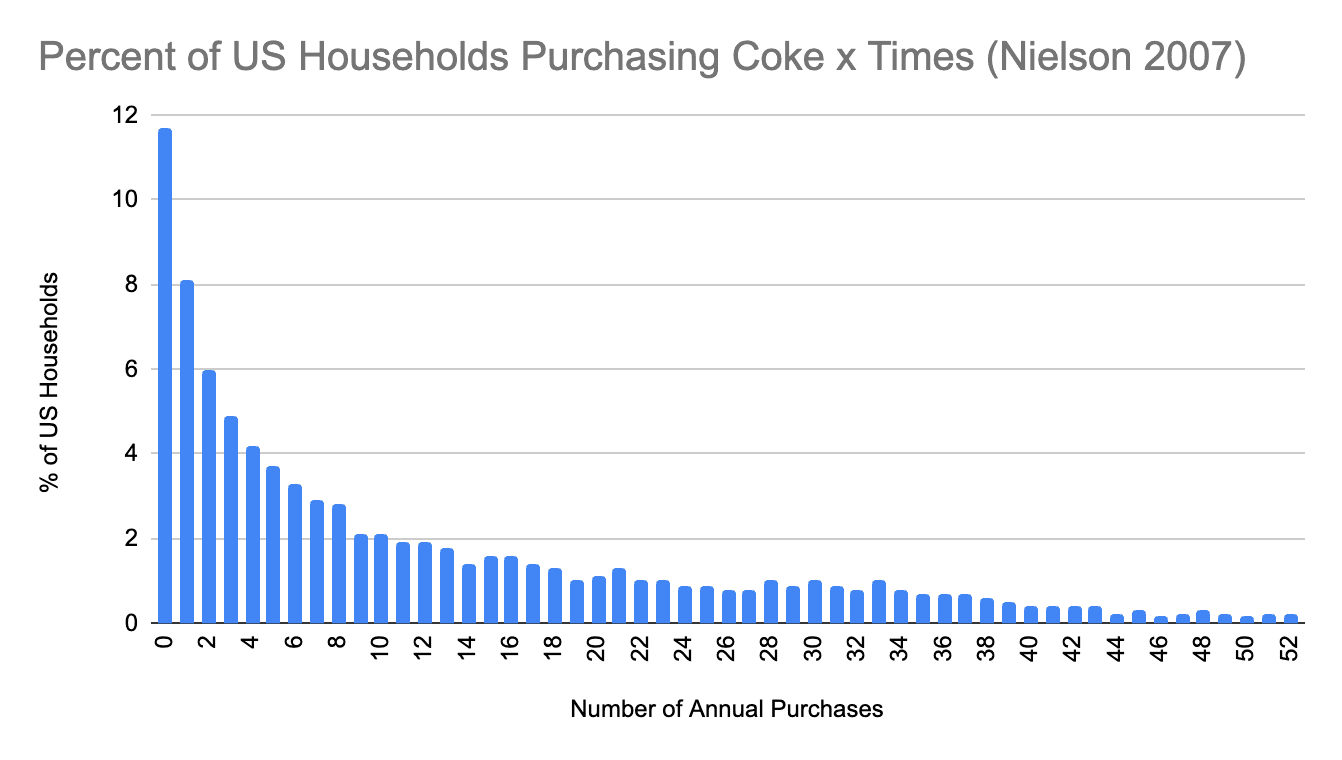
This connects directly to the light-buyer argument in Never Always, Never Never. Chapter 9 makes the case that most of a brand's revenue comes not from a small group of fanatics but from a large population of occasional buyers who purchase infrequently. The goal is not to squeeze more from your heaviest buyers, but to make it slightly easier and slightly more natural for a wide population to buy again. Black Friday, designed well, is an opportunity to do exactly that across your entire customer base, not just the new-customer segment.
For more on how light buyers drive brand growth, and why the composition of your customer base matters more than its concentration, the evidence from the Ehrenberg-Bass Institute is worth understanding before you plan next year's promotional calendar.
The Honest Conclusion
Black Friday is effective at generating orders. Data on this point is unambiguous. Global online sales reached approximately $79 billion in 2025, up 6% year over year according to MikMak, with U.S. online sales reaching around $18 billion. The event moves volume at scale.
What it does not do automatically is create customers. Ometria's 4% repeat rate among Black Friday 2024 acquisitions is the clearest measure of that gap. The promotion works. The relationship, in most cases, does not form.
Brands that will get more from Black Friday next year are not those who discount more aggressively or spend more on acquisition. They are the ones who treat the event as the beginning of a measured customer journey, build retention architecture before the sale starts, segment their approach by category economics, and use the event to deepen relationships with people who already know them.
Everyone else is renting demand. And the rent goes up every year.
---
For a deeper look at how discounting affects brand positioning over time, see [Discounts Buy Volume and Rent Loyalty](/blog/price-promotions-dont-build-brands). And if your Black Friday measurement relies primarily on ROAS, [this post on why ROAS misleads ecommerce brands](/blog/why-roas-is-misleading) is worth reading before you close out the year.
 Patrick Gilbert
 is the CEO of AdVenture Media and author of Never Always, Never Never and the bestselling Join or Die. He has been ranked among the top 5 PPC experts worldwide and has delivered keynotes at Google events across three continents.
More about Patrick →Enjoyed this?
Subscribe for more articles on strategy, AI, and what's actually working in marketing.
No spam. Unsubscribe anytime.