The Best Marketing Books for Small Business Owners

Most small business owners get conflicting marketing advice from every direction. Niche down. Go broad. Build loyalty. Chase new customers. Post on social. Run Google Ads. Ignore social. Books on this list don't all agree with each other. That's the point.
What they share is rigor. Each one gives you a framework, a mental model, or a body of evidence that helps you make better decisions in your specific situation. Some of them will contradict each other directly. Where they do, I'll tell you which one to follow and when.
A honest caveat before we start: Never Always, Never Never: Strategic Marketing in an AI World by Patrick Gilbert, published in 2026, is my book. I've placed it third on this list because I think its framing is genuinely useful for small business owners drowning in contradictory marketing advice. You can decide whether you agree once you've read the description.
---
The List
How Brands Grow: What Marketers Don't Know by Byron Sharp
Few marketing books have earned the influence this one carries. Byron Sharp and the Ehrenberg-Bass Institute spent decades studying how brands actually grow, across categories, geographies, and market conditions. Their conclusion cuts against almost everything small business owners are taught: brands grow primarily by increasing the number of buyers, not by deepening loyalty among existing ones.
Two mechanisms Sharp identifies are mental availability and physical availability. Mental availability is the probability that a buyer thinks of your brand in a purchase situation. Physical availability is how easy your brand is to find and buy. Both matter. Neither alone is enough.
Implications for small businesses are significant. Most small business marketing advice focuses on serving existing customers better, building loyalty programs, and targeting your best buyers more precisely. Sharp's evidence suggests this is the wrong emphasis for growth. The majority of your customers are light buyers who purchase rarely and without much thought. Winning more of their occasional purchases, rather than extracting more from your most loyal customers, is where growth actually comes from.
Published by Oxford University Press in 2010, it carries an Amazon rating of approximately 4.6/5. Read it first. Everything else on this list makes more sense after you understand Sharp's framework.
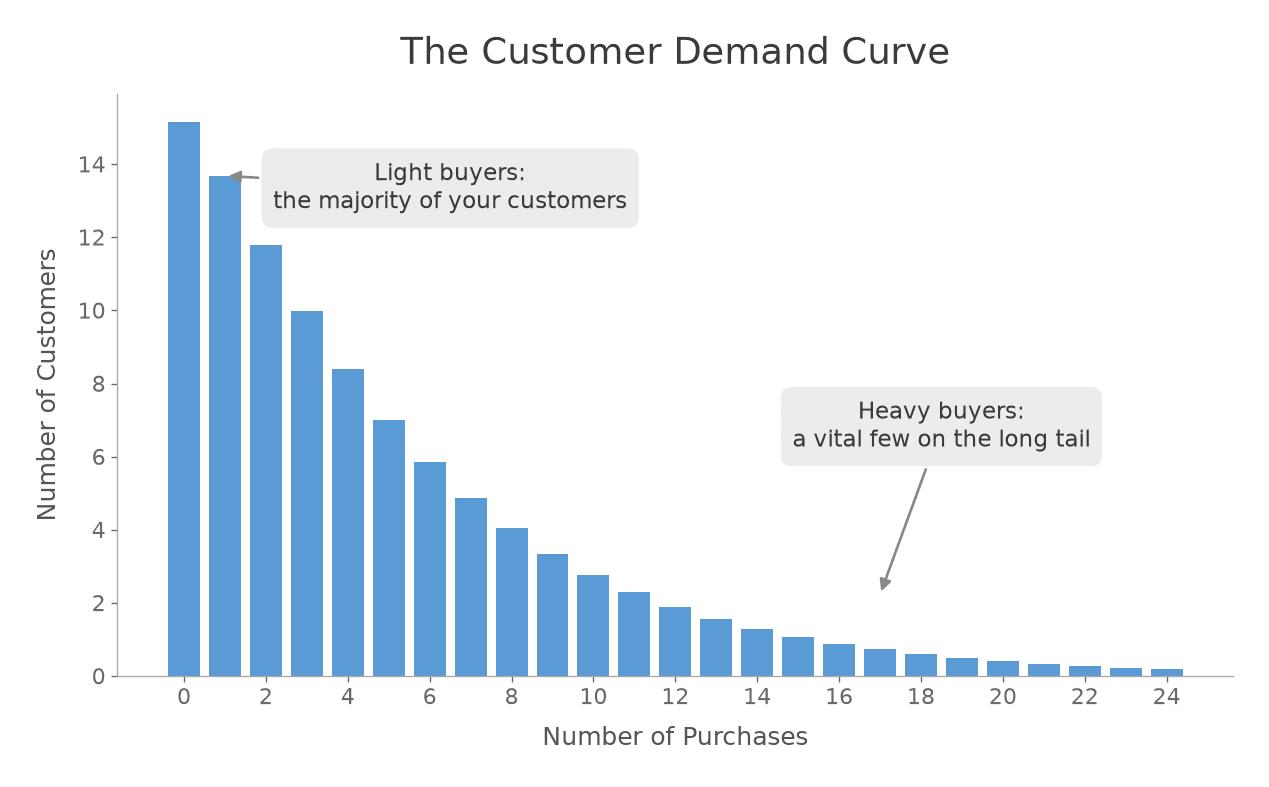
Worth noting: Sharp's findings come from aggregate data across large consumer categories. If you operate a subscription business, a highly specialized professional service, or a category where relationships genuinely drive repeat purchase, some of his conclusions require adaptation rather than direct application. Underlying logic still holds. Specific tactics may need adjustment.
---
The 1-Page Marketing Plan: Get New Customers, Make More Money, and Stand Out From the Crowd by Allan Dib
Allan Dib's 2016 book from Successwise does one thing extremely well: it forces you to get specific. Most small business owners have a vague sense of who they're marketing to and no clear system for following up. His nine-section framework replaces that vagueness with structure organized across three stages: attracting prospects, converting prospects into customers, and increasing customer value after the sale.
With an Amazon rating of approximately 4.7/5 from more than 11,000 ratings, it's clearly connecting with its intended audience. A business owner who has never formalized their marketing will find exactly the operational discipline needed here: who you're targeting, what you're saying, which channels you're using, and what happens after someone buys.
Read it alongside How Brands Grow, not instead of it. Dib's framework is excellent for execution. It doesn't tell you much about the broader strategic question of whether you're reaching enough of the market. The light buyers vs loyal customers tension doesn't get resolved here, and Dib's emphasis on funnels and retention can inadvertently push you toward over-investing in your existing customer base. Use his system for how to execute. Use Sharp for what to prioritize.
---
Never Always, Never Never: Strategic Marketing in an AI World by Patrick Gilbert
Never Always, Never Never, published by Dellrock Media in 2026, starts from a premise that sounds obvious but most marketing books ignore: no rule applies in every situation. Correct strategy depends on your category, your competitive position, your customers, your resources, and what your competitors are doing.
That framing matters most when you're trying to reconcile contradictory advice from books like the ones on this list. Should you focus on light buyers or loyal customers? Should you niche down or go broad? Should you invest in brand or performance? Each answer depends on context, and developing the judgment to read that context is the actual skill worth building, especially as AI makes tactical execution faster and cheaper.
Chapters on mental availability and physical availability cover how small businesses can apply Ehrenberg-Bass principles in categories that don't look like Coca-Cola. The light buyers chapter addresses what it actually means for a local business or e-commerce brand when the majority of your customers only buy from you once or twice a year, and why your advertising strategy needs to account for that reality rather than assume your best customers represent everyone.
I'm Patrick Gilbert. I also run AdVenture Media, a digital marketing agency. This book grew out of questions I kept encountering from clients: which advice is right, and when? I've tried to answer that honestly rather than construct a tidy framework that ignores the evidence when it's inconvenient. Whether I succeeded is for you to judge.
---
Building a StoryBrand: Clarify Your Message So Customers Will Listen by Donald Miller
Donald Miller's 2017 book from HarperCollins Leadership solves a specific problem that plagues small businesses: confusing messaging. His seven-part framework positions the customer as the hero, the company as the guide, and structures the entire communication arc around the customer's problem and desired outcome.
If your website makes visitors work to understand what you do and why they should care, StoryBrand fixes that. As a communication tool, it's a good one. It carries an Amazon rating of approximately 4.6 to 4.7/5 from more than 10,000 ratings, which reflects how clearly it resonates with business owners who have struggled to articulate their value.
A limitation worth naming: clear messaging doesn't create demand by itself. A website that perfectly explains your offer still needs traffic. A well-structured sales message still needs to reach enough buyers. StoryBrand tells you how to communicate once someone is paying attention. It doesn't tell you how to build the mental availability that gets them to pay attention in the first place. Use it for your website, your email sequences, your sales conversations. Don't mistake it for a growth strategy.
---
This Is Marketing: You Can't Be Seen Until You Learn to See by Seth Godin
Seth Godin's 2018 book from Portfolio is the most philosophically ambitious entry on this list. Its core argument is that marketing is fundamentally about understanding the worldview of the people you serve, creating genuine change for them, and earning permission over time rather than interrupting strangers with promotional messages.
Godin's concept of the smallest viable audience is the idea that you should begin by identifying the smallest group of people whose needs you can serve exceptionally well, then build from there. A new business with limited resources trying to establish a foothold will find this sound positioning advice. Know exactly who you're for and what you're changing for them before you scale.
Where this book requires care is in how you read it over the long term. Godin's framing can lead business owners to conclude that narrow, loyal audiences are always the right goal. Byron Sharp's evidence pushes back hard on that conclusion for most categories. Resolution isn't complicated: use Godin's smallest viable audience thinking to sharpen your initial positioning and product development. Don't use it as a permanent excuse to avoid reaching the broader market of light buyers who will ultimately determine whether your brand grows.
---
Contagious: Why Things Catch On by Jonah Berger
Jonah Berger's 2013 book from Simon & Schuster translates social psychology research into a practical framework for word-of-mouth marketing. His STEPPS model identifies six mechanisms that make products and ideas spread: social currency, triggers, emotion, public visibility, practical value, and stories.
Small businesses without large advertising budgets will find genuine value in understanding why people share things. Word of mouth is often the most cost-effective customer acquisition channel available to a local business or early-stage brand. Berger gives you a framework for designing products, messages, and experiences with shareability in mind rather than hoping it happens accidentally.
An important caveat: a contagious campaign that generates conversation doesn't automatically generate sales or broad market penetration. Virality is not the same as growth. STEPPS generates hypotheses worth testing. It doesn't guarantee that testing will produce profitable results. Use it to inform your creative and referral strategy, while measuring actual business outcomes rather than shares and impressions.
---
$100M Offers: How To Make Offers So Good People Feel Stupid Saying No by Alex Hormozi
Alex Hormozi's 2021 book from Acquisition.com is the most tactically direct entry on this list. Its core argument is that most businesses fail to convert because their offer is weak, not because their marketing is bad. Hormozi's Value Equation frames perceived value as a function of the desired outcome, the perceived likelihood of achieving it, and the reduction of time and effort required. Chapters walk through constructing offers around those levers: pricing, packaging, bonuses, guarantees, and risk reversal.
Service businesses, agencies, coaches, and high-margin product businesses will find the offer construction principles genuinely useful. If your conversion rate is low and you've already confirmed that qualified prospects are reaching your offer, this book will likely help you diagnose the problem.
Two honest limitations. First, the aggressive framing and "feel stupid saying no" language works better for direct-response businesses than for companies trying to build long-term brand trust. Stacking bonuses and guarantees can cheapen a premium positioning. Second, a stronger offer doesn't solve a demand problem. If not enough people are thinking of you when they're ready to buy, offer construction is the wrong lever. Fix mental availability first. Then use Hormozi to close more of the demand you've created.
---
Purple Cow: Transform Your Business by Being Remarkable by Seth Godin
Godin's 2003 book from Portfolio makes an argument that has aged well: in a world where ordinary products are easy to ignore, being genuinely remarkable is a competitive necessity. His Purple Cow metaphor describes a product or experience so distinctive that people notice it without being prompted and talk about it without being paid to.
The most useful application of this idea for small businesses isn't "be weird." It's a prompt to examine whether your product, service, or experience has any element that people would actually remember and mention to someone else. That's a harder question than it sounds, and asking it seriously is worth the price of admission.
Directionally strong and operationally thin, the book tells you the destination without mapping the route. Paired with Berger's STEPPS framework for understanding what actually spreads, and Sharp's research on distinctive brand assets for understanding what actually builds memory, Purple Cow becomes more useful as an aspiration than as a standalone strategy guide.
---
Where These Books Disagree (And Which Side to Take)
Most important is the disagreement about who you should be marketing to.
Godin argues for the smallest viable audience. Dib's framework emphasizes serving your best customers well. Hormozi's offer construction is implicitly aimed at converting qualified prospects who are already close to buying.
Sharp's evidence says this entire orientation, while useful for early positioning and conversion tactics, is insufficient for growth. Most of your buyers are occasional, low-consideration purchasers who aren't thinking about you most of the time. Marketing's job is to remain easy to recall and easy to buy when those moments of consideration arise, however infrequently.
This doesn't make Godin, Dib, or Hormozi wrong. Their advice applies to specific problems within a broader strategic context that Sharp defines. Follow Sharp's framework for how to think about growth. Use the other books to execute better within that framework.
---
Brand vs. Performance: A Tension Running Through Every Book
The brand vs performance marketing tension shows up everywhere in this list. StoryBrand and Hormozi are fundamentally about conversion. Sharp and Godin (at his best) are about building the conditions that make conversion possible. Both matter. Sequence and proportion vary by business stage and category.
For a deeper look at how this split plays out in practice, the analysis of how Airbnb cut performance marketing spend and grew is worth reading alongside this list.
---
Navigating the Contradictions
If you want a framework for navigating these contradictions in your own context, the chapters on light buyers and physical availability in Never Always, Never Never address exactly that problem. So does our light buyers marketing learn page, which covers the Ehrenberg-Bass evidence in detail.
---
How to Approach the Reading List
Read How Brands Grow first. It reframes everything else.
If your biggest problem is an unclear message and a confusing website, go to StoryBrand next. If you've never formalized your marketing at all, the 1-Page Marketing Plan will give you a system to work from. If your conversion rate is the constraint, Hormozi is the right lever to pull.
Return to Sharp when you're tempted to narrow your focus entirely to your best customers. Evidence that light buyers drive brand growth is not an argument against serving your best customers well. It's an argument against ignoring everyone else.
None of these books tells you exactly what to do in your category, with your budget, against your specific competitors. That judgment is yours to develop. Books give you better raw material to work with.
 Patrick Gilbert
 is the CEO of AdVenture Media and author of Never Always, Never Never and the bestselling Join or Die. He has been ranked among the top 5 PPC experts worldwide and has delivered keynotes at Google events across three continents.
More about Patrick →Enjoyed this?
Subscribe for more articles on strategy, AI, and what's actually working in marketing.
No spam. Unsubscribe anytime.