The Best Product Marketing Books Worth Actually Reading

Most product marketing reading lists are just lists. Ten books with identical blurbs that say things like "essential reading" and "must-have framework." You finish reading and still don't know which book to open first, or why.
This list is organized differently. Product marketing has three distinct jobs: figuring out what your product is actually for, deciding how to communicate it, and determining how it reaches a market. The books below are grouped by that logic. Within each section, the best book for most people is listed first.
A few caveats before you start. The research is honest where the information is thin. A couple of entries below have shorter descriptions because the available detail doesn't warrant more. A padded summary is worse than a short one.
Deciding What the Product Is For
This is the job most marketing teams skip. The product exists, it ships, and marketing's role is to "take it to market." As Patrick Gilbert covers in Never Always, Never Never: Strategic Marketing in an AI World, that assumption sits at the heart of most marketing failures. Product is the first P for a reason. If buyer personas vs product market fit is confused, no channel strategy compensates for it.
Never Always, Never Never: Strategic Marketing in an AI World by Patrick Gilbert
The chapter on buyer personas and product-market fit is among the most practically useful treatments of adoption theory in any recent marketing book. Gilbert works through Everett Rogers' adoption curve and Geoffrey Moore's chasm concept, but the real contribution is the argument that personas don't fail because they're wrong about who the customer is. They fail because they assume uniform behavior across people who are actually at different stages of readiness. A Busy Dad Dave who loves fitness gadgets and a Busy Dad Dave who finds them overwhelming can look identical in a demographic profile and behave nothing alike in a purchase decision. The book also draws a sharp line between early adopters, who buy on belief, and the pragmatist majority, who buy on proof. That distinction shapes the entire go-to-market question. The AI framing woven throughout makes it one of the few marketing books written for the environment marketers are actually operating in now.
Obviously Awesome: How to Nail Product Positioning so Customers Get It, Buy It, Love It by April Dunford
Released in 2019 by Ambient Press, with a second edition listed by booksellers for 2026, this is the clearest modern book on product positioning as a repeatable process. Dunford's central argument is that positioning should start from competitive alternatives: not what you think your product is, but what customers would use if your product didn't exist. That reframe changes the entire exercise. Most teams define positioning by describing their product's features. Dunford argues you should define it by understanding the context in which your product becomes the obvious choice. Consistently recommended across product marketing reading lists and for good reason.
Inspired: How to Create Tech Products Customers Love by Marty Cagan
First released in 2017, Inspired is primarily a product management book, but it earns a place on product marketing lists because the upstream work matters. Product marketers who sit in isolation from product discovery tend to spend their time marketing things the market didn't ask for. Cagan's argument for strong, cross-functional product teams applies directly to how marketing gets involved early enough to shape positioning rather than just describe a finished product.
Deciding How to Say It
Getting the product framing right is only half the job. The other half is understanding how messages actually stick, and more importantly, how customers give you honest feedback before you scale the wrong message.
Positioning: The Battle for Your Mind by Al Ries and Jack Trout
Originally released in 1980 by McGraw-Hill and rated 4.4 out of 5 stars on Amazon, this is the book that named the concept. Ries and Trout's core argument: the marketing battle is fought in the customer's mind, and you win by owning a simple, distinct position rather than trying to be everything. The book is dated in places, particularly in how it thinks about media, but the foundational logic holds. Mental availability and the principle of owning a clear memory structure in the buyer's mind are the same ideas, refined by decades of empirical research. Read this one for the original argument, then layer in the Ehrenberg-Bass Institute research for the evidence base.
The Mom Test by Rob Fitzpatrick
A short book about customer conversations, The Mom Test solves a specific, painful problem. When you ask customers whether they like your product or messaging, they tell you what you want to hear. Fitzpatrick's framework restructures the questions so you get signals about real behavior instead of polite encouragement. For product marketers doing messaging validation, this is the most practically useful book on the list after Obviously Awesome. It's also the fastest read.
Made to Stick: Why Some Ideas Survive and Others Die by Chip Heath and Dan Heath
Out since 2007, Made to Stick gives you the structural logic of why some messages are remembered and others disappear. The framework, built around six qualities (simple, unexpected, concrete, credible, emotional, story-driven), is useful for product marketers at the messaging stage. This is less about positioning and more about what makes a positioned idea actually land in the mind. It pairs well with Positioning as the practical complement to the strategic framing. For deeper thinking on emotional advertising effectiveness, the Ehrenberg-Bass research and Les Binet and Peter Field's IPA DataBank work carry more empirical weight, but Heath and Heath remain the clearest explainer of message stickiness.
Books for B2B and SaaS Contexts
Books in this section are most directly applicable to product marketers working in enterprise software, SaaS, or other B2B environments where buyer complexity and category design play a larger role.
Loved: How to Rethink Marketing for Tech Products by Martina Lauchengco
Written specifically for product marketing practitioners in B2B and SaaS contexts, Loved centers on connecting product value to buyer needs through disciplined market understanding, category design, and launch execution. If your context is enterprise software or SaaS, this is worth reading alongside Obviously Awesome.
Deciding How It Reaches a Market
Distribution, go-to-market sequencing, and category design are strategic decisions, not channel selections. The books in this section treat them that way.
Crossing the Chasm by Geoffrey A. Moore
First published in 1991, this is still the clearest framework for understanding why products stall after early traction. Moore's core insight is that there's a structural gap between early adopters and the mainstream pragmatist majority, and the behaviors that succeed on one side of that gap actively repel buyers on the other. Early adopters respond to novelty and aspiration. Pragmatists respond to proof and risk reduction. The whole product concept, the idea that pragmatists aren't buying your core product but the entire surrounding system of support, onboarding, and reliability, is one of the most useful frames in go-to-market strategy.
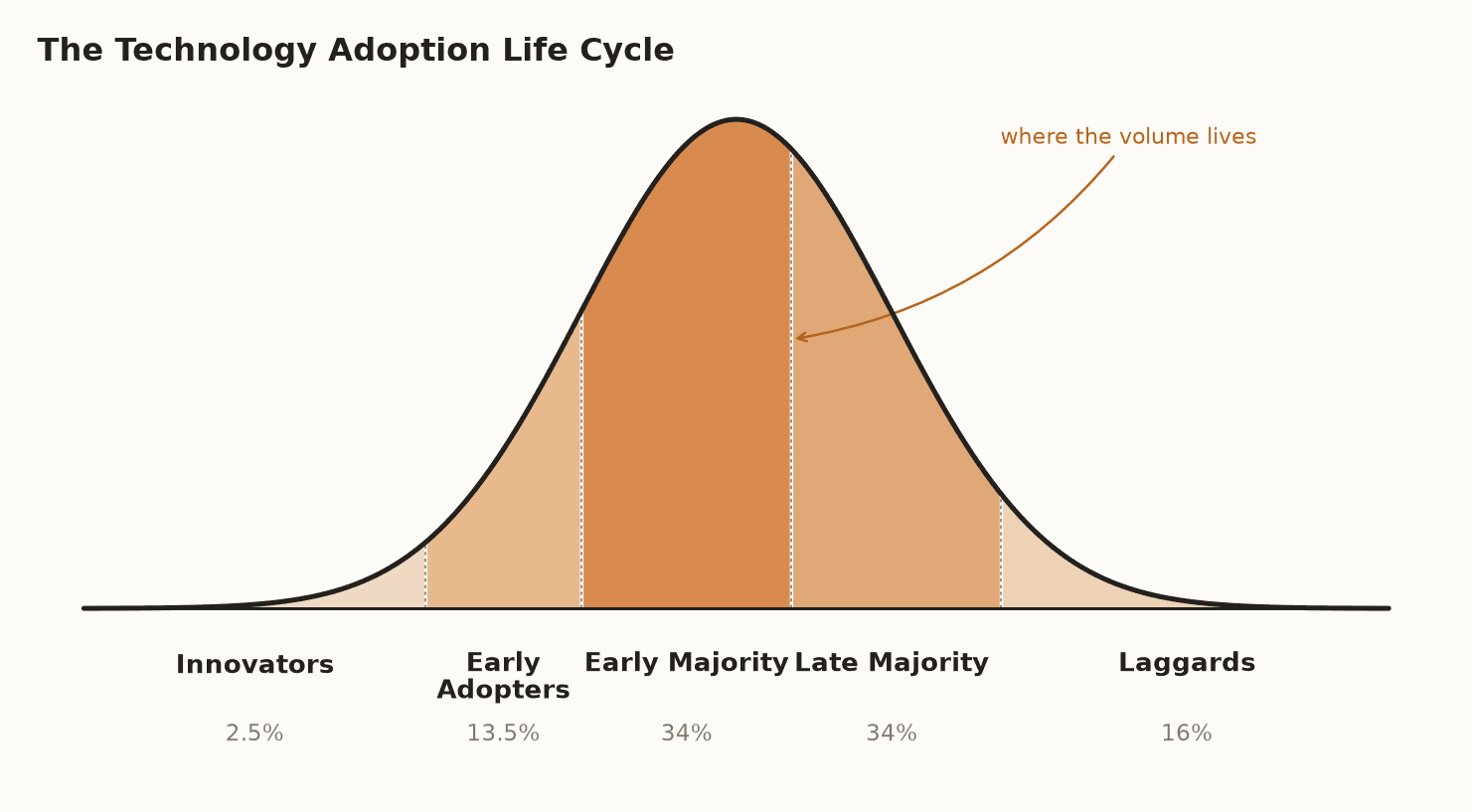
For product marketers, this reframes the strategy vs tactics question at the go-to-market level. Crossing the chasm isn't a messaging problem. It's a readiness and risk-reduction problem. The strategic implication: if growth has stalled after a strong early launch, look at what pragmatists need to feel safe saying yes before changing your messaging or budget allocation.
Play Bigger by Al Ramadan, Dave Peterson, Christopher Lochhead, and Kevin Maney
Released in 2016, Play Bigger makes the case that the highest-value market position isn't being the best product in an existing category. It's designing and owning a new category entirely. The book argues that companies who define a category tend to capture the majority of the value in it, because they write the rules by which buyers evaluate alternatives. Useful for product marketers working on category creation or repositioning plays, though it skews toward B2B and venture-backed contexts.
Monetizing Innovation by Madhavan Ramanujam and Georg Tacke
Also from 2016, this is the book most commonly missing from product marketing reading lists, which is a mistake. Ramanujam and Tacke's argument is that pricing and willingness-to-pay should be designed early in the product development process, not treated as a downstream adjustment after the product is built. For product marketers, this reframes pricing as a positioning signal, not just a revenue decision. How you price communicates who the product is for and what category it belongs in.
How to Read This List
If you only read two books from this list, read Obviously Awesome and Crossing the Chasm. Dunford gives you the framework for finding the right position. Moore gives you the framework for understanding which buyers you can actually convert at each stage of growth.
If your primary challenge is messaging and customer insight, add The Mom Test next.
If you're working on a product that's hit early traction but stalled, Crossing the Chasm and the chapter on buyer personas vs product market fit in Never Always, Never Never are probably the most direct diagnosis available.
At AdVenture Media, the adoption curve and whole-product logic from Moore show up regularly when teams are trying to figure out why a product that converts well in early audiences stops scaling. The strategic question is almost always the same: what do pragmatists still need that the product or the surrounding experience isn't yet providing?
The marketing strategy framework question underneath all of this is also worth naming directly. These books won't tell you how to set goals, assess your gap, or build an actionable plan. For that, you need a different kind of framework. But for the positioning, messaging, and go-to-market architecture underneath any good strategy, the books above are the right starting point.
For further context on how brand and performance fit together once go-to-market is sorted, the post on why buyer personas mislead marketers covers the adoption curve argument in more depth.
 Patrick Gilbert
Patrick Gilbert is the CEO of AdVenture Media and author of Never Always, Never Never and the bestselling Join or Die. He has been ranked among the top 5 PPC experts worldwide and has delivered keynotes at Google events across three continents.
More about Patrick →Enjoyed this?
Subscribe for more articles on strategy, AI, and what's actually working in marketing.
No spam. Unsubscribe anytime.