Shot on iPhone Turned Customers Into Apple's Ad Agency

Apple spent roughly $1.5 billion across approximately 50 Shot on iPhone campaigns and never once explained a camera specification. That is the whole story, and it is worth understanding precisely.
Launched in 2015 as "World Gallery," the campaign promoted the iPhone 6. Apple selected 162 photographs from real users, printed them at billboard scale, and placed them across more than 10,000 installations in 75 cities across 25 countries. The creative agency was TBWA\Media Arts Lab. The brief, essentially, was: show what the camera does by showing what people make with it.
It won the Cannes Lions Outdoor Grand Prix in 2015. It has since accumulated more than 50 Cannes Lions awards or shortlists across successive executions and won the Grand Prix for Creative Effectiveness. By the numbers reported in 2025: more than 20 billion out-of-home impressions, more than 14 billion campaign views, more than 265 million engagements on Apple's account, and more than 40 million visits to an iPhone product page in a single year.
Those figures come from campaign case study reporting, not independently audited sources, so treat them as directional. What they describe is a campaign that has remained active across a decade and multiple iPhone generations without fundamentally changing its format. That consistency is not an accident. It is the whole point.
Distinctiveness, Not Differentiation
Most technology advertising tries to win on specifications. More megapixels. Better low-light performance. Faster processing. Apple's competitors have run those ads. Apple chose a different structure entirely.
The campaign makes a product claim without stating one. A stunning image at billboard scale implies sensor quality, optical capability, and computational power more convincingly than any spec sheet. Viewers do not process a technical argument. They experience the output and draw their own conclusion.
The distinction between differentiation and distinctiveness is one Patrick Gilbert covers in Never Always, Never Never. Differentiation asks consumers to compare and evaluate features, the kind of deliberate System 2 thinking that rarely happens in real purchasing situations. Distinctiveness works through System 1: it creates memory cues that make a brand easier to notice and recall at the moment of need.
Byron Sharp and his colleagues at the Ehrenberg-Bass Institute have shown that most brands in a category offer broadly similar products at broadly similar quality levels. Consumers do not experience the fine distinctions marketers obsess over. What they experience is familiarity, ease of recall, and the feeling that a brand belongs in consideration. Jenni Romaniuk, also from Ehrenberg-Bass, extends this through her work on distinctive brand assets: colors, shapes, characters, and formats that act as mental shortcuts, making a brand recognizable before the audience consciously evaluates it.
Shot on iPhone has built exactly this kind of asset. Its format is immediately recognizable: a full-bleed photograph of exceptional quality, white sans-serif type in the lower left corner, a minimal product reference. No headline. No feature list. The brand is carried by the image and the restrained attribution. After a decade of repetition across dozens of executions, that format is itself a distinctive asset. You know it before you read it.
What the Billboard Actually Does
Apple marketing executive Tor Myhren has described outdoor advertising as especially valuable because it creates a physical, public expression in an increasingly transient media environment. The format choice matters strategically, not just aesthetically.
Displaying a user's photograph on a billboard changes its perceived status. The customer becomes a featured photographer. The iPhone becomes the instrument behind culturally significant work. That framing does something a product demonstration cannot: it transfers aspiration from the output to the tool.
Here the halo effect operates at scale. Never Always, Never Never covers this in the chapter on emotional advertising: when an audience encounters something impressive and connects it to a brand, that positive perception spreads. The transfer is not limited to the specific attribute on display. A viewer who is moved by a photograph identified as Shot on iPhone does not just update their opinion of the iPhone's camera. They update their broader perception of Apple as a company associated with quality, creativity, and cultural participation.
Les Binet and Peter Field's analysis of the IPA Databank found that emotional campaigns produce bigger and more durable business effects than rational ones. Their research shows that emotional campaigns are nearly twice as likely to achieve significant profit growth as rational campaigns over a multi-year horizon. Shot on iPhone is not a pure emotional brand campaign in the traditional sense, but it functions like one: the emotional response to the photography is the mechanism of persuasion, not the product claim.
Customers as Creative Infrastructure
What makes Shot on iPhone structurally unusual is that Apple outsourced creative production to its customers without losing control of the brand.
None of the 162 photographers selected for the original World Gallery received a brief. They simply used an iPhone and produced photographs worth selecting. Apple curated, formatted, and distributed. The result is advertising that does not look like advertising: it looks like a photography exhibition that happens to carry a product attribution.
For mental availability, this structure matters. John Dawes and the Ehrenberg-Bass Institute have established that at any given moment, only about 5% of your potential audience is actively in-market for your product. The other 95% are not evaluating options. They are living their lives. Brand advertising's job is to build positive associations with that 95% so that when they eventually do enter the market, your brand is already familiar, trusted, and easy to recall.
The campaign reaches the 95% because it does not look like a purchase prompt. It is visually engaging content in a public environment. People encounter it without their guard up. The halo transfers quietly.
Put differently, this is the 95-5 rule in practice. The campaign is not optimizing for conversion. It is building the memory structures that make conversion more likely, months or years later, when someone who once stood in front of a billboard walks into a carrier store.
Consistency as the Real Strategy
Zappi's analysis of the "Snowbrawl" execution reported advertising distinctiveness scores of 4.1 against a 3.8 norm, and brand distinctiveness scores of 3.9 against a 3.7 norm. Those margins are not dramatic in isolation. What makes them meaningful is the platform they sit on: a decade of consistent format repetition that has made the Shot on iPhone template immediately recognizable without explanation.
In Never Always, Never Never, the chapter on distinctiveness makes this point through the Guinness story. When David Ogilvy linked Guinness to oysters in his early 1950s work for the brand, he was not inventing a unique product attribute. He was creating a memory shortcut: when oysters come to mind, Guinness comes to mind. Power came not from the initial creative idea but from the repetition and consistency that followed. Guinness layered on the harp, the toucan, the slogans, decade after decade. Each element reinforced the others. Distinctiveness compounds when you do not abandon your assets.
One lesson from the chapter is blunt: most brands sabotage themselves by changing creative direction when they get bored, not when their audience does. A new CMO, a new agency, a new look. Each change resets the clock on distinctiveness. Shot on iPhone has survived multiple iPhone generations, multiple creative cycles, and competitive pressure from Samsung and Google precisely because Apple resisted that impulse. The format evolves. The structure does not.
An Ad Age-covered installment featured NHL players photographing their daily routines. Local photographers, celebrities, and filmmakers have appeared in market-specific executions. The campaign adapts at the content level while preserving the category entry points it has built: the association between the iPhone and serious, beautiful, emotionally resonant photography.
The Claim That Is Never Stated
Among Shot on iPhone's most underappreciated elements is what it does not say.
No claim is made about the best camera. No sensors are compared. Computational photography, low-light performance, and stabilization go unmentioned. None of that is needed. The photograph makes the claim implicitly, and an implicit claim is more persuasive than an explicit one because it invites the viewer to reach the conclusion themselves.
Reaching people before they are ready to buy, building associations that make the brand feel capable and culturally relevant, so that when the buying moment arrives the brand is already the natural choice, is precisely what the chapter on the halo effect in Never Always, Never Never describes as working on the 95%.
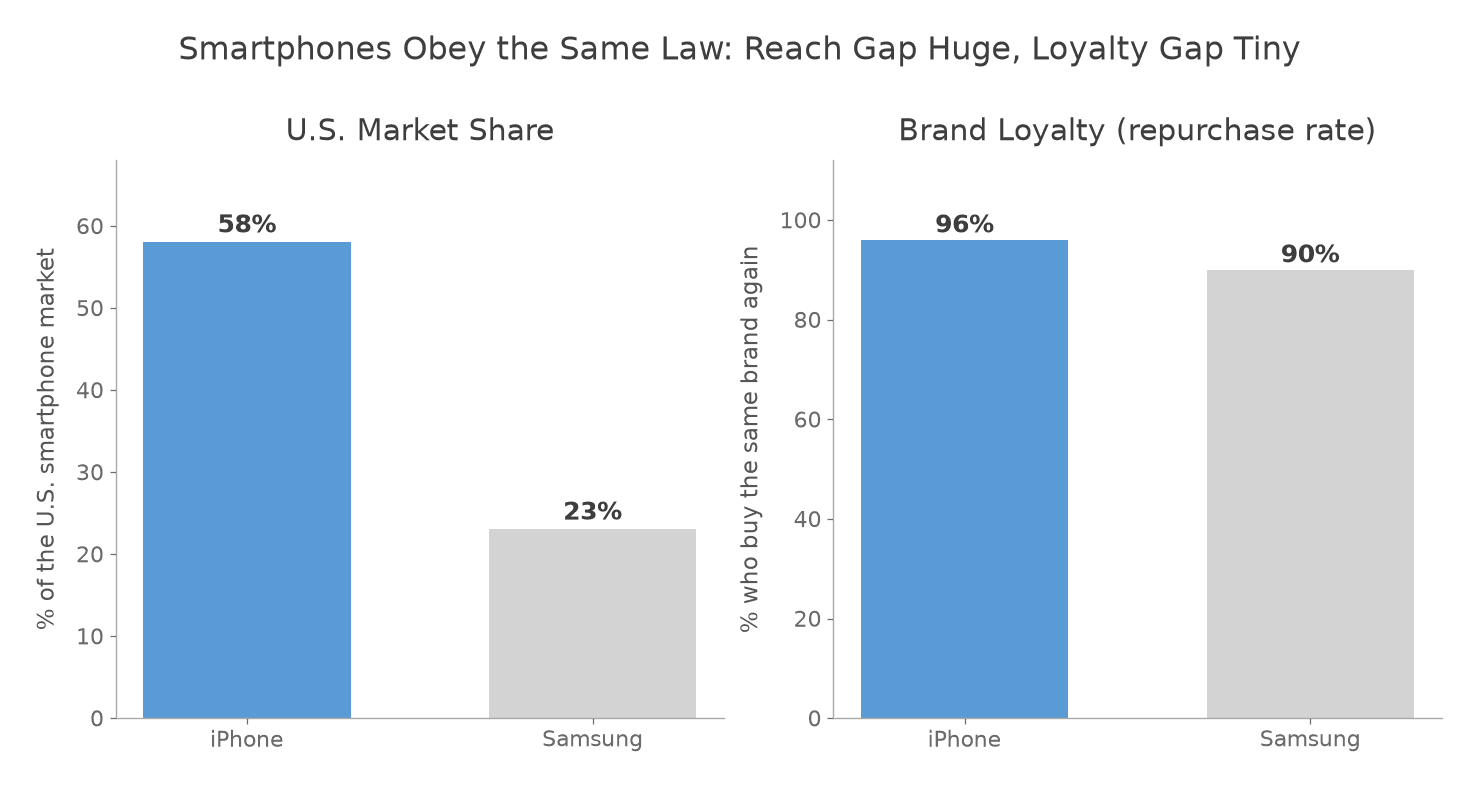
Zappi's figures, treated as directional, suggest the campaign has generated more than 20 billion out-of-home impressions and a claimed five-percentage-point increase in global smartphone market share since 2015. The research is careful to note that market share growth cannot be attributed to a single campaign, and that caveat is worth taking seriously. Pricing, distribution, product development, carrier relationships, and competitor performance all influence smartphone sales. Shot on iPhone did not cause Apple's growth in isolation.
What it did was build a scalable system: customer-generated creative supplied the proof, outdoor media supplied the prestige and reach, and the product's camera capability supplied the underlying story. Running for a decade, each element reinforces the others and Apple has not broken the system.
For comparison, we examined how Apple's Think Different campaign operated as pure brand building with no product claim at all. Shot on iPhone is more grounded: it always connects back to a specific product capability. That specificity is what makes it both more accountable and more durable as a campaign platform.
The Takeaway
Shot on iPhone is not interesting because it used user-generated content. Lots of brands have tried that. Its interest lies in building a distinctive brand asset out of a format, then protecting that format for ten years while everything around it changed.
Format is the asset. White type, full-bleed photography, restrained attribution. After enough repetition, audiences recognize it before they read it. That recognition is worth more than any individual campaign execution.
Most brands never get there because they do not stay long enough. They change direction before the format becomes a memory structure, before the association between the brand and the feeling compounds into something durable. AdVenture Media sees this pattern constantly: brands with strong creative ideas that reset before those ideas have time to build real mental availability.
Every brand faces the question this campaign poses: not whether you can produce beautiful work, but whether you can produce beautiful work in the same recognizable format for a decade, and whether your organization has the discipline to leave it alone when it is working.
That is a harder problem than the creative brief.
 Patrick Gilbert
 is the CEO of AdVenture Media and author of Never Always, Never Never and the bestselling Join or Die. He has been ranked among the top 5 PPC experts worldwide and has delivered keynotes at Google events across three continents.
More about Patrick →Enjoyed this?
Subscribe for more articles on strategy, AI, and what's actually working in marketing.
No spam. Unsubscribe anytime.