Performance Marketing is No Longer Just Bottom Funnel Marketing
Last week, I expressed one of my hot takes: I really dislike the user-generated-content (UGC) craze. Nearly every UGC ad on the internet is the same ad: a woman in a kitchen, a small sigh, a line about how some ordinary task used to be such a hassle until she found the brand, and a 15% off code riding along in the corner the whole time. But then I argued that done well, UGC is a cheat code, and that the version which works taps a specific emotional memory instead of describing a product. That's how a brand crosses the chasm from its early adopter customers to appealing to the broader majority.
What I didn't describe is where creators fit into the modern buyer's journey.
Look at what those ads are doing. A product claim, an objection handled, and a discount code with a reason to use it today. That is a conversion ad, built for somebody who is already in the market and close to deciding, and it is aimed at the very bottom of the funnel.
Now look at who has been orchestrating this phenomenon: performance marketers. People like me, who spent most of their career running bottom-funnel campaigns on platforms like Google and Meta. So when a new creative format arrived, we did the only thing we know how to do with a new format. We pointed it at conversion, measured it on last click, and judged it by whether it beat a ROAS target.
Nobody should be surprised by how that turned out. Mark Ritson published a column in The Drum this month putting numbers on it. Brands will spend more than $12 billion on creators in the US alone this year, and 86% of American marketers now use influencer marketing, up from 64.5% in 2020. Underneath that enthusiasm, an audit of 100,000 creator accounts found that 37% of influencer followers showed signs of being fake or purchased.
Then there's the number everybody in the influencer world repeats, the one that shows up in every pitch deck and every LinkedIn post defending the channel: brands earn $5.78 for every dollar spent on influencer marketing. That figure is built on earned media value, which is not actual money. It's an estimate of what all that attention would have cost if somebody had paid for it, and as Ritson points out, no CFO has ever paid a dividend out of it.
An industry that has to invent its own currency is telling you something about the strength of the real one.
Step back from creators for a minute, because this series has been building one argument for two months:
- The 95/5 rule. At any given moment only about 5% of your market is actually shopping, and every performance marketer alive is bidding on that same 5%.
- The economics of that fight. Why clicks get more expensive every year, and why a strategy built entirely on winning today's buyers eventually stops working.
- Category entry points. How a brand gets into somebody's head long before the buying moment arrives.
- Crossing the chasm. What it takes to get from the early crowd to the much larger majority sitting behind them.
- UGC. Last week, as one practical way to do it.
Five issues, one argument: Performance marketers have to stop living exclusively at the bottom of the funnel.
And since we've now spent several issues setting up an argument for full-funnel strategy, it finally makes sense to talk about the funnel itself.
The funnel I learned looked like a triangle.
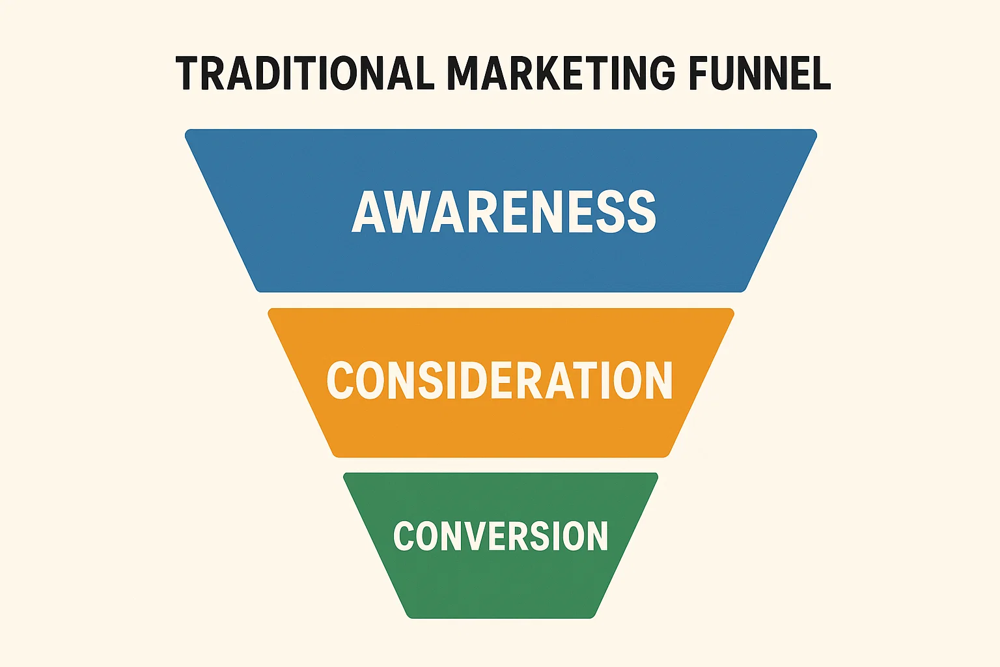
Awareness at the top, consideration in the middle, conversion at the bottom, and a customer moving down through it in order, with very little overlap between the stages. Ads were consumed in a vacuum. When somebody saw a Tide commercial in their living room, they couldn't act on it even if they wanted to. To buy Tide they had to turn off Seinfeld, get in the car, and drive to the store.
That model held up for decades, because it described what was actually happening.
Then digital arrived, and we got the first half of it exactly right.
Search advertising worked immediately, and Ben Thompson of Stratechery, who writes what is probably the sharpest running analysis of the tech industry anywhere, explained why better than anyone else has:
"Search ads were so effective because consumers were entering the purchase funnel already at the bottom: they already wanted insurance, or to travel, or a lawyer."
Search was never a way to build demand, it was a way to intercept demand that already existed. Somebody standing in the middle of the internet shouting I'm buying a washing machine, who wants my money, and Google teleporting them to your front door.
Thompson drew what that era actually looked like.
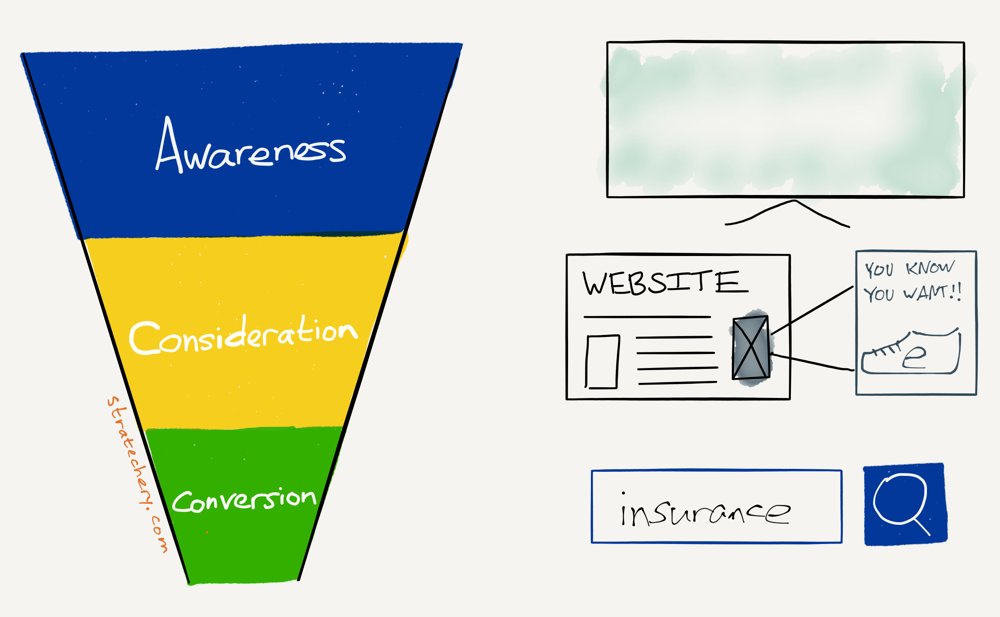
Digital Advertising 1.0. Ben Thompson, Stratechery, 2016.
A search box down at conversion, a banner ad floating around consideration, and nothing at all next to awareness.
It wasn't for lack of trying. The first real attempt to climb up the funnel was that banner ad, which was a digitized newspaper ad with worse manners. Poor targeting, disruptive placement, and it flopped. So the industry drew the wrong conclusion from it. We decided upper-funnel didn't work online, when what had actually failed was one bad format.
That changed on Facebook's Q4 2015 earnings call, when Sheryl Sandberg described something that sounded like the holy grail. A UK ecommerce retailer had just run its best Black Friday ever by doing the entire funnel inside one platform: video ads to build buzz in the days beforehand, then retargeting the people who engaged with them, then dynamic product ads showing the exact items those people had browsed. For the first time, an advertiser could prospect, nurture, and convert without ever leaving the interface.
By 2015 digital marketing was in full swing and smartphone adoption was already high, but mobile commerce was still in its infancy. Which is why, for all the excitement around what Sandberg was describing, it's worth noticing what it still was: the same triangle. Awareness, then consideration, then conversion, in that order. What Facebook had compressed was the time and the number of channels it took to move somebody through. The sequence itself was untouched.
Which means the bottom-up approach wasn't stupid. It was correct for a while, and that is exactly why it has been so hard for our industry to give up.
The strategy that came out of all this is one I ran for a decade, and I'd guess most performance marketers reading this have run some version of it too. You start on Google Search, where the return is most obvious. Then you add Performance Max. Then Meta. Then Display, then Video, each step reaching a slightly broader audience than the one before it, each step justified by the returns of the step below.
I've watched this fail for the last five years in accounts of every size, and it fails the same way every time. The bottom two rungs perform. The next rung up performs a little worse, because it's reaching people who weren't already looking for you. The rung after that gets killed in a quarterly review for missing its ROAS target. So the brand retreats back down to the campaigns that work, concludes that upper funnel doesn't pay, and ends the year exactly where it started, bidding against the same competitors for the same 5%.
Earlier this week I was on a call with a prospect whose budget has been 90% bottom-funnel Google and Meta for the last eight years.
I told him what I tell most people in that position, which is that in 2026, bottom-funnel search optimization is mostly past the point of diminishing returns. Most Google Ads accounts I audit are in fine shape. They generally aren't hurting the brand and they aren't growing it, and they're hitting the ROAS the client asked for. There's real work to do in most of them, but a new bid strategy or a fresh set of negative keywords is not going to take you from $10 million to $50 million next year.
Then I told him what I'd actually recommend. Build your bottom-funnel infrastructure first and get it right. Then blow up the ceiling and expand the very top of your funnel to the broadest possible reach you can afford. Then connect the dots in the messy middle of the funnel, cross the chasm, and turn all that reach into profit.
The part that surprises people is what happens after that. Once it's running, you can increase your investment in Google and Meta by a multiple of what you're spending today and see a better ROAS than you were getting before, for the reasons I laid out in Issue #9. Your conversion rate climbs, because a growing share of the people clicking your ads already know who you are. Your cost per session falls, because a growing share of your traffic is traffic you no longer have to buy.
The person whom I was describing this to was with me the entire way. Nodded along, asked good questions, and then when I finished he said:
So when you say expand the very top of the funnel, you mean like a top-funnel Search campaign?
No. That is not what I mean.
A top-funnel Search campaign is not top funnel. It's a broader keyword inside the same auction, shown to people who are already typing your category into a search bar. That's still search, and search is still the bottom.
What I mean is something like television. Or out of home. Or streaming audio, sponsorships, etc. The kind of media that puts your brand in front of somebody who has never once gone looking for what you sell and won't for another eight months.
And I want to be careful here, because this is not a knock on him. He's a sharp operator who has been rewarded for 15 years for thinking exactly that way. It's the water we swim in. When your entire professional life has taken place inside a Google Ads interface, "the top of the funnel" gets translated into the nearest available object, which is a broader keyword.
Which brings us to what actually changed.
Today's consumers carry an infinite shelf of information in their pockets: reviews, price comparisons, product specs, and now AI assistants to do the sorting for them. Brands meet them with mobile-optimized websites, one-click checkout, and AI assistants of their own. We live in a world of abundant choice and unlimited information, and in that world the buyer's journey stopped being a sequence.
Consumers don't necessarily enter at the top of the funnel through a traditional brand ad anymore. Your next customer might discover you through a Meta Advantage+ catalog ad, a YouTube video, a creator partnership, or a competitor keyword in Google Search. And yes, we all still discover new things on television and CTV. The path in is anywhere, the path out is anywhere, and the purchase can happen at any point in between.
So, back to where we started.
The reason every UGC ad looks the same isn't that creators lack imagination. It's that we bought something new and immediately fit it into the only frame we had, exactly the way we did with display ads in 2010, and exactly the way that prospect did on the phone with me this week. Marketers take every new idea and squeeze it into the framework they're already comfortable with. That isn't stupidity. It's what expertise feels like from the inside, right up until the ground moves underneath it.
And the ground has moved:
- The funnel stopped being linear. There's no fixed entrance and no fixed order anymore, which breaks every strategy built on climbing it one rung at a time.
- A well-run bottom funnel is table stakes. It keeps you in the game. It is not a growth strategy.
- Going up funnel doesn't mean broader keywords. It means media that reaches people who aren't looking for you yet.
- The payoff lands back at the bottom. Buyers who already know you click cheaper and convert better, which is how full-funnel brands scale their Google and Meta spend at a better ROAS instead of a worse one.
None of this is an argument against bottom-funnel marketing. (Never always, never never.) It's an argument about what performance actually means. If the goal is profitable outcomes for a business rather than a number on a dashboard, then embracing full-funnel strategy is the only way to make the economics actually work at the bottom of the funnel, and the only way to initiate real growth.
Performance marketing is no longer just bottom-funnel marketing. It hasn't been for a long time. And most of us are still building our budgets, hiring our teams, and writing our strategy decks as though the customer were walking politely down a triangle somebody drew on a whiteboard in 2004.
The death of that triangle bothered Google too. It bothered them enough to run one of the most complex and expensive consumer research studies in the company's history, just to understand how people actually buy in a world of unlimited choice. What came out of it was a brand-new framework for the modern buyer's journey, and it has shaped the way I think about marketing strategy every single day for the last five years. It was also the catalyst that made me want to write a second book: Never Always, Never Never exists because this research made that profound an impact on my worldview.
That research, and the framework it produced, is the topic of next week's issue.