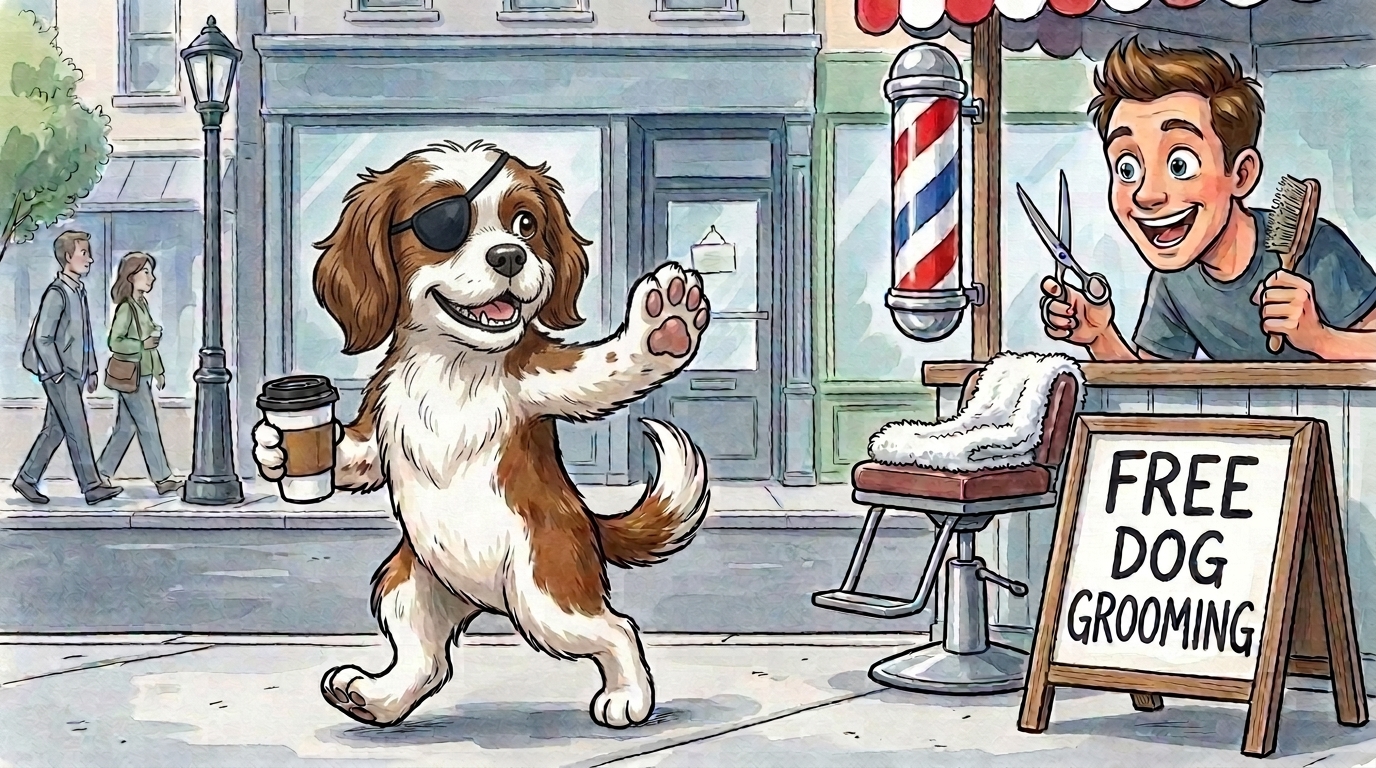
Imagine you set up a stand on a busy sidewalk tomorrow morning offering free haircuts. A real barber, good chair, no catch and no waiting.
Out of the next hundred men who walk past, how many take you up on it?
About five.
The other ninety-five will turn down a free haircut. Not because they doubt the barber, or because the offer wasn't targeted well, or because your sign needed better copy. They'll turn it down because they don't need a haircut today. The price of the product, even when that price is zero, is completely irrelevant to someone who isn't in the market for it.
That example comes from Mark Ritson.
A few weeks ago at the Cannes Lions Festival, the annual gathering in France where the biggest names in marketing and advertising fly in to give talks, hand out awards, and drink rosé on yachts, Ritson shared a stage with Byron Sharp. If you don't spend your time in the world of marketing academia (and I can't imagine why you wouldn't), these are two of the most influential thinkers in the field, and two men famous for publicly beating each other up. So when they sat down together for one of the marquee sessions of the entire week, the billing was a clash of titans. Then afterward they recorded a podcast for Uncensored CMO, and instead of a brawl they spent ninety minutes drinking Krug and agreeing with each other.
The thing they agreed on most was a topic I dedicated an entire chapter to in Never Always, Never Never: the 95/5 rule.
At any given moment, only about 5% of your potential buyers are actually in the market for what you sell. The other 95% aren't buying from you or from anyone else in your category. They're the guys walking past the free haircut.
Here's what our industry did with that information. We built entire machines dedicated to fighting over the five guys who want the haircut. Ignore anyone who might need a haircut tomorrow.
We've given those machines different names over the years. Your grandfather's generation called it direct response. The consultants call it activation. My world calls it performance marketing. Whatever the label, the job description is identical: find the people who are ready to buy right now, and convert them before a competitor does. I've built my career on this. I've spent more than a decade at AdVenture Media optimizing Google and Meta accounts, and the vast majority of that spend has been pointed squarely at the 5%.
And to be clear, that's not a mistake. Even Ritson, mid-podcast, put it plainly: this is why we need short, targeted performance marketing, "because that's where all the money is." The 5% is where the money is today.
The problem is what happens when everyone points their budget at the same small crowd. Every brand in your category is bidding on the same in-market buyers, in the same auctions, at the same moment. That's the real reason CPCs have climbed year after year. It's not Google squeezing you (though they're happy to let it happen). It's arithmetic. Too many bidders chasing the same five buyers.
So let me spell out the economics, because this is where the 95% stops being a philosophical idea and starts showing up in your P&L.
Take two brands selling the same $100 product with $50 of margin, bidding on the same keyword, paying for the same clicks.
Brand A does everything "right" by performance marketing standards. Tight funnel, great landing page, all budget in Google and Meta, every dollar accountable. But nobody has ever heard of them, because 100% of their spend chases the 5%. When their clicks arrive, they convert at 1%. That's one sale per hundred clicks, which means at $50 of margin they can afford to pay 50 cents per click before the math breaks. That number is a ceiling, and the ceiling decides everything: how often they show up, how many auctions they can win, how big they're allowed to get. Their maximum market share was set the moment their conversion rate was.
Brand B sells the same product at the same price, but they've spent the last three years reaching the 95% with ads those people were never supposed to "convert" on. So when someone from that audience finally needs the product and starts shopping, Brand B isn't a stranger. The click arrives warm. Those clicks convert at 2.5%, which means a customer costs forty clicks instead of a hundred, which means Brand B can pay $1.25 per click before the math breaks.
Same product, same price, same auction, but one brand's ceiling is 50 cents and the other's is $1.25. Brand B can outbid Brand A on every single click and still bank more profit per sale. They win the impression, the click, the customer, and the market share, and it looks like they're better at Google Ads. They're not better at Google Ads. They did the work outside the ad account that made the ad account easy.
The auction has no idea who you are. The person clicking does.
Go back to the sidewalk for a second. Only five of those hundred men need a haircut, but realistically almost none of them are going to sit down for a free one from a stranger they've never heard of. So an unknown barber might get the chance to talk to five people and still walk home having cut zero heads of hair. Now put the most famous barber in the world behind that chair, the one everybody already trusts, and he might go five for five. He might even talk a few guys who weren't in the market at all into climbing into the chair. Same corner, same free offer. The only thing that changed is whether people already knew him before he asked.
In the book, I share benchmarks from Nik Sharma, who built his career running bottom-funnel Meta ads for brands like Hexclad and Rare Beauty. A celebrity-backed makeup brand acquires customers for $3 to $10 while a nearly identical unknown brand pays $30 to $50. Not because of targeting, not because of campaign structure. Because one brand already lived in people's heads and the other was introducing itself at the worst possible moment: the moment it was asking for money.
The podcast put a number on that too. When someone finally enters the 5%, roughly 70 to 80% of the time they buy the brand that was already in their head before they started shopping. In B2B it's even more brutal: about 80% of buying decisions are effectively made before the pitch process begins. The shortlist is the battle, and the shortlist was written months or years earlier.
I've lived the losing side of this, and it taught me the whole lesson.
Back in 2015 I worked with a client who sold drop-shipped insulated coffee mugs. They retailed for about $25, and because they were drop-shipped the margins were thin, so the whole thing only worked if we could buy a sale for less than $6. And it worked beautifully. We built a real business doing five figures in monthly profit, and almost all we did was chase the 5%, mostly through Google Shopping ads.
It worked because it was still the golden age of digital arbitrage, when two things were true at once. There was very little competition, so clicks cost a fraction of what they'd cost once the space filled up. And the competitors we did have were other small drop-shippers just like us. The household names weren't running Google Shopping ads to mobile-optimized stores yet. For a short window, a tiny brand could profitably and consistently pick off that in-market 5%, and nobody bigger was there to stop us.
Then one day we woke up and Yeti, Stanley, Keurig, and Thermos were all running Google Shopping ads to beautiful mobile-optimized stores. And for them, two things were true. They had household-name recognition, which lifts click-through and conversion rates before you spend a dollar. And they had far better margins than our little drop-shipper, because they manufacture their own products, run more efficient supply chains, and earn repeat purchases and upsells over a customer's lifetime. A brand like Yeti, selling a nearly identical $25 mug, could afford to spend five times what our client could on the exact same click. Overnight, the economics of that business stopped working.
I've watched a version of that play out in nearly every category I've touched in the last fifteen years. The brands that invested in being known didn't just win a branding trophy. They earned the right to outbid everyone else on the clicks that actually convert.
One important caveat: the 5% is not a fixed group of people. It's a different 5% every week. People fall into the market without warning, from a job change, a move, a new baby, or a washing machine that dies on a Tuesday. And they fall right back out the moment they buy. Which means the 95% you reach this month isn't an "awareness play" floating somewhere in the clouds. A slice of them tumbles into the market next week, another slice the week after, on and on, every week, forever. Sharp made this point beautifully: brand advertising doesn't have delayed effects, it has lasting effects. It starts working immediately. You just can't see it in this week's ROAS, because only 5% of the people you reached could possibly have bought anything this week.
If you want to know whether any of this applies to you, the diagnosis takes about five minutes. Open your Google or Meta account and compare the last twelve months to the twelve before. If your CPCs keep climbing while your conversion rate stays flat or sinks, you've been harvesting demand without ever planting any. And if your competitors' ads seem to be everywhere lately while yours are getting priced out, I have some bad news: they've already read this newsletter.
In the book I compare all this to investing, because the best time to diversify a portfolio is when you're flush, not when the market turns. The same is true here. The time to start reaching the 95% is while your performance campaigns still look great, because the brands that wait for the stall are starting a three-year project on the day they needed it finished.
I run a performance marketing agency. It would be very convenient for me to tell you that everything can be fixed inside the ad account, that the right bidding strategy or campaign structure will save you. But the best accounts I've ever managed were made great outside the ad account, by brands that treated the 95% as their actual audience instead of a rounding error. I've watched it play out too many times to believe anything else.
The 5% is where the money is. The 95% is where the long-term profit is.
Personal Carve Out: I finally started a YouTube channel
People have been telling me for years to put my talks somewhere people can actually find them. So I did. I started a YouTube channel.
Right now it's a mix. Some keynotes, the AI office hours sessions, and a few new videos I've been recording myself. The latest one is on light buyers and the customer demand curve. Same idea I wrote about a few weeks ago, but it lands differently when you can hear me talk through the yoga story.
Here's the honest part: I'm starting from zero. Genuinely zero subscribers. If these emails have been worth anything to you, subscribing would mean a lot. That's the whole ask.
I cover the 95/5 rule, the halo effect, and how to actually balance top and bottom funnel budgets in Never Always, Never Never, on Amazon in paperback and Kindle. If you've read it and it landed with you, a quick review helps more than you'd think.