Product Comes First for a Reason
Mark Ritson went on a WARC podcast a few weeks ago and repeated a number that should embarrass all of us. When Ipsos ran a test of basic marketing knowledge across more than a thousand marketers in the United States, the UK, Canada, and Australia, only 35% passed. Sixty-eight percent could not correctly identify the four P's of marketing, arguably the most famous framework in the entire field.
Product, price, place, promotion, the framework Jerome McCarthy laid out in 1960 that every marketing textbook has opened with since. Literally every marketing textbook. In college, we joked that you could skip the first three weeks of every marketing class, knowing all you'd miss is a refresher on the four P's. And two-thirds of the people who do this for a living can't pick them out of a lineup.
Here's the part that turns it from sad to funny. Of the marketers who failed, three out of four rated themselves above average at their craft. Ritson called it a living example of the Dunning-Kruger effect, and he's right. We aren't just an undereducated profession. We're a confidently undereducated one.
His larger point, the one he's been making for years, is that marketing is strange in its contempt for its own fundamentals. Say the words "marketing principles" in a room full of practitioners and watch everyone reach for their phones. Bring up the four P's and someone will tell you it's outdated and academic. As Ritson put it, the people he works alongside are good men and women, but they lack a fundamental knowledge of marketing. And it's a real problem.
Marketing pulls people from everywhere. Part of what makes the industry so unique is that it includes folks with diverse educational backgrounds. I know brilliant marketers who studied history, English, film, and a couple who studied nothing at all. Compare that to accounting, where nearly everyone in the room has an accounting degree. Our range of backgrounds is a real strength. But the downside is that most of these folks never actually studied marketing in an academic setting, and of those who did, many forgot everything they learned the moment they received their diploma.
That's how you end up with an entire profession that doesn't know its own first principles and doesn't believe it needs to. So we mock the idea of marketing education, and we're the least educated in it. Go figure.
So let's talk about the four P's, and specifically about the order.
Product, price, place, promotion. Product comes first because it's the foundation the other three stand on. And almost every modern marketing conversation I sit in runs the list backwards. We pour our energy into promotion, the creative and the channels and the bidding and the targeting. We give some thought to price. We spend a little on place (which is distribution).
And product, the actual fit between what's being sold and the people it's for, is simply assumed.
That assumption is everywhere: the product exists, it shipped, and somebody approved it. So marketing's job is to take it to market, and when the numbers disappoint, the instinct is to refresh the creative, cut the price, or change the channel mix. The last thing anyone examines is whether the product fits the market in the first place.
That's backwards, and it's an expensive kind of backwards. You can rent attention. You can discount until it hurts. You can flood every channel you can afford. What you cannot do is make people want something they don't want, understand something they don't understand, or feel safe adopting something they aren't ready for. No amount of promotional sophistication saves a product the market hasn't decided it wants.
Which brings me to product-market fit, a phrase founders love and marketers like to treat as someone else's job. It isn't. And product-market fit almost never arrives fully formed.
In hindsight, every big product feels inevitable. Of course people wanted this. But trace the mass-market hits back to the beginning and you rarely find a grand vision of universal appeal. You find a narrow use case and an accident of timing.
Chocolate is a great example. In the early twentieth century, chocolate in the United States wasn't a household treat. It was expensive, inconsistent, and unfamiliar. It didn't go mainstream through indulgence or branding. It went mainstream through logistics. When the country entered World War I, the military needed food that was cheap, calorie-dense, portable, and shelf-stable, and chocolate fit the bill perfectly. The government struck a deal with Milton Hershey, and overnight chocolate stopped being a luxury and became a ration. Soldiers carried it, ate it daily, and came to associate it with comfort and routine. When they returned home, the habit came with them, and then it spread to their families. Chocolate didn't earn its place by being delightful. It earned it by being useful.
Play-Doh is another one. It spent its first years in the 1930s as a compound for cleaning coal soot off wallpaper, and it should have died the moment American homes moved off coal heat. But somebody noticed that children liked playing with it. The product never changed. The market did.
Product-market fit is contextual. It appears at the intersection of what a product can do and a moment when that capability solves a real problem for a specific group of people. Scale comes later, often much later. And this is exactly where marketing teams go wrong. They see a product with mass-market potential and market it as though that potential already exists. Products don't leap from obscurity to ubiquity. They move through stages.
Geoffrey Moore mapped those stages in a book called Crossing the Chasm, and you've probably seen the picture even if you never read it.
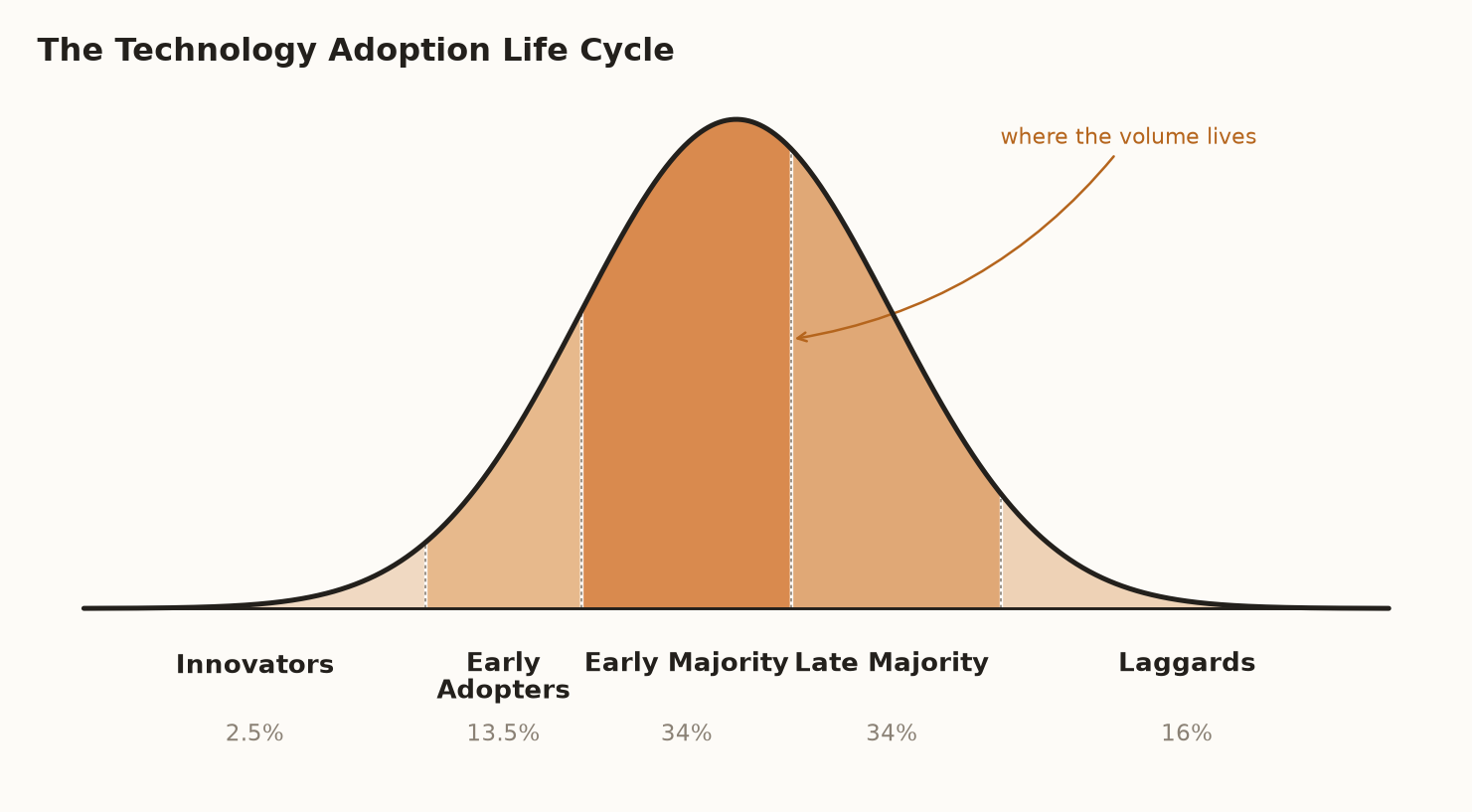
Here's the whole market in one picture. Adoption starts on the left with a small band of innovators, the people who try things simply because they're new. Right behind them are the early adopters (the visionaries), who are chasing an edge and will tolerate a rough, unfinished product if they believe the upside is big enough. Together they're a thin slice of the total market, loud and enthusiastic and nothing like the crowd sitting behind them.
Then comes the early majority—the pragmatists. This is where a product either scales or stalls. Pragmatists are not impressed by novelty. They want proof that something works in the real world, for people like them, without requiring heroics. They aren't asking is this exciting? They're asking is this safe? They don't want to be first. They want to be right.
The reason most never make it that far is the gap between those two groups.
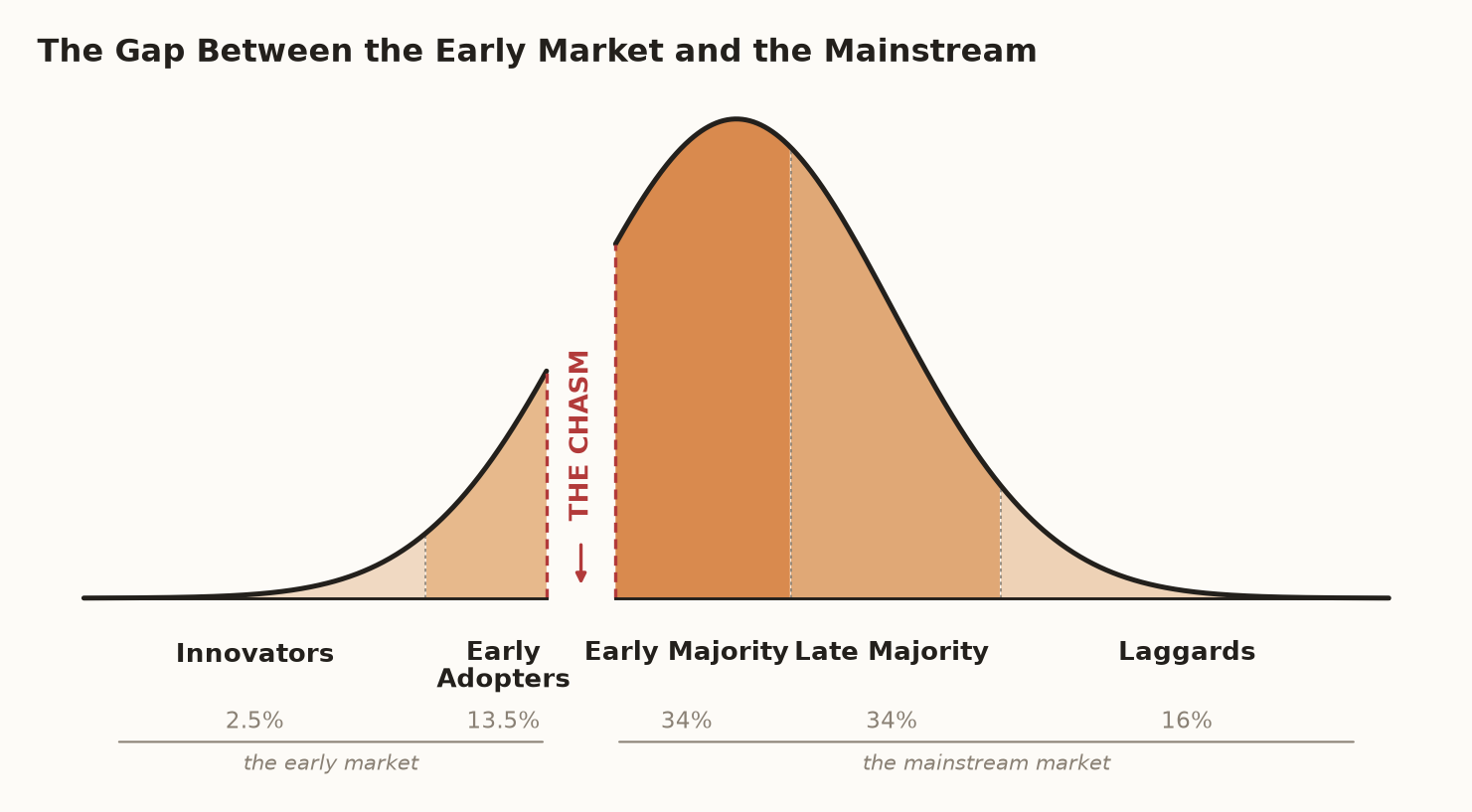
Moore called it the chasm, and he filled a book with companies that fell into it because they never noticed their marketing had to change. The trap is that the exact behaviors which win the early market are the ones that repel the pragmatists. Big promises sound risky. Novelty sounds unstable. A wall of fanatical early users reads as a warning rather than an endorsement. It's why so many products feel stuck after a promising start. They didn't lose product-market fit. They never finished finding it.
The biggest mistake I've seen brands make in a digital-first world is coming out of the gate hot, then assuming their 1,000th customer will be very similar to their 10th. But Moore's research (and my ten-plus years running digital marketing campaigns for hundreds of digital-first brands) tells a different story.
The exact thing that convinced your 10th customer to try you is the same thing that will turn others away as you attempt to scale. But when you're a relatively new brand, and all you've seen for the last three years is compounded growth through bottom-funnel channels like Google and Meta, it's impossible to see this harsh reality, or to recognize when you're about to hit that wall. And once you've saturated your early adopters, your Lookalike Audiences are no longer valuable, and neither is the creative or the rest of the strategy that got you there.
So how does anyone cross a gap like that on purpose?
Not by shouting at the whole market at once. Moore borrowed his answer from the military. You don't invade a coastline everywhere at the same time. You pick a single beachhead, a narrow stretch you can actually take, you win it completely, and you use it as the staging ground for the territory next door. Secure one segment and it topples into the next, the way a single bowling pin takes down the pins behind it. The best brands land several of these beachheads at once, because audiences overlap and the momentum compounds as they push toward the pragmatic middle of the market.
You've watched the finished version of this in your own life. Think about the products that showed up first among the people who like to picture themselves as early: the smartphone, the energy drink nobody had heard of, the water bottle that somehow turned into a personality. Some of you bought an iPhone when it was still the choice of gadget obsessives, drank Celsius when it lived on a shelf in the vitamin store, or owned a Stanley long before it took over every school pickup line in America.
None of those are the innovative choice anymore. They crossed the chasm. The iPhone and Celsius and Stanley didn't win because the early crowd loved them. The iPhone won because the group chat turned on the one friend whose texts came through green instead of blue. Celsius won because it was perceived as the first energy drink accepted by people who seem to have their lives together. And Stanley won because my wife, tired of me ridiculing hers, bought me one last Christmas so I'd realize on my own what I'd been missing.
In other words, these brands reached critical mass by winning the moment the cautious majority decided they were the obvious, everyone-else-is-doing-it pick. That shift, from the exciting choice to the pragmatic one, is the whole ballgame. And most brands never pull it off, because pulling it off means changing the very thing that won them the early crowd in the first place.
The same curve is playing out in my own industry right now, faster than I've seen it happen with anything.
A year ago, ChatGPT was still the king of AI and few people were familiar with Claude. But it started gaining steam with the innovators and early adopters (us included). A few months later it's everywhere, and in whole categories of business you already look behind if you're not using it every day.
I felt the chasm get crossed on a sales call this week. For more than a year, prospective clients have been asking us how we use AI. It's a fair question and we're happy to answer it. This week, for the first time, someone asked it differently. They didn't ask whether we use AI, or even how. They asked how we were using Claude, by name. They just assumed that of course we'd be using it in 2026, the same way they'd assume we use email.
They were right. And the striking part wasn't the answer, it was the assumption folded into the question. Claude out of the box has broad appeal and isn't built for any single niche, but inside digital marketing it has already made the jump from the tool the early crowd swore by to the pragmatist's default, the choice where not using it is now the thing that looks strange.
Which is where the four P's come back around. The industry that rolls its eyes at the fundamentals keeps rediscovering them the hard way. Product is first on that list because it was always first. Get the fit right, help the cautious majority feel safe enough to cross, and promotion finally has something real to carry. Skip it, and all the targeting and creative and clever bidding in the world just make a product people don't want easier to find.
This whole thing started with the fact that most marketers can't name the four P's. So this is a convenient time to mention, purely by coincidence, that there's a great new book on the most important principles in marketing, how to actually use them, and how they hold up in an AI-driven world. Written, as luck would have it, by yours truly. There's an entire chapter dedicated to product-market fit. Order your copy on Amazon today.
Prefer to listen? The audiobook is now on Spotify.