UGC is a Cheat Code
You've seen this ad a thousand times. A woman turns to her phone in the kitchen, sighs, and says something like: Wow, for a mother of three, [doing some everyday thing] used to be such a hassle... until I found [brand]. Cut to the unboxing. Cut to the product in action. Cut to the happy family. A fifteen-percent-off code rides along in the corner the whole time. It's the same ad every brand is running, and you already know exactly how it goes.
I've long been pessimistic about UGC. It has its place, but most of it is a lazy stand-in for good creative. Somewhere along the way marketers became obsessed with it, because it's a cheap and fast way to get creative into a paid social account, and we convinced ourselves it was something greater than it really is. It's what a brand reaches for when it doesn't have the budget, the bandwidth, or the skill to make something better. If cost and speed and skill weren't a factor, almost every brand would take one great, polished commercial over a stack of talking-head testimonials every single time.
Open Instagram in 2026, and if a handful of brands in the same category are targeting you, you're watching the same UGC ad on a loop, all of it shot from the same script. None of those brands are distinguishing themselves from one another, which is the opposite of what advertising is supposed to do. We built a playbook, everyone ran it, and we regressed to the mean. The cherry on top is that most of these creators aren't good actors, so the whole thing comes off as disingenuous.
But not all UGC is created equal. (Never always, never never.) Done right, it's a cheat code.
I've spent the last several issues circling the same idea from different directions. The 95/5 rule says it's more effective to reach your entire target audience than to pour everything into the five percent of buyers ready to purchase today. And when I say reach your target audience, I don't mean mass-market to the whole country. I mean think of your audience as smaller bubbles sitting inside that population, and reach all the people in those bubbles, not just the five percent already raising their hands.
Last week I wrote about crossing the chasm, the gap between the early adopters who try things because they're new and the early majority who wait until something feels safe. Most brands stagnate right there, because their marketing never crosses that gap from the early crowd to the far larger majority sitting behind them.
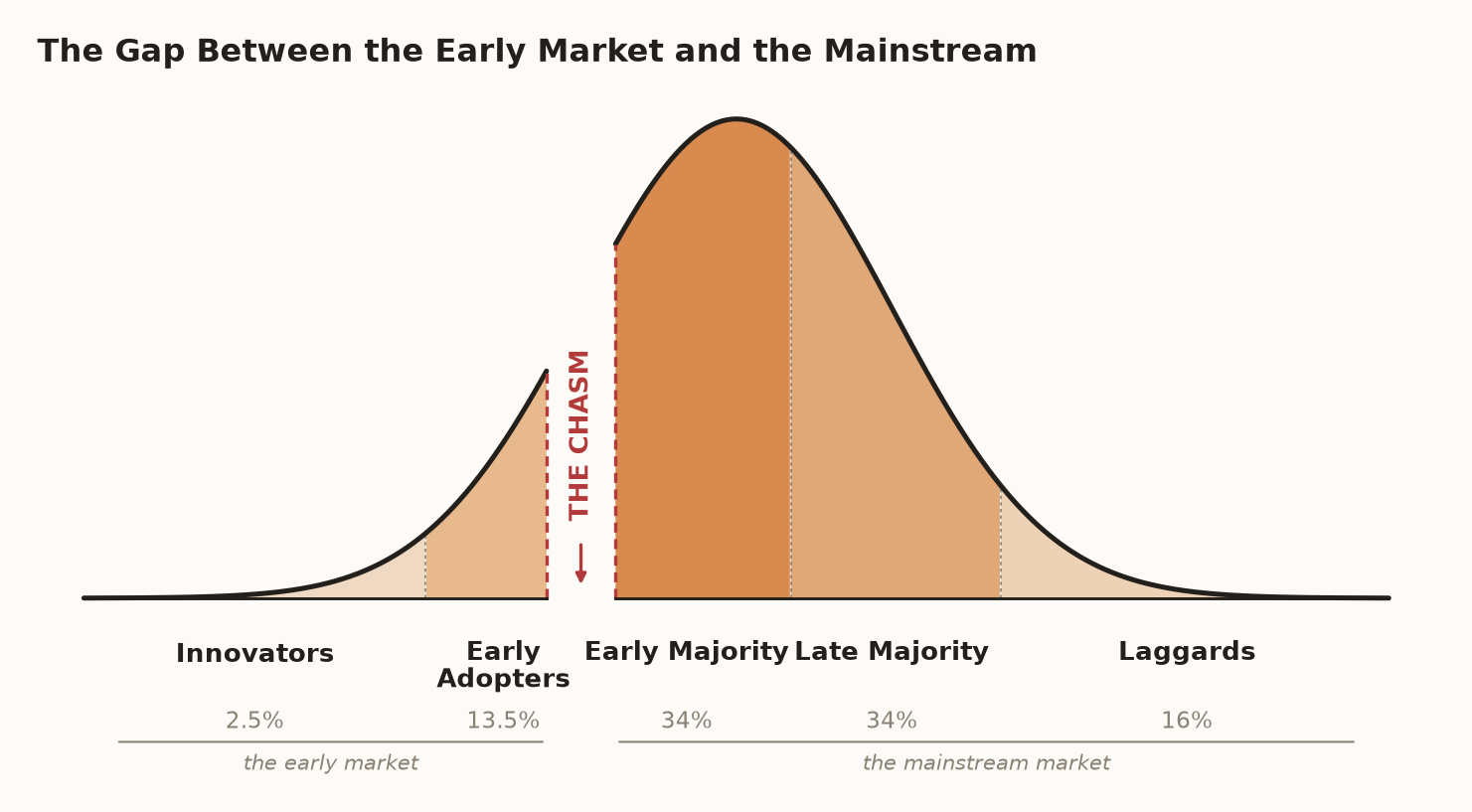
What I didn't get into last week is how you actually cross the chasm. The people on the right side of it, the pragmatic majority, aren't hunting for the best option, they're hunting for the one they can trust. They want what the people who look, live, and think like them are already buying. This issue is about how you give them the confidence that your brand is exactly that.
Let's break it down, starting with the entire population.
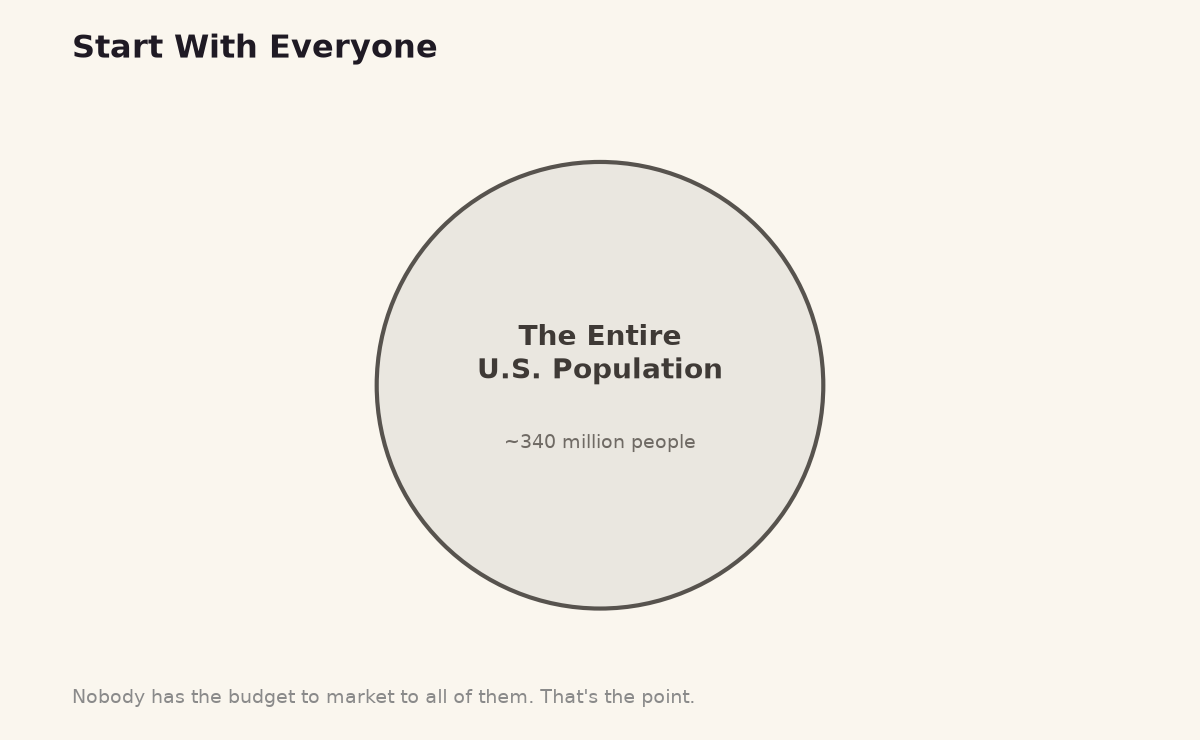
Somewhere inside that is your real addressable market, the people who could plausibly buy what you sell. For most brands that's a small slice of the country.
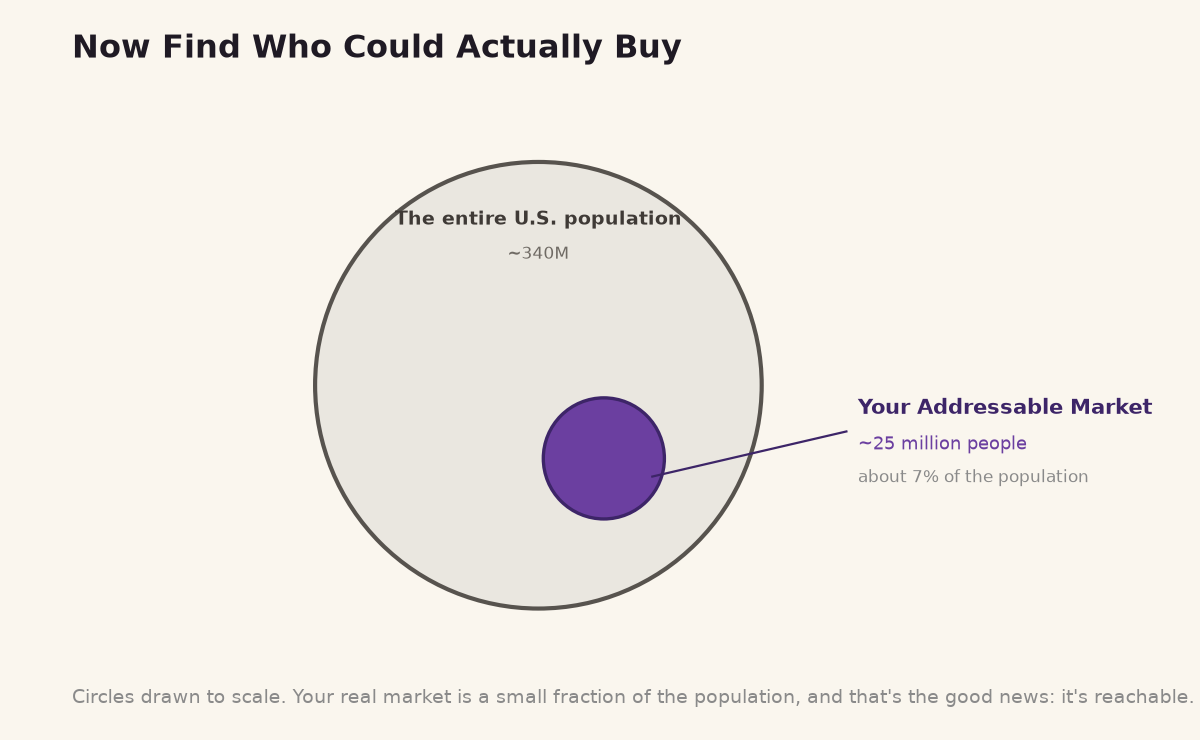
And inside that smaller circle, the same adoption curve from last week plays out all over again. A few innovators, a band of early adopters, and the big pragmatic majority sitting behind them, waiting to see what everyone else does first.
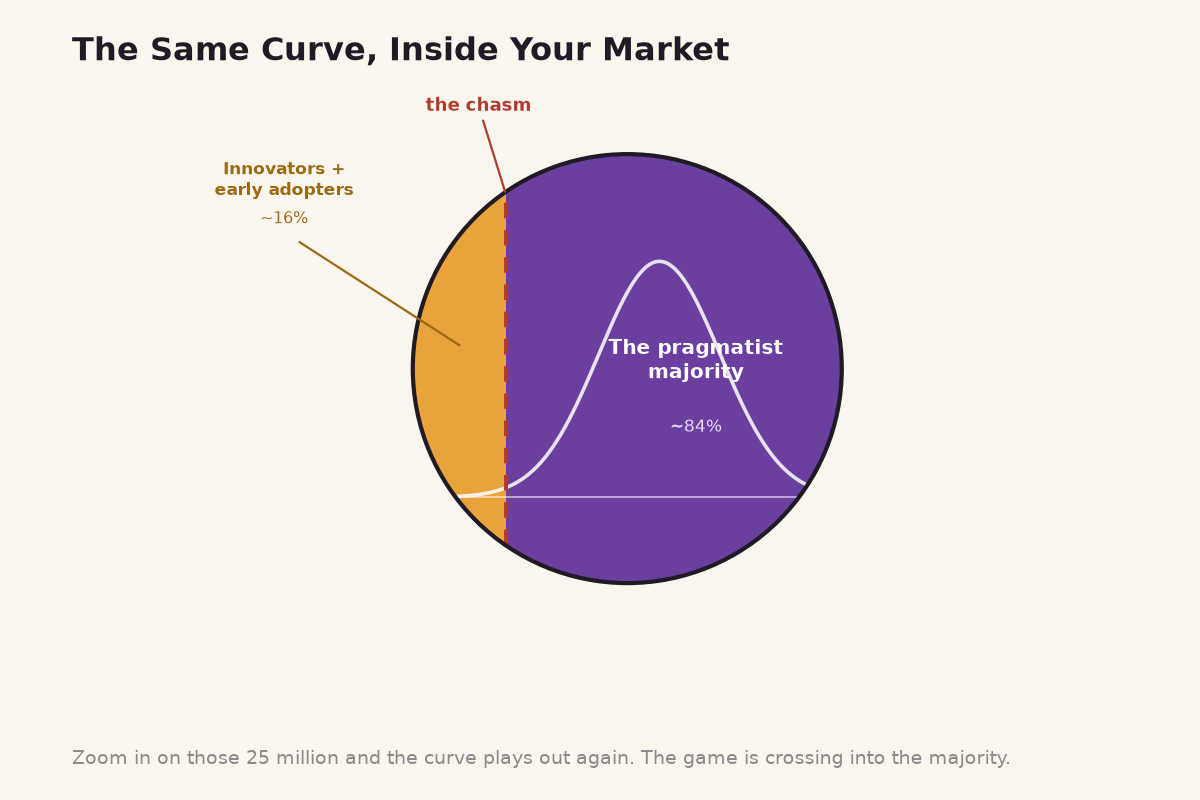
For a stagnating brand, the whole game is crossing that inner chasm, from the early crowd on the left to the majority on the right.
You already know how this feels from the other side, as a consumer. Think about the Stanley water bottle. It started as something you saw once on Instagram. Then your trendy cousin showed up with one at Thanksgiving. Then they were on your coworkers' desks. And eventually everyone you knew, you included, caved and decided that hauling around a forty-ounce quencher was a non-negotiable part of daily life. Somewhere in that run you stopped thinking of it as the thing the early crowd liked, and started thinking, if everyone around me is carrying one, it must actually be good, and I should try it.
A brand crosses the chasm the moment the pragmatic majority feels confident it's the right choice for them, and that confidence comes from watching people like them already choose it.
You don't get there from a standing start. To grow a brand, you first have to win the innovators and early adopters, the people out front who set the tone. The majority watches what the trendy cousin and the fashion-forward crowd are doing even when they're not ready to move yet, and they sit back until it feels like the thing has taken over their feed before they'll touch it. That slow snowball, from a handful of early believers to critical mass, normally takes years.
Geoffrey Moore's answer to this in Crossing the Chasm is the beachhead, an idea he borrowed from military strategy. You don't invade the whole coastline at once. You concentrate everything on one narrow segment you can win outright, dominate it completely, and then use it as the staging ground for the segment next door, each niche toppling into the next like dominoes.
The entire SaaS industry, or at least the SaaS products that actually succeeded, has run this beachhead-and-domino playbook for the last twenty years. Take Slack. My company uses Slack. Everyone in my bubble seems to use Slack, and since we all live inside our little bubbles, I naturally concluded that everybody uses Slack. In reality, Slack holds around 15 percent of the business communication market. And part of why I use Slack is precisely because my bubble uses it. Agencies like ours always seem to run on Slack. Most of my clients are on Slack. Most of my vendors are on Slack. Slack crossed the chasm with a certain kind of digital-first agency, which made it the go-to, no-brainer, you're-weird-if-you-don't-use-it choice for every business in my orbit, and that momentum helped get it acquired by Salesforce for $27.7 billion in 2020. At some point I looked around and realized we had no choice but to start using it. We weren't early adopters. We followed the trend of our bubble, and we've now been Slack users for nearly a decade.
Slack could afford to let that snowball build for years. Most brands can't wait that long, and this is where good UGC earns its cheat code status. It lets you manufacture the sense that an army of people like your buyer already use your product and love it. It builds a halo effect around the brand and compresses the part that would otherwise take years, so the majority feels the momentum sooner and finally gives you a look.
Say a brand sells premium beach gear. Good chairs, a big umbrella, a wagon that actually rolls across soft sand, plus the stuff that keeps the kids busy for an hour. Ask most agencies to build a UGC strategy for that brand and you'll get something that looks a lot like this: hire five creators. Each one shoots a variation on the same ad: a mom smiling at her phone, sighing about how going to the beach with the kids is such a hassle, yada yada yada, telling you this is her brand of choice, and then offering a code for fifteen percent off.
That ad isn't interesting, and it isn't even interesting to the families it's aimed at, unless one of them happens to watch it the morning after a genuinely miserable beach day. The structure is a Mad Libs template: as a [broad demographic], [broad activity] used to be such a hassle until I found [brand]. It works for anything. Drop in any audience and any chore and the machine keeps running.
So picture the feed of an actual mother of three.
One video: as a busy mother of three, going to the beach was such a hassle until I found this brand.
Next video: as a busy mother of three, back-to-school shopping was such a hassle until I found this brand.
Next one: as a busy mother of three, finding convenient, healthy meals for the family was such a hassle until I found this brand.
The one after that: as a busy mother of three, visiting an auto shop, even for a simple oil change was such a hassle until I found this brand.
It's the same ad wearing a hundred different costumes, and because everyone is running it, none of it registers. She scrolls right past all of it.
Here's a different way to approach the same problem. Beach gear is inherently a product about a place. The environment it lives in, the sand and the parking lot and the boardwalk, matters as much as the person using it, and often more. So instead of casting for a demographic, cast for a setting. Pick a few beach destinations. Find a creator who actually lives in each one. Then tell a story about what it's actually like to go to that specific beach. The goal isn't to dramatize the hassle. The goal is to make someone feel something, excited or nostalgic or homesick for a place they know in their bones, by putting a very specific thing they love up on the screen.
I grew up on Long Island. Of the roughly eight million people who live there, a huge share are familiar with the same beach day routine: packing the car, heading south down the Wantagh Parkway toward Jones Beach. A few miles out, the iconic 231-foot "Jones Beach pencil" landmark (which I think is a water tower?) comes into view as your final destination. You hunt for a parking spot, unload the car, and cross an enormous, blazing-hot desert of a parking lot. Then you march through a damp tunnel beneath the parkway, out over the boardwalk, and finally out onto the scorching hot sand.
My body aches just thinking of all the times I've hauled a heavy cooler through that exact death march. Nobody has to tell me the walk is exhausting, because I've done it a hundred times. Just show me a photo of "the pencil" and I can feel the heat of the parking lot. I can hear the annoying seagulls. I can smell the ocean and the cheap sunscreen.
If you then showed me a product that might make that trek less dreadful, I'd buy it on the spot. No salesmanship necessary.
That's what UGC should do. Put the creator in the shoes we have worn, let the story do the talking, and don't waste a second explaining the hassle to the people who lived it. Then, and only then, it's obvious why a lightweight backpack beach chair would have been a saving grace on that walk.
Now consider a second ad for a Philadelphia-based audience. "Down the shore" means the family beach house in Avalon or Stone Harbor or Cape May, the same one every summer, and the walk isn't from a parking lot. It's out the door of the house, down a few blocks past the Wawa, over the dunes, to the stretch of sand your family has claimed for decades. Different world, same move. Put that creator in that part of the story, and the audience will feel the message.
And now, a third ad for a NYC audience, where the story might be the train ride out to Montauk. I've personally never had to carry a beach chair on a subway, and that's exactly the point—many others have had that experience, and your UGC should speak directly to that.
There's no reason to stop at three. Your addressable market was never just "people who go to the beach." It's Jones Beach and the Jersey Shore and Montauk and the Outer Banks and a dozen more, each one a specific world with its own landmarks and its own shared memory you can build a story around.
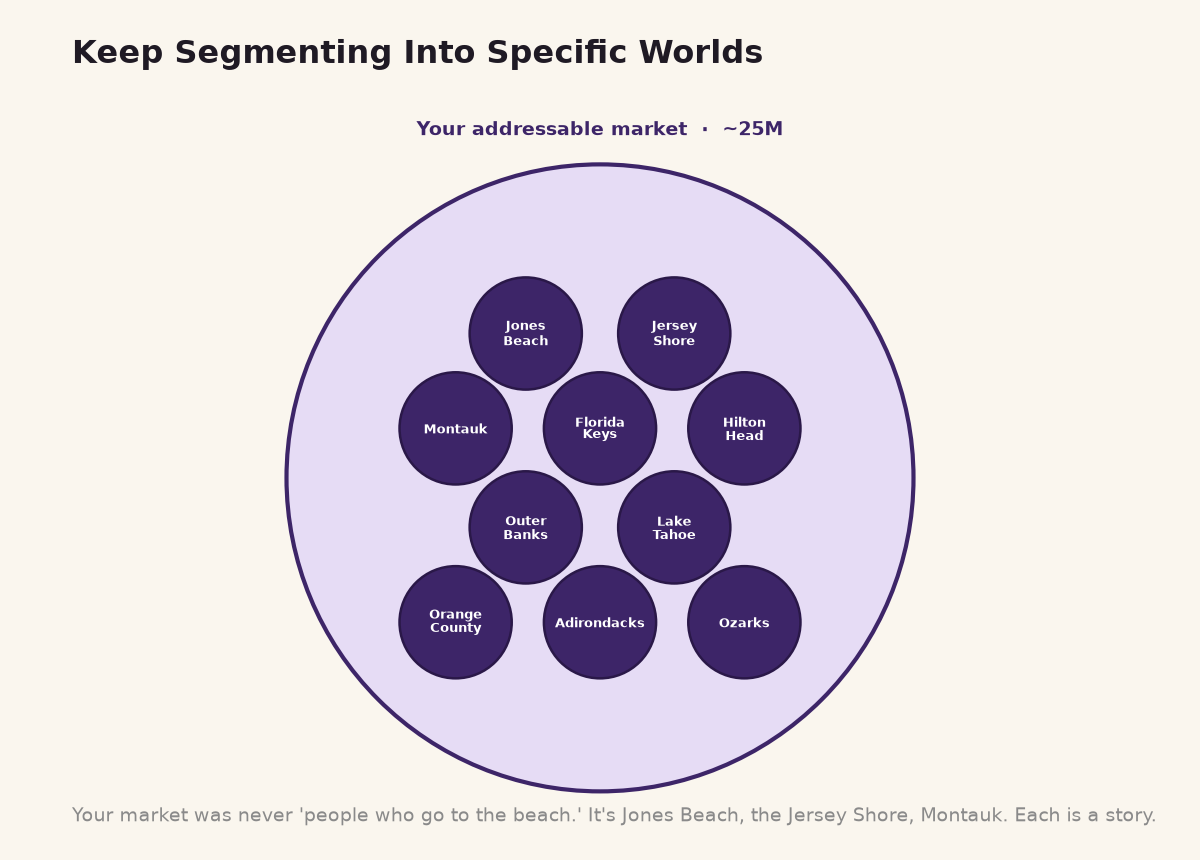
A warning about that drilling down, because most marketers take it in exactly the wrong direction. When we hear "get more specific," the instinct is to pile on demographic and psychographic detail until we've built the perfectly specific buyer persona, so the mother-of-three ad becomes an ad for the 45-year-old mother of three who votes Democrat and loves college football. You end up with a more detailed template, not a better ad.
The real opportunity is to find your target audience and tell a story that resonates with them. I have almost nothing in common, demographically, with a 45-year-old mother of three. But I would absolutely feel her journey across that Jones Beach parking lot. That's what UGC does at its best: it establishes an early adopter narrative arc that emotionally resonates with a diverse group of people.
And that's how you cross the chasm. The pragmatic majority doesn't need to match the person on the screen. They need to recognize the world on the screen, feel that your product already belongs in it, and conclude that it belongs in theirs too.
Most UGC fails because it's used as a lazy shortcut—a way to fill the feed without making anything worth watching. Used well, it's the opposite. It's how you manufacture the halo that makes a cautious majority feel confident enough to choose you, and you do it without paying for Coca-Cola's reach. So stop making the mother-of-three ad. Find the drive down the Wantagh, the walk past the Wawa, the train out to Montauk, and tell that story instead.
I go deep on all of this in Never Always, Never Never. Chapter 15, "The Emotional Edge," is all about how emotion actually moves buyers and how brands make the leap from the early crowd to the mainstream. Order your copy on Amazon today.