
A few weeks ago I was reviewing a Meta ads account for a golf equipment brand. The account was struggling. It wasn't hitting its performance goals, and the campaigns were nowhere near as profitable as the brand wanted them to be.
Meta bills on CPM (cost per thousand impressions). For a conversion-optimized campaign selling clubs and gear that run a few hundred dollars a pop, I'd expect a CPM somewhere north of $30, and before I logged in, that's what I assumed I'd find. Instead it was around ten dollars. We were reaching what looked like our exact target audience for a third of what I expected to pay.
You'd think that would be good news. It was a red flag.
The click-through rate was strong, close to 5%, so people were seeing the ads and clicking. But the conversion rate (CVR) was on the floor. Put those two facts next to a suspiciously cheap CPM and the picture gets clear fast. In advertising, higher-quality traffic almost always costs more to reach. When the price of an audience collapses, it usually means the audience got worse. We weren't getting a deal. We were buying cheap eyeballs from the wrong audience.
Here's what made it dangerous. Every other number in that account was visibly ugly. Conversion rate, return on ad spend (ROAS), average order value (AOV), all clearly underwater. The cheap CPM was the one metric that looked like it was working in our favor, like our dollars were stretching further than we'd forecast. It was the single bright spot, and it was the thing quietly holding the whole account back.
That's what happens when you read one number on its own. And reading numbers on their own is how most people run their advertising.
Last week I wrote about the 95/5 rule: at any moment, only about 5% of your market is actually shopping. Everyone in performance marketing, all of us running Google Ads, Meta Ads, and the rest, bids on that same 5%, and that's why clicks keep getting more expensive. The 5% is where the money is today. The 95% is where the long-term profit lives.
In last week's issue I made the case that reaching the 95% isn't a branding indulgence. It's what lifts your conversion rate later, because the people you warmed up while they were out of market convert far better once they fall into the in-market 5%. That quietly changes the economics of what's even possible in your performance campaigns. This week I want to go one level down, into the actual levers you turn to make any of it work.
Ask most advertisers what matters most in an ecommerce account and you'll hear the same three numbers: total spend, total revenue, and return on ad spend. Those are the numbers on every dashboard, in every client update, on every screenshot in every pitch deck. And for the person actually managing the account, they're close to useless.
ROAS is a scoreboard. By the time it moves, the game is already over, and it hands you the final score without a single second of the game film. It tells you efficiency was down 15% this week. It never tells you why. There's no instruction buried inside it, no next move, nothing you can grab and pull. It's the most reported number in our industry and the least actionable.
The numbers I actually watch sit one level below that:
- Total sessions
- Cost per session
- Average order value
- Conversion rate
Three of them multiply into revenue, since sessions times conversion rate times average order value is your top line, and cost per session prices the whole thing. Move any one and revenue moves with it. But these four tell you which one moved. "Revenue went down" is not a story. "Sessions held, conversion rate held, but average order value slipped" is a story, and a story is something you can act on.
Better yet, it's a story you can see coming. Keep your finger on the pulse of these four and you can call a ROAS move before it ever lands in your account. More importantly, you can act while it's still on the way, and change where it lands, instead of explaining it after the fact.
Go back to that golf account for a second. Of these four, three looked like the problem: sessions were light, conversion rate was poor, and average order value was well below where it should have been. Cost per session was the only one that looked healthy, precisely because the traffic was so cheap. Turn the model on its head, though, and that cheap cost per session wasn't the bright spot in spite of the other three. It was the reason for them. The low cost was the red flag that explained why nothing else was pulling its weight.
Cost per session (CPS) is the one almost nobody tracks, and I'd argue it matters most.
It's your total ad spend divided by every session your site gets, not just the ones you paid for. That denominator is the whole point. Free and cheaper traffic, from organic search, direct visits, word of mouth, email, and brand searches, spreads the cost of your expensive paid traffic across a much larger base. The more visitors who arrive through channels you didn't have to buy, the lower your blended CPS, and the more you can afford to pay for the paid clicks that remain.
Which leads somewhere strange, coming from a guy who runs a performance marketing agency: over the long term, nearly every brand should be working to become less reliant on paid advertising. I mean it. When I see a client pulling 60 or 70% of their traffic from paid sources, I don't see a healthy account. I see one that's dangerously exposed to a market that only ever gets more expensive.
Picture two brands selling the same product at the same price, bidding on the same clicks. For Advertiser A, 70% of site traffic comes from paid. For Advertiser B, only 30% does, and the rest arrives free. Even if their conversion rates are identical, B's blended CPS is far lower, which means B can bid higher on the exact same click and still come out ahead.
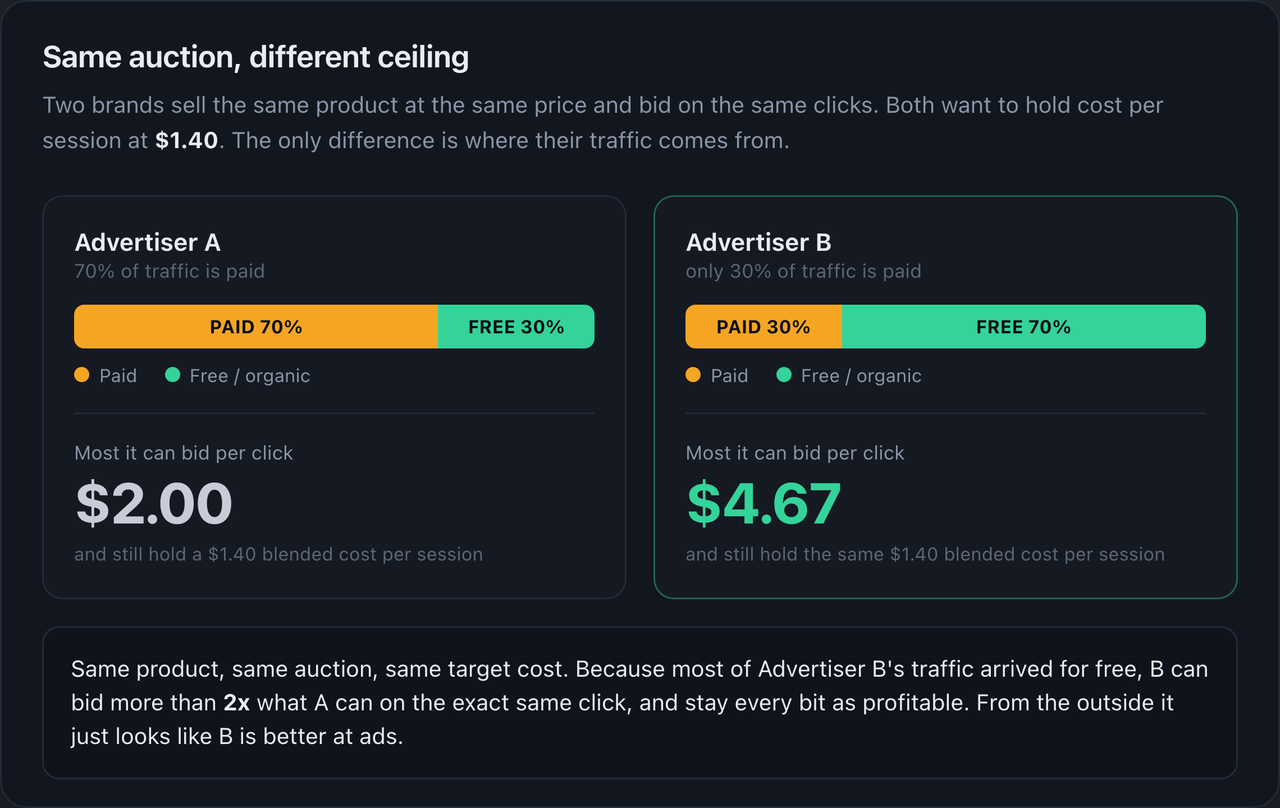
B outbids A all day and banks more profit per sale while doing it. From the outside it looks like B is just better at running ads. B is better at everything that happens before the ad.
None of this is a pitch to go start an SEO program. It's a mix of SEO, organic social, PR, and the kind of broad brand advertising and CTV that gets people searching for you by name later. Do that work and two things become true at once: you get less reliant on paid, and the paid dollars you do spend go further. Ideally both keep climbing in absolute terms. That's how you buy market share profitably instead of renting it.
When CPS climbs, it's usually one of three things:
- Your clicks got more expensive.
- Your share of free traffic shrank.
- You moved budget into pricier channels.
That last one bites people quietly. You can run a balanced plan across search, Meta, YouTube, and organic at about a dollar a session, then pull all the upper-funnel money into bottom-funnel Google Search and watch your CPS jump to four dollars overnight. There's no target number to hit here. What matters is that CPS is a leading indicator. A shift shows up here before it ever reaches your ROAS or your revenue, which gives you room to react while you still can.
Conversion rate is where our industry completely lost the plot.
Somebody sees a low conversion rate and immediately reaches for the CRO playbook that's been popular for fifteen years: test the button color, rework the form fields, redesign the checkout, move the trust badges. Some of that has its place. Most of it has been commoditized into oblivion, and a website that lets a motivated person buy the thing is mostly fine. Put simply, if you're an ecommerce brand running a modern Shopify template, you've already checked just about every CRO box that actually matters.
In reality, conversion rate is mostly decided by forces much bigger than your checkout layout. Three of them:
- The quality of your traffic.
- Competition, which is really just supply and demand.
- The value of your offer, which runs through the most overlooked of the four Ps: product.
Competition you mostly can't control. When more rivals crowd the auction, your conversion rate drops. Demand runs the other way: it surges in Q4, which is why most advertisers see their conversion rate jump over the holidays. The offer, though, you can control. Do you have product-market fit? Is the value obvious and easy to understand?
A lot of what gets diagnosed as a conversion-rate problem is really an offer problem wearing a disguise.
Of those three, the two you actually control are the quality of your traffic and the strength of your offer. Which brings us back to the golf brand and its ten-dollar CPM. Strong click-through rate, weak conversion rate, a bargain price: the signature of good clicks from the wrong people. My goal was never to pay more per impression — it was to reach a better audience, and a better audience almost always costs more. So we've spent the last couple of weeks tearing up the targeting, fully expecting our CPS to rise, because a more expensive session that converts beats a cheap one that never will.
That leaves average order value, which moves on three things: your price, your cross-sell and upsell, and which products you actually put budget behind. The third one sneaks up on people. You'll watch AOV drop and go hunting for a reason, and it turns out your Advantage+ or Shopping campaigns quietly started favoring your cheaper SKUs. You weren't selling less per order because of the market. You were advertising the discount rack.
Put all four together and every ecommerce account decomposes the same way.
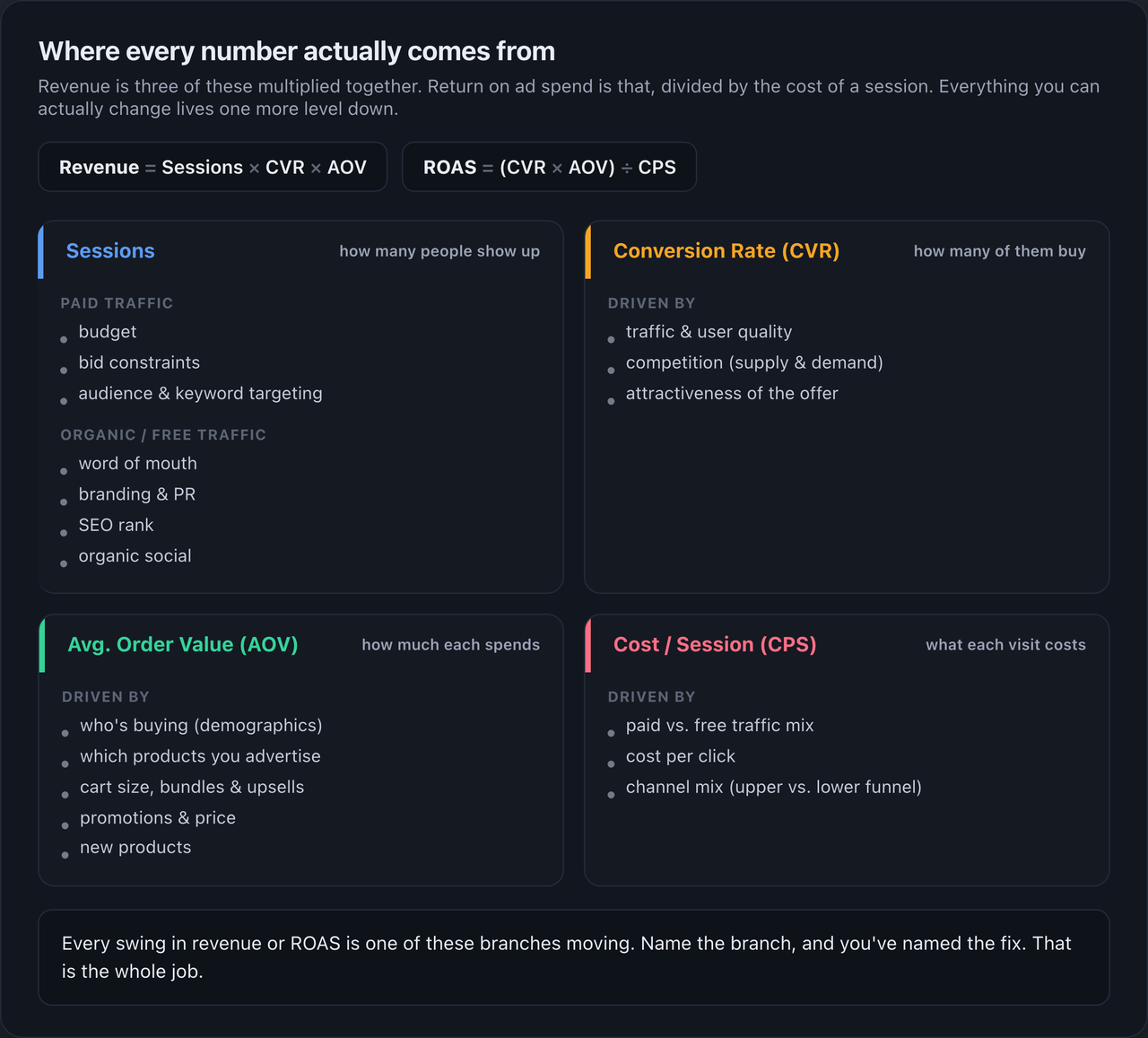
That's the whole map. Revenue is three of these multiplied together, ROAS is that divided by the cost of a session, and every result you'll ever stare at is one of these branches moving. The skill isn't watching the top-line number. It's knowing which branch it came from.
Here's how we actually look at an ecommerce account.
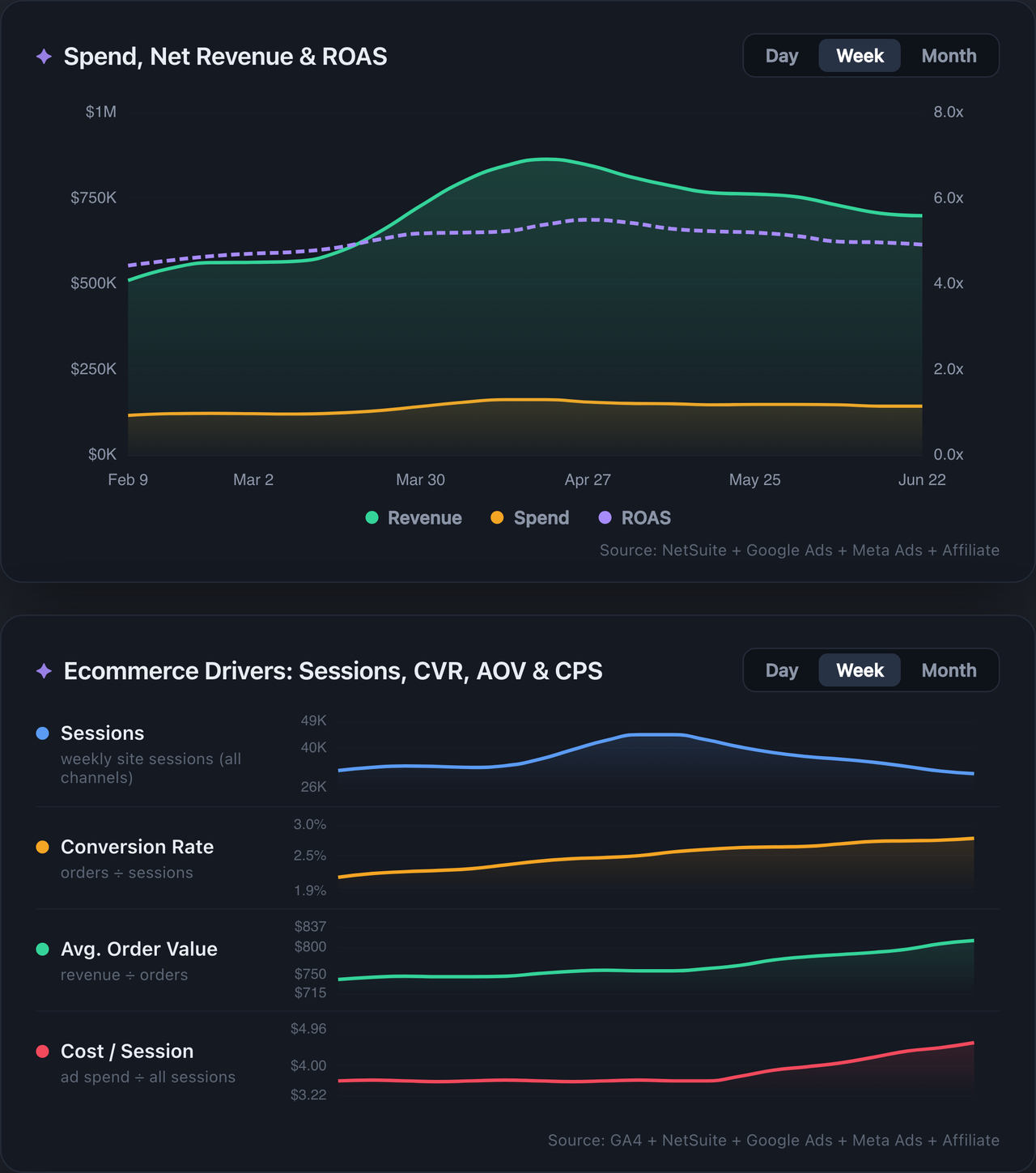
Not one number, and not a period-over-period delta that a single strange week can distort. The full timeline, with all four drivers laid out beneath the top line so you can watch them move. Early in this stretch, ROAS climbs. Look underneath and you can see why: conversion rate is rising while the cost of a session holds flat. Then it rolls over and falls, and underneath, the story has flipped. Conversion rate has leveled off, and CPS is climbing hard. Same account, same chart, two completely different stories a few weeks apart, and you can read which is which before anyone runs a report. I don't think most advertisers have ever looked at their account this way, and it changes what you notice.
Then, because performance is never one thing, we go a step further.
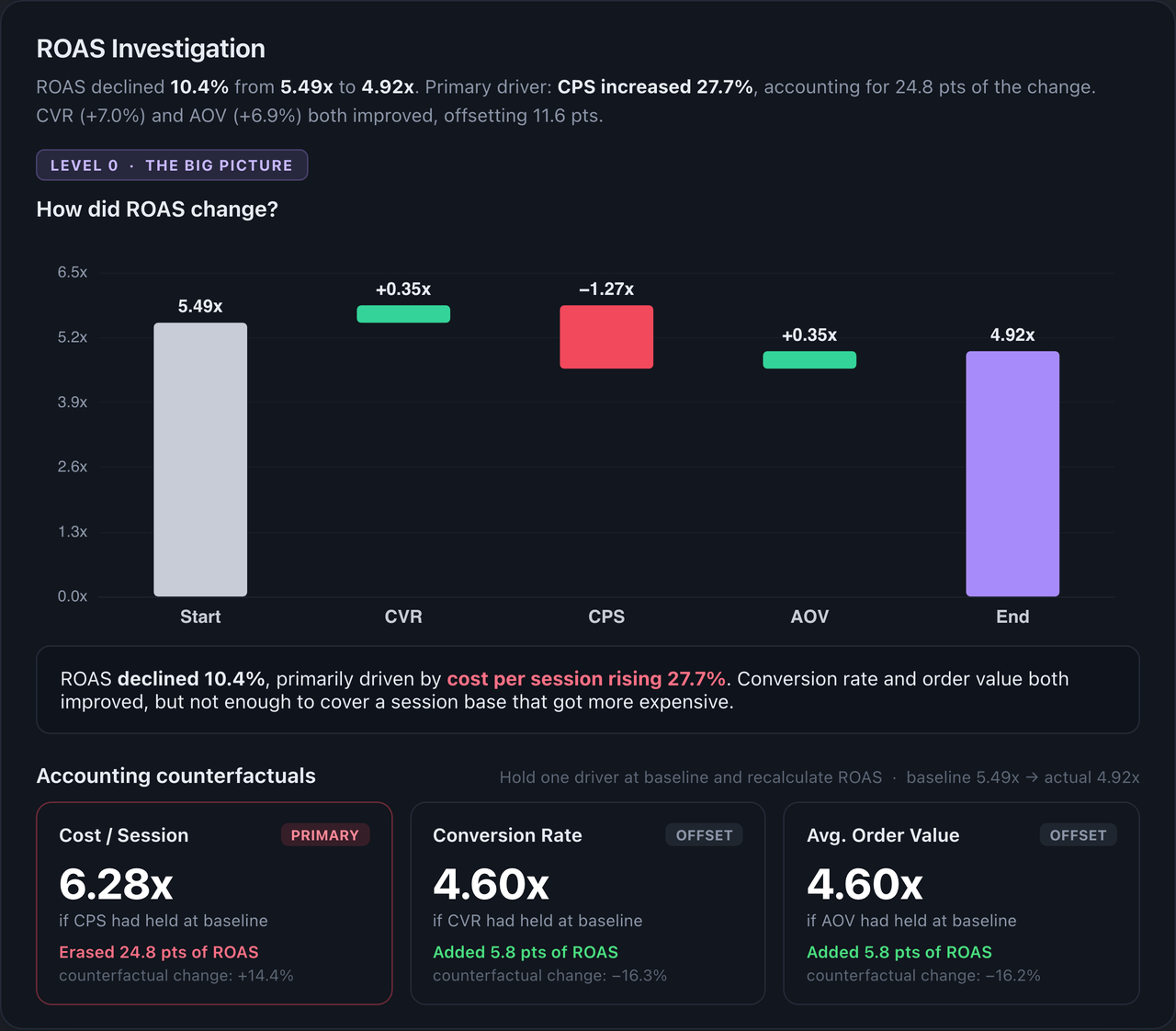
This zooms in on that decline. ROAS fell about 10%, from 5.49 down to 4.92. The analysis holds each driver at its baseline, one at a time, and recalculates what would have happened. Conversion rate actually helped. Average order value actually helped. The entire decline traces back to a single input: CPS rose almost 28%. That's the whole story. It's never just one thing, but it's usually one thing that outweighs the rest, and now you know which.
And knowing which tells you what to do. This isn't a creative problem or a bidding problem, so the fix isn't inside the ad account at all. It's the media mix. You go find cheaper sessions: lean into retargeting, or fund the upper-funnel and brand work that generates organic demand, until the blended cost of a session settles back down to where the rest of the account can carry it.
Compare that to the reflex. Most performance marketers see ROAS down 15% and reach for the same tired playbook. In Google they cut the budget or crank the ROAS target. In Meta they decide the creative's gone stale and queue a refresh. Sometimes that's the right call. Usually it's a guess dressed up as a decision, aimed at the wrong part of the machine entirely. You can't see the real cause on the scoreboard. You can only see it in the film.
The real payoff shows up when you stop reacting and start planning.
Once you can see the four drivers, the question changes from "what do I change this week" to "over the next quarter, which of these can we actually move." Maybe there's room to bundle and cross-sell toward a higher AOV. Maybe the traffic quality is soft and the answer is better channels, not more of the cheap ones. Maybe CPS is the ceiling, so you start building repeat visits, organic reach, and the kind of upper-funnel brand lift that pulls people back on their own. Do that upper-funnel work well and you move two things at once: brand lift lowers your CPS, and the repeat visitors it brings tend to convert better too.
That's where performance optimization belongs in 2026. Not in the belief that one more Google campaign structure is the thing standing between you and profitability. That answer is narrow, it's fifteen years old, and it ignores nearly everything that decides whether the math actually works.
And keep in mind which slice of the market this is. These four numbers are how you win the 5% who are ready to buy today, the exact people every competitor is bidding against you for right now. Last week was the argument for feeding the 95% so more of tomorrow's buyers show up already knowing you. This is the other side of the same coin: when they do show up, this is how you convert them without lighting money on fire. Play both and the whole machine compounds.
ROAS tells you whether you're winning or losing. It will never once tell you why. And why is the only thing you can actually change. I've watched too many good marketers spend years chasing that one number, wondering all the while why the game never got any easier.
Personal Carve Out: Say yes to the awkward event
I'm writing this on an Amtrak down to Baltimore, under an orange, smoke-choked sky that looks like the end of the world. I'm on my way to a wedding, which is a cheerier thing than the sky suggests.
A few weeks ago, in Issue #2, I told you how a handful of lucky breaks at Penn State rerouted my entire life. That issue was really about buyer personas, but I snuck in a personal story: a club lacrosse team I almost didn't join, which led to a student philanthropy, which led to a career, my closest friends, and eventually my wife.
This weekend I get to see a few of those people, the ones I rarely see anymore. Jamie is the one getting married. He was our goalie, and was (and still is) the nicest guy on the planet. I'll also see Elliot, who is the reason I walked onto that lacrosse team in the first place. And Michelle, the fundraising chair for the women's team, helped pull the whole group together, which is a subtle way of saying she's a big reason I met my wife.
My favorite line in the Penn State alma mater goes: "When we stood at childhood's gate, shapeless in the hands of fate, thou didst mold us, dear old State." I've never thought it was really about the school. It's about the people you happen to be standing next to when it counts. Chance encounters and one-off conversations that often change the trajectory of your life.
And it doesn't stop at college. A late-night pub conversation in Dublin in 2019, with the emcee of the Google Premier Partner awards, gave me the confidence and conviction to write my first book. A similar experience at a conference in Amsterdam in 2021 shaped the second. In 2015, torn between a safe job on a big software marketing team and a strange little startup called AdVenture Media, I took advice from a friend of a friend of a friend I have still never met in person—a guy I know only as "Chard." He told me to take the risk. He was right.
Almost every one of those turns came out of a conversation I badly wanted to skip. Introducing yourself to a stranger at a conference is uncomfortable in the exact way that being one of a hundred mediocre freshmen at lacrosse tryouts was uncomfortable. The good stuff was on the far side of that feeling every single time.
We often need to be reminded to say yes to the in-person stuff, especially the awkward version, because the best turns of my life all came out of rooms I almost skipped. And just as important: reach out and tell the people who shaped you that you appreciate them. If that feels like too much, just send them the song "All Your Favorite Bands" by Dawes and tell them it made you think of them. They'll understand.
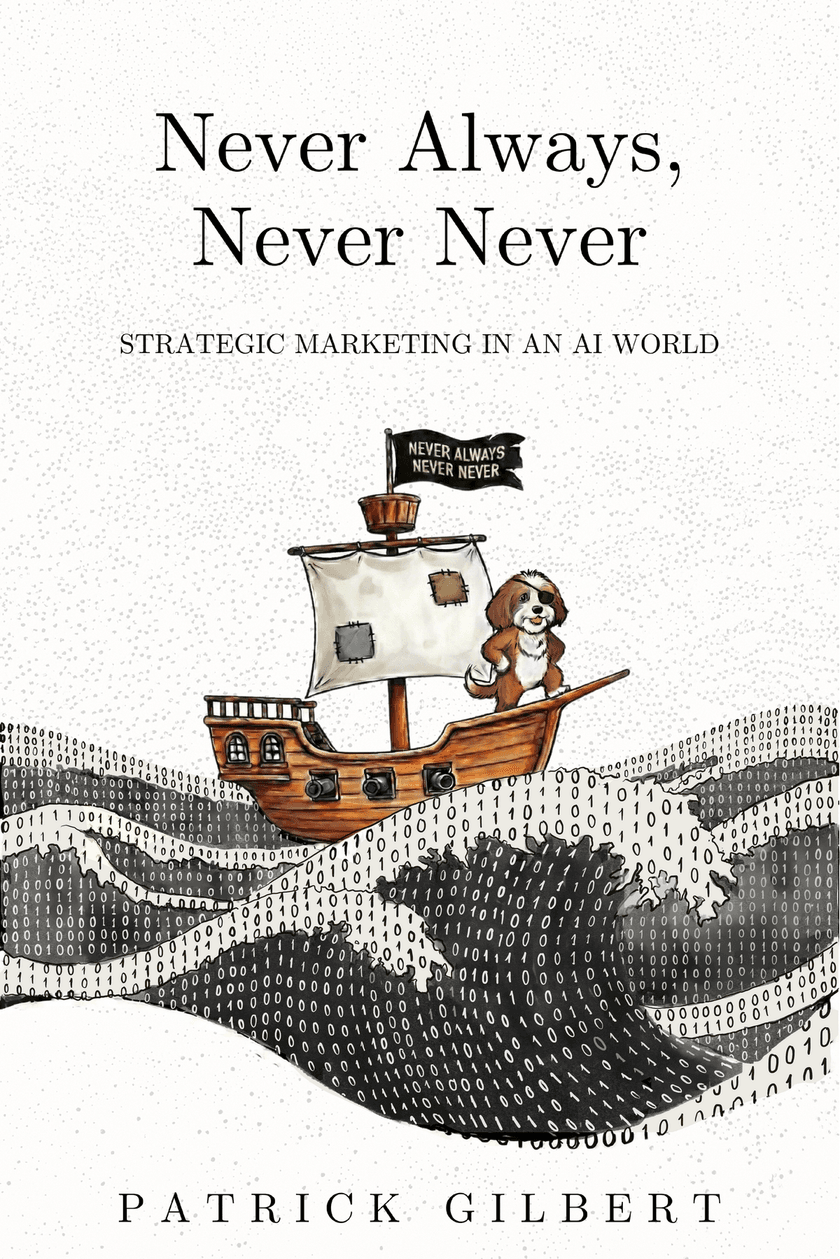
I go deep on the economics of all this, why revenue is a probability game and why no single metric ever tells the whole story, in Never Always, Never Never, on Amazon in paperback and Kindle. If you've read it and it landed with you, a quick review helps more than you'd think.