The Jingle Renaissance of 2026
I never owned the board game Mouse Trap.
But the commercial ran constantly when I was a kid in the 1990s, and the song was so catchy that I can still recite every word of it, in order, along with the melody. Three decades later, that song still lives in my brain rent-free.
If you watched any of the ads in last week's issue, you might have noticed that a lot of them have custom songs. The MitoGrow spots are a chorus of singing plants. The second Glitter Stix ad is a full musical. The Augusta Lawn Care spot is a rock song about a landscaping company.
Even the Exotic Nutrition ads, which don't have a song running underneath them, are full of sound we placed deliberately: the crunch of a sugar glider digging into its food bowl, the host's Southern drawl, and a short little jingle on the title card at the very end. Even when we aren't using music, we're thinking hard about the sound effects, the voiceovers and any melody that shows up inside the creative.
That was on purpose. We have been leaning hard into sound, because I think it is one of the most overlooked elements of marketing strategy right now, and that makes it one of the biggest opportunities.
For most of my career, sound was an afterthought.
When I started working in digital advertising, the overwhelming majority of social video was watched on a phone with the sound off, because nobody wanted their phone blaring an ad on the train or in line at the coffee shop.
In 2016, big Facebook publishers told Digiday that about 85% of their video views happened without sound. This was such an obvious phenomenon that Facebook introduced automatic captions for video ads that same year.
So the industry adapted. Captions became mandatory, every ad had to make sense on mute, and the visual hook in the first few seconds became the thing everyone obsessed over.
Music, meanwhile, became the last box you checked, if ever. You'd finish the edit, find a royalty-free track to lay underneath it and upload it to the ad account.
Voiceovers got the same treatment. In most creative meetings I've sat in, the only conversation about the voice comes down to one question: should it be a man or a woman? Almost nobody asks what kind of personality the voice should have, what accent it should carry, how the inflection should rise and fall, or what kind of energy the narrator brings into the room.
As it turns out, the man-or-woman question matters less than people think. A 2017 study in the Spanish Journal of Marketing played radio ads for 987 listeners and found that the pitch of the voice had a bigger effect on whether people remembered the ad than whether the voice was male or female.
That was 10 years ago.
Times have changed. The problem is that most advertisers didn't.
Notably, people started listening to ads! In the AirPods era, short-form video became a sound-first medium. Adam Mosseri, the head of Instagram, said in 2024 that around half of all video impressions on the platform are viewed with the sound on. Resourcera's 2026 roundup of Instagram Reels statistics puts it higher, at about 80% of people watching Reels with the sound on.
And yet most ads are still made as if it were 2016.
When the research firm Ipsos analyzed 2,015 US video ads, only 8% of them used any kind of audio asset, like a jingle or a sonic logo (the short signature sound at the end of an ad, like Intel's five-note bong).
In the 1970s, a brand's jingle was one of the most valuable things it owned.
State Farm's "Like a good neighbor" jingle debuted in 1971. Barry Manilow wrote the music for a flat fee of $500, and the company is still using it more than half a century later.
In my book I wrote about Safelite, the auto glass repair company. Their jingle is about as simple as it gets: "Safelite repair, Safelite replace." Four words, sung with a cadence that rises and then falls like an exhale, a sigh of relief.
The copy itself is not clever or sentimental. And yet, every time you hear it, you feel a tiny sense of reassurance that your problem will be taken care of. Safelite has been running some version of it since 2007.
I grew up on Long Island, where P.C. Richard & Son, the regional appliance chain, has a whistling jingle that anyone who grew up around New York can probably whistle back to you. In the early 2000s they struck a deal with the Yankees so that every time a Yankees pitcher threw a strikeout, the P.C. Richard whistle played throughout the stadium.
Fans came to tie that sound to the joy of a strikeout, so they likely have a more positive feeling about the brand without ever knowing why. To this day, P.C. Richard still "owns" Yankee strikeouts.
And then there is Kars4Kids, a former client of ours. Love it or hate it (and plenty of people hate it), you can probably sing it. That jingle started running on New York radio in 1999, and it made Kars4Kids the best-known name in car donation.
When they brought us in, a big part of the job was helping them diversify into digital, because so much of the organization was still being carried by that one radio spot. A good jingle can set you up for decades.
Each of these is a distinctive brand asset, which helps build mental availability, the likelihood that your brand comes to mind at the moment someone is ready to buy. (I wrote about mental availability in Issue #7, the one about Disney.)
Sound may be the strongest asset of all. In that same Ipsos study, ads with an audio asset were 3.44 times more likely to be top performers, meaning people noticed the ad and remembered who it was for. Ads with a visual asset were only 1.15 times more likely. Jingles and sonic logos scored the highest of any asset in the study, ahead of characters, celebrities and logos.
So if jingles work, why did everyone stop making them?
My assumption was that they peaked, got overdone and stopped working. But I can't find any evidence that jingles stopped working.
The only reasons I can find are about taste. Jingles started to sound corny and old-fashioned to younger audiences, borrowed pop songs felt cooler, stock music was cheaper, and then the sound-off era made the whole question seem irrelevant.
In other words, the industry got bored. The pendulum swung so far in one direction that every brand had a jingle, and then it swung so far back that almost nobody does.
The lesson most marketers took from that is that jingles are corny. I think the better lesson is that when every brand has a jingle, none of them stand out, and when almost no brand does, the few that do are impossible to miss. (Never always, never never.)
Think of all the brands you know that were founded in the last 15 years. How many of them can you hum?
I've thought about this a lot, and I'm sure some exist, but I can't name one. That's the point.
The YouTube factor
According to Nielsen, YouTube is now the most-watched streaming platform on American televisions, ahead of Netflix, Disney+, Hulu, Peacock and every broadcast network. In July of this year, 14.2% of everything Americans watched on a TV came through YouTube.
People get confused by this, so let me clarify the difference between YouTube and YouTube TV. YouTube TV is the paid subscription that replaces your cable package. I'm talking about YouTube, the creator platform with the cute videos of cats. That platform is the number one streaming platform on TV screens in the US.
In spite of all that, advertising on YouTube is cheap. Putting your ad on 70-inch TVs in living rooms across America, on the number one streaming platform, costs less than advertising on Instagram.
And because they're TV ads, people don't skip them, and they watch them with the sound on.
I'd encourage you to pay attention to the YouTube ads you see over the next week. You'll likely notice that very few of them put any thought or effort into music, sound or jingles. And you'll realize how easy it would be for your brand to stand out among all that laziness.
For most of the brands we work with, that opportunity used to be completely off the table.
If you were a small or mid-sized company and you went to an agency asking for a polished TV commercial with an original jingle, you assumed you were looking at a six-figure project before you spent a single dollar on media. Safelite and State Farm could afford that, but a bootstrapped startup like MitoGrow never could.
Thankfully, AI now lets talented people make that kind of work at a fraction of the cost. That opens the door to a renaissance of quality advertising that is no longer reserved for brands the size of Safelite.
The audience turned the sound on years ago. Most advertisers are still making ads for people on mute.
The brands that take sound seriously now will have that space almost to themselves, and with any luck, someone will still be able to sing their ad 30 years from now, the way I can still sing a commercial for a board game I never owned.
Introducing AdVenture Plus This week we launched AdVenture Plus, the platform for ongoing AI training. Twice a month, you sit in live while we work: building agents from a blank folder, breaking down new AI models the week they drop, and showing you the tools and prompts we run our own agency on. Every session is recorded. The first live session is Friday, October 9 at noon Eastern. We'll build a working AI agent from scratch, live, in an hour. Members also get the Agent Context Kit, our tool for teaching your AI assistant how you work and write, plus 50% off every public workshop we run. The month of October is free. Sign up today and keep building your AI skills with us. |
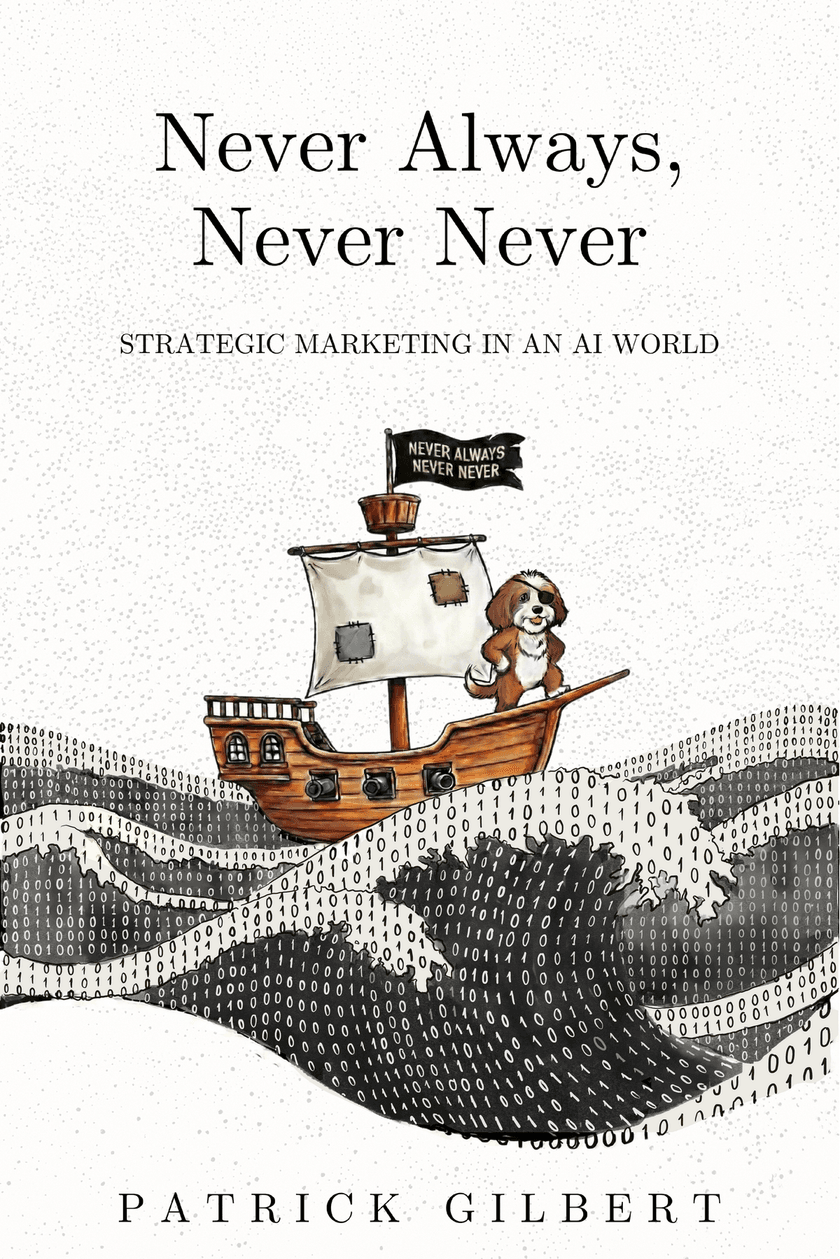
Safelite's jingle shows up in chapter 15, on emotional advertising. Kars4Kids is in chapter 14, on being distinctive, and the P.C. Richard whistle is in chapter 3. Prefer to listen? The audiobook is on Spotify and Audible.
One more thing
A jingle is a distinctive asset you can hear. This is the story of one you can see: the dog on the cover of my book.
Why I Put a Dog on My Book Cover: A Marketing Lesson in Distinctive Assets · 4:47
I put new videos up on YouTube most weeks. Subscribing there helps more than you'd think.