Every Marketing Rule Has an Exception. Here's How to Find Yours.

Google's Display Network is expected to record its third consecutive year of declining advertising revenue in 2025, even as global advertising spending approaches $1.19 trillion. The rule that "digital advertising grows" is true in aggregate. It just isn't true for every digital format.
That gap between the rule and the reality is where most marketing strategy goes wrong.
Marketing rules of thumb are not wrong. They are averages. And averages conceal the conditions under which the opposite strategy outperforms. The discipline of marketing strategy is not memorizing the rules. It is knowing when your situation is the exception.
At the core of Never Always, Never Never: Strategic Marketing in an AI World by Patrick Gilbert sits exactly that idea. Drawing on a compressed, high-stakes brand-building engagement, the book shows what happens when you stop treating rules as fixed and start treating them as testable hypotheses. The lesson runs through every chapter: reject rigid prescriptions, embrace context.
The Rules Are Descriptions, Not Laws
Most marketing rules of thumb describe what happens on average across a broad sample of brands, categories, and campaigns. This is their value. It is also their limitation.
Take the 95-5 rule, associated with the B2B Institute and the Ehrenberg-Bass Institute. It describes the idea that most potential buyers in any category are not actively in-market at any given moment. The strategic implication is that brands should invest in mental availability before buyers enter the market, rather than focusing exclusively on capturing existing demand.
Solid principle. Genuinely useful. And also not universally applicable.
A company with constrained cash flow, a short sales cycle, and a highly measurable inbound opportunity may rationally prioritize activation over long-term brand building. Conversely, a brand selling infrequently purchased, high-consideration products may need years of broad mental availability investment before performance media can work efficiently. The 95-5 framework applies differently to both situations. Using the same allocation for each would be a mistake.
Similar logic applies to the 60:40 framework. Les Binet and Peter Field's research has been interpreted as supporting a roughly 60:40 balance between long-term brand building and short-term activation. Mark Ritson has acknowledged that the research faces methodological criticism while arguing its overall direction remains sound. What often gets lost in the popularization of this framework is that the appropriate split depends on brand size, category purchase frequency, current penetration, growth ambition, competitive intensity, and measurement horizon. A challenger brand with weak awareness needs a different mix than a mature brand with strong memory structures. A seasonal retailer shifts heavily toward activation before a major selling period and pulls back afterward.
As a starting point, the 60/40 rule is useful. It is not a policy.
When Platform Rules Break Down
Channel-level rules are particularly fragile. Aggregate growth of digital advertising does not guarantee growth for every digital format, every advertiser, or every campaign objective.
Alphabet, Amazon, and Meta were forecast to account for 56.1% of the advertising market excluding China in 2025, rising to 58.0% in 2026, according to WARC. That concentration creates a misleading impression that platform-wide benchmarks are universal. Performance inside any of those platforms varies by campaign objective, creative format, audience maturity, first-party data quality, conversion volume, product category, attribution method, and auction competition.
Google Display declining three years running while overall digital advertising grows is a clean example. "Be where digital is growing" doesn't tell you where inside digital. Channel labels are too broad to be strategically useful. "Digital" contains search, retail media, social video, connected television, display, creator media, and emerging AI interfaces. Each has different supply, demand, measurement, and pricing dynamics.
Automation rules face the same failure. Meta's investment in products like Reels and Advantage+ has driven continued advertiser demand, and automated campaign systems can outperform manual approaches when an advertiser provides sufficient conversion data, strong creative variation, and a large enough audience. But automation is not automatically superior. It underperforms when conversion volume is low, when the product has a long offline sales cycle, when tracking signals are incomplete, or when the objective is difficult to reduce to a short-term conversion event. "Let the algorithm decide" works best when the algorithm has enough reliable feedback to work from. When it doesn't, the algorithm optimizes toward the wrong signal with considerable confidence.
None of that is a reason to distrust automated platforms. It is a reason to understand the conditions under which they thrive and the conditions under which they don't. The distinction between AI bidding and manual control matters precisely because neither is universally correct.
The Grown Brilliance Case: Rules That Should Have Stopped Everything
Patrick Gilbert covers what happens when you reject the rules in Never Always, Never Never, drawing on the launch and growth of Grown Brilliance, a lab-grown diamond brand built from scratch.
By conventional standards, the strategy should not have worked. Lab-grown diamonds carried cultural stigma. Buying required consumers to spend thousands of dollars on something they'd only seen in photographs. The brand had no history, no reviews, and no physical presence. When people outside the company heard the concept, the near-universal response was: this will never work.
Conventional rules said to narrow focus to cost-conscious or environmentally minded buyers. The founder's bet was different. He believed lab-grown diamonds would go mainstream, not as a niche, but as a disruptive force. Building for the broad middle of the market, rather than the self-selecting early fringe, became the strategic foundation. Ehrenberg-Bass research supports this instinct: brands grow by acquiring more buyers across the market, not by deepening loyalty within a narrow audience. Treating a small, defined niche as the addressable market caps growth before it starts.
Timing rules also pointed the wrong way. Rather than pulling back when short-term ROAS softened, the brand increased advertising investment during one of the slowest periods in the jewelry calendar. The strategic logic was that competitors would retreat, CPMs would fall, and share of voice would be available at a discount. That excess share of voice opportunity was worth more than short-term efficiency. By absorbing attention while the market was quiet, the brand built mental availability for buyers who weren't yet shopping.
Short-term ROAS suffered. Market position strengthened. The book makes the case that those two outcomes are not contradictory. They are what long-term strategy looks like while it's working.
One other rule the brand's approach violated: "distinctive assets matter more than differentiation in commoditized categories." Ehrenberg-Bass Institute research challenges the assumption that meaningful differentiation is always the main driver of brand growth. But Grown Brilliance operated in a category where the actual product is chemically identical to what incumbents sell. Strategic emphasis fell on luxury positioning, pricing power, and emotional resonance through creative, not on explaining the technical differences. The product had a genuine difference. The brand was built on something the buyer could feel. Both mattered, and the mix required judgment, not a framework.
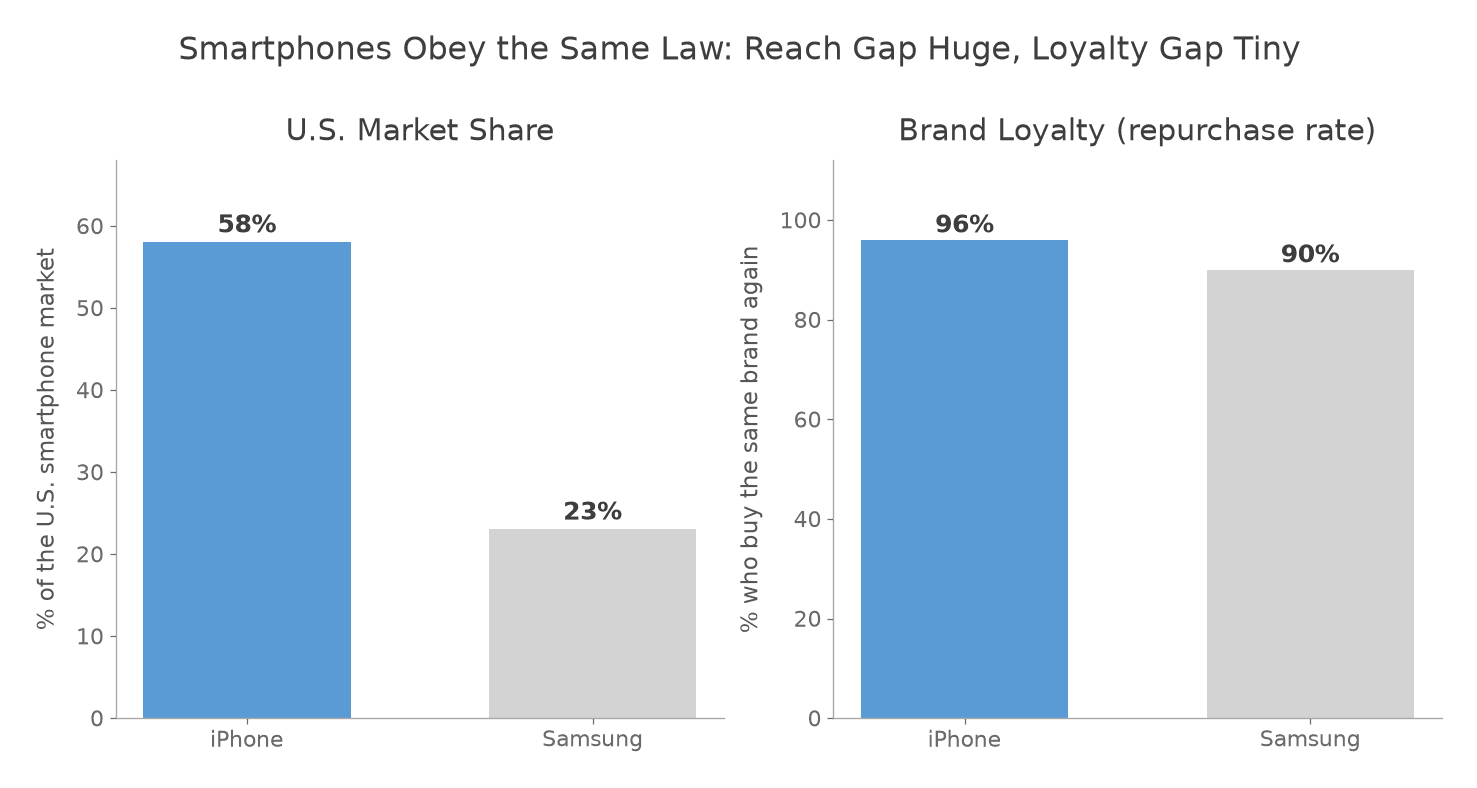
This is the double jeopardy law working as Byron Sharp described it. Small brands don't just have fewer customers; they have slightly less loyal ones too. The only exit from that trap is penetration, and penetration requires reach, not precision.
The Framework: Rules Plus Conditions
Most marketing rules fail not because they're wrong, but because they're incomplete. They describe the average effect without explaining the mechanism. Without the mechanism, you can't tell whether the rule applies to your situation.
Before applying any marketing rule of thumb, ask:
- What outcome was this rule designed to optimize, and over what time horizon?
- For which category and buying cycle was it originally observed?
- Was the evidence causal, correlational, or descriptive?
- Does your brand have the reach, data, and distribution for the rule to function?
- What would make the opposite strategy more appropriate right now?
- Can the decision be tested through a holdout, matched-market test, or controlled budget shift?
- What is the marginal return of the next dollar under this rule versus an alternative?
Rules fail in predictable ways, which is why this diagnostic matters. They confuse averages with mechanisms. They ignore marginal returns. A 60:40 split may be sensible at one investment level and inefficient after brand spending reaches saturation. They overlook strategic objectives. Right approach for awareness differs from the right approach for penetration, retention, revenue recovery, or category creation. And over time, they become organizational shortcuts: a benchmark that made sense in one market condition becomes a policy long after those conditions have changed.
Incrementality testing is one of the few tools that can tell you whether a rule is actually working in your specific context, as opposed to whether it worked on average in someone else's context. The score on the scoreboard matters less than whether your decisions actually caused the score to change.
Distinguishing strategy from tactics matters here too. A tactical rule, applied without strategic context, is just a default. And defaults compound over time into an organization that is optimizing toward the wrong thing with increasing efficiency.
What Broad Reach Actually Means in Practice
One rule that holds up under scrutiny, with appropriate conditions attached, is the case for broad reach in brand building. Ehrenberg-Bass Institute research consistently argues that brands grow through light buyers, not through loyalty programs or narrow segmentation. Mental availability, the ease with which a brand comes to mind in relevant buying situations, requires consistent exposure across a wide audience, most of whom are not actively shopping.
But even this rule has conditions. Broad reach makes sense for long-term brand growth. It is less efficient for short-term activation campaigns targeting buyers with identifiable intent. Mark Ritson's summary of Les Binet and Peter Field's work draws exactly this distinction: broad targeting is associated with brand building, while tighter targeting can improve efficiency for performance activity.
Practical conclusions here are not "broad" or "narrow." They are:
- Use broad reach to build future demand among buyers who are not yet identifiable as active prospects.
- Use narrower targeting when the buyer has measurable intent or a known relationship with the brand.
- Do not treat current purchasers as the entire addressable market.
That third point is where many brands get trapped. Most loyal buyers are already converted. Growth lives in the people who barely know you exist. At AdVenture Media, this tension between efficiency-focused performance campaigns and broader brand investment comes up in almost every serious strategic conversation.
The relationship between brand building and direct response is not an either/or question. It is a sequencing and proportion question, and the right answer changes as the brand matures.
Take the Rule, Find the Exception
Marketing rules of thumb are starting hypotheses, not conclusions. The discipline is in identifying when your situation diverges from the conditions that produced the rule.
Strong marketing advice is not a framework you apply consistently. It is a question you ask rigorously: does this rule apply here, and what would change if it didn't?
Answering that question honestly is the actual meaning of "never always, never never." Not that rules are useless. That rules are conditional. And the marketers who understand the conditions will consistently outperform those who follow the playbook.
For a deeper look at how to build the mental availability that makes broad reach compound over time, and how to measure whether it's actually working, the frameworks in the Ehrenberg-Bass body of work are still the most grounded place to start. Pair that with honest attribution and a clear-eyed view of your category's buying cycle, and the rules become tools rather than constraints.
 Patrick Gilbert
 is the CEO of AdVenture Media and author of Never Always, Never Never and the bestselling Join or Die. He has been ranked among the top 5 PPC experts worldwide and has delivered keynotes at Google events across three continents.
More about Patrick →Enjoyed this?
Subscribe for more articles on strategy, AI, and what's actually working in marketing.
No spam. Unsubscribe anytime.