Coca-Cola Has Run the Same Christmas Idea for Decades. That Is the Strategy.

"Holidays Are Coming" trucks first appeared in 1995. Coca-Cola has been running variations of the same idea ever since. That is not creative laziness. That is one of the most disciplined brand strategies in advertising history.
Most marketing commentary treats repetition as a warning sign. If you're running the same campaign year after year, surely you're leaving growth on the table? Surely consumers are tuning out? The evidence says otherwise. For Coca-Cola, the repetition is the point. Recognition is the return on investment.
What Three Real Trucks and 30,000 Light Bulbs Actually Bought
Producing the original 1995 spot was not a cheap shortcut. Three real 40-foot trucks, each weighing approximately two tonnes, were covered with around 30,000 light bulbs each and driven through a snowy landscape while the "Holidays Are Coming" soundtrack played. The creative structure was deliberately simple: quiet winter scene, a musical cue, glowing red convoy arrives, onlookers react with recognition and warmth.
That simplicity was strategic. Rather than explaining why Coca-Cola was better than Pepsi or making a product claim, the ad did one thing: it planted Coca-Cola at the center of a specific cultural moment. December arrives. The trucks arrive. Christmas has begun.
Reportedly, the campaign disappeared during part of the early 2000s, then returned in 2007. That gap is itself instructive. Even after years off air, the asset retained enough memory encoding that its return felt like a reunion rather than a relaunch. Generic advertising does not produce that effect. It only happens when an asset has been repeated enough times to become genuinely owned.
The Science Behind Repeating Yourself
Jenni Romaniuk at the Ehrenberg-Bass Institute has done the most rigorous work on what she calls distinctive brand assets: the non-name elements that help consumers identify a brand quickly and retrieve it in buying situations. Colors, shapes, sounds, characters, taglines, and advertising devices all qualify. Critically, these assets only become powerful through repetition across time and channels.
The Christmas system is a textbook example of how multiple assets work together:
- The red trucks create an ownable visual symbol that no competitor can easily replicate
- The "Holidays Are Coming" music functions as an audio retrieval cue
- Santa imagery, even partially shown, triggers the broader seasonal emotional network
- Snow and winter landscape anchor the occasion
- The contour bottle and Coca-Cola red connect everything back to the product
No single element carries the whole load. Power comes from co-occurrence. When you hear the music, you see the trucks. When you see the trucks, you feel December. When you feel December, you think of Coca-Cola. That chain of associations is not accidental. It was built through decades of consistent repetition.
Patrick Gilbert covers precisely this in Never Always, Never Never: the real challenge with distinctive assets is not creating them, it is sticking with them long enough for them to compound. Creativity matters, but without consistency, creativity does not compound.
Mental Availability at a Specific Buying Moment
Mental availability is the probability that a buyer will think of your brand in a buying situation. For most brands, most of the time, that buying situation could be almost anything. For Coca-Cola's Christmas campaign, the target is precise: the weeks of December, when consumers are buying soft drinks for gatherings, meals, and celebrations.
Byron Sharp's work at the Ehrenberg-Bass Institute describes how memory structures are built through consistent advertising that repeatedly connects a brand to specific category entry points. Coca-Cola's Christmas platform creates connections to a cluster of them simultaneously:
- Family meals
- Hosting gatherings
- Gift-giving occasions
- Seasonal entertainment
- Shared celebrations
Rather than simply signaling that Coca-Cola exists, the trucks signal that Coca-Cola belongs at Christmas. That is a meaningfully different kind of mental availability.
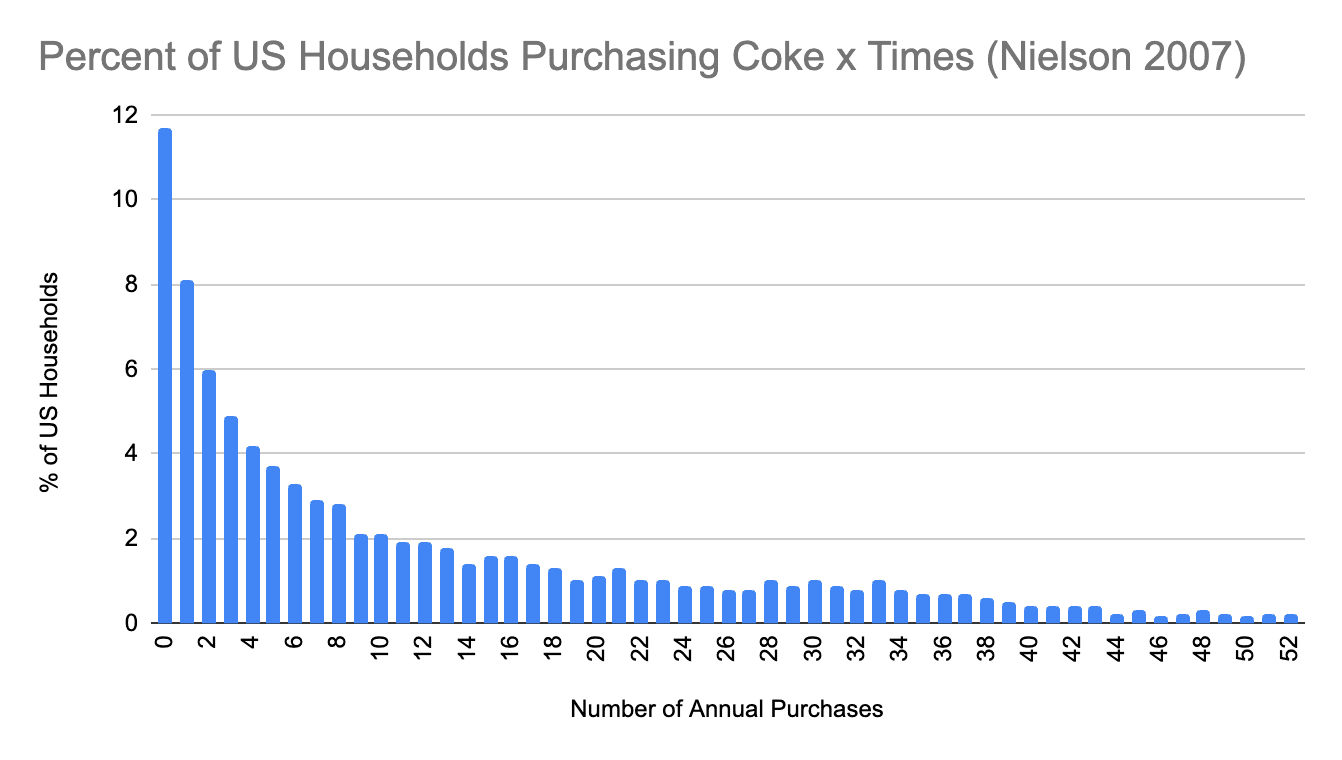
Light buyers are the campaign's primary audience. The Christmas campaign does not need to persuade them to switch from a competitor. It needs to make Coca-Cola the brand that comes to mind when December arrives and they are loading up a shopping cart for a family dinner. That is a much more achievable goal, and a far more efficient use of the company's substantial annual advertising budget. Most Coca-Cola buyers are light buyers, purchasing occasionally rather than every week, which makes this chart central to understanding the strategy.
The Santa Asset: Older Than the Trucks
Before the trucks, there was Santa. Haddon Sundblom began creating Santa illustrations for Coca-Cola in the 1930s, images of a warm, jolly, red-suited figure drinking Coca-Cola and visiting homes on Christmas Eve. Coca-Cola did not invent Santa Claus, but those illustrations helped cement the visual version of Santa that dominated the 20th century.
Strategically, Santa served the same function the trucks would later achieve: connect Coca-Cola with gift-giving, warmth, hospitality, and family gatherings. Coca-Cola was not advertising a product during December. It was inserting itself into the ritual.
Building a category entry point over generations creates unusually high barriers for competitors. And once a brand owns an entry point that deeply, the bar for execution rises accordingly. Which brings us to 2024.
The AI Controversy Is a Craft Problem, Not a Strategy Problem
In 2024, Coca-Cola released a 15-second generative-AI recreation of "Holidays Are Coming." The trucks were there. The music was there. Snow, the seasonal cues, even a suggested Santa presence via a red sleeve and white cuff. The strategic skeleton was intact.
Execution drew significant criticism. Viewers described the spot as soulless and lifeless. Media coverage pointed to unnatural-looking people, awkward movement, and visual glitches. Reduced visibility of Santa weakened a familiar cue that viewers had expected.
Coca-Cola's European CMO, Javier Meza, stated publicly that the company's initial brief was simply to bring "Holidays Are Coming" into the present. AI emerged as a possible production solution afterward. The company did not start with a mandate to use AI for its own sake.
In 2025, Coca-Cola used AI again despite the prior year's reaction. The campaign ran two executions: "Holidays Are Coming" and a U.S.-exclusive version called "Holidays Are Coming, Fantastical," which included AI-generated animals such as meerkats, rabbits, koalas, and raccoons alongside an AI Santa holding a Coca-Cola bottle. The company stated the spot tested well with average viewers, though no detailed methodology or numerical results were made publicly available.
Public criticism continued in 2025, again focused on the emotional quality and warmth of the execution rather than the underlying campaign concept.
Viewers who criticized the AI versions were not saying that Christmas trucks are a bad idea. They were saying that this version of the trucks did not feel the way the original did. That is a craft and production critique, not a strategic one. The asset system remained intact. The executional treatment fell short of the emotional standard that decades of high-quality production had established.
At AdVenture Media (adventuremedia.ai), this tension between production efficiency and emotional craft quality is one of the central questions practitioners are working through as AI tools become more capable. The Coca-Cola case is a useful reference point: the asset survived the execution, but the execution cost the brand goodwill it had spent decades earning.
A parallel appears in something Never Always, Never Never identifies in a different context: a distinctive asset becomes powerful through repetition, but that same repetition raises the stakes for every new execution. When consumers have an established emotional memory of how something should feel, deviations become unusually noticeable. The stronger the asset, the higher the bar.
A broader analysis of where AI-generated advertising currently stands on craft quality is available in the post on AI-generated ads and the quality gap.
Differentiation vs. Distinctiveness
A persistent temptation in marketing is to treat the Christmas campaign as a problem to be solved through novelty. The logic goes: consumers are bored of the same trucks. Time for something new. Time to differentiate.
Confusing differentiation with distinctiveness is where that logic breaks down. Differentiation means giving consumers a rational reason to prefer your product over a competitor's. It requires them to process, compare, and evaluate. That rarely happens when someone is choosing a soft drink at a supermarket in December.
Distinctiveness works differently. It gives consumers a mental shortcut. The trucks are distinctive because they are ownable, recognizable, and deeply encoded. They do not need to be new to work. They need to be familiar.
In Never Always, Never Never, Patrick Gilbert draws on Jenni Romaniuk's research to make exactly this point: brands win not by persuading consumers that their product is uniquely better, but by being easier to recognize and recall. After thirty years of repetition, the trucks do not tell consumers something new about Coca-Cola. They tell consumers instantly that Christmas is here and Coca-Cola belongs in it.
Les Binet, whose long-term effectiveness research with Peter Field documented through the IPA DataBank has shaped how serious marketers think about brand investment, has articulated this directly: standing out and being different matters, but do not confuse saying something different with saying it in a different way. Difference is less important than distinctiveness.
$5.4 Billion in Advertising Needs an Asset to Work With
Reported advertising costs reached $5.4 billion in 2025, up from $5.1 billion in 2024 and $5.0 billion in 2023. That approximately 8% year-over-year increase is a substantial commitment from a company that sells products in more than 200 countries and territories.
Spending at that scale requires assets that can carry weight across markets, languages, and media formats. The Christmas truck platform does that. The illuminated convoy, the music, the red and white color system, and the winter setting translate across cultures with minimal adaptation. The emotional signal, celebration and arrival, is not language-dependent.
Physical availability also enters the picture here. Coca-Cola's route to market runs through independent bottling partners, grocery retailers, convenience stores, restaurants, and vending. Christmas advertising supports that distribution by creating demand at exactly the moment when retail environments go seasonal. The trucks are not just a visual device. They symbolically represent the product arriving in stores. Brand advertising is most likely to convert when the product is easy to find, and Coca-Cola ensures that it is.
This connects to a broader principle covered in our analysis of brand vs. performance budget allocation: brand-building investment earns its return over time, through memory structures that make performance marketing more efficient when demand moments arrive.
The Takeaway
Coca-Cola has not been running the same Christmas campaign for decades because it lacks creativity. Decades of repetition built asset recognition that would cost years to rebuild if abandoned.
Debate over the AI executions in 2024 and 2025 is real and legitimate. When an execution does not meet the emotional standard that consumers have come to expect from a beloved campaign, the criticism is fair. But that criticism lands at the level of production quality, not strategic direction. The trucks, the music, the red, the winter setting: those assets are intact and they remain one of the most effective seasonal brand salience machines in consumer goods.
The lesson for every other brand is not to run the same ad forever. Build assets worth repeating, then have the discipline to actually repeat them. Most brands fail at the second step. They build something memorable, get bored of it before their customers do, and reset the clock. Each reset costs them years of compounding recognition.
Repetition is not the enemy of marketing. Inconsistency is.
 Patrick Gilbert
 is the CEO of AdVenture Media and author of Never Always, Never Never and the bestselling Join or Die. He has been ranked among the top 5 PPC experts worldwide and has delivered keynotes at Google events across three continents.
More about Patrick →Enjoyed this?
Subscribe for more articles on strategy, AI, and what's actually working in marketing.
No spam. Unsubscribe anytime.