Think about all the different reasons a person might walk into a McDonald's on any given day.
The obvious one is hunger, but it's only the beginning. Someone might pull in because they have a sleeping infant in the back seat and the drive-thru is the only way to get a meal without waking her. Someone else stops because it's late at night and McDonald's is the only place still open, or because they're craving something fast and cheap, or because a strange and specific hunger for a McDonald's cheeseburger has taken hold and nothing else will do.
And some people stop for none of those reasons at all. Maybe they just need a clean restroom off the highway. (I'll admit to a long-held opinion here: of all the national chains scattered along America's interstates, McDonald's has consistently the cleanest and most reliable bathrooms.)
Here's a stat that surprised me. For a great many Americans, McDonald's isn't a restaurant at all: it's where they get their coffee. McDonald's is one of the largest coffee sellers in the country, and McCafé alone generates more than four billion dollars a year in the United States. More than a million Americans buy a single cup of coffee from McDonald's on their way to work each day and order no food at all.
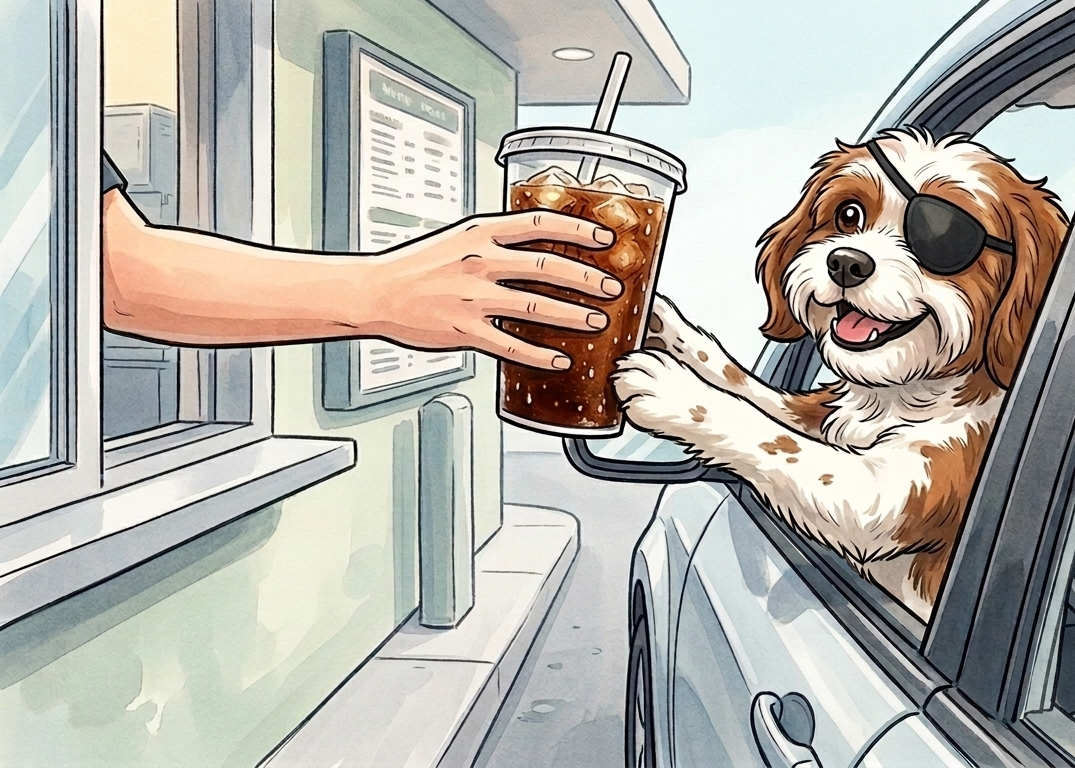
Here's my reason: McDonald's serves the best Diet Coke on the planet. So when the craving hits, that's where I go, food or no food.
And the list keeps going. There are parents who need to get the kids out of the house, and the PlayPlace does the job (a birthday party there is practically a rite of passage). There's the friend you agree to meet because McDonald's sits halfway between you both. There's the kid in the back who only wants the latest Happy Meal toy. The reasons a person ends up walking through those doors are close to endless.
Every one of those examples is a distinct moment in an ordinary life when McDonald's suddenly becomes the obvious answer to a question the person is actually asking. Jenni Romaniuk of Ehrenberg-Bass calls them category entry points.
A few weeks ago, I wrote an entire issue about category entry points, using 5-hour Energy, Pedialyte, and Coca-Cola to make a point about strategy: how you find the moment your competitors have overlooked and claim it for yourself. That was about differentiation. Who you compete with, and how you position against them.
This issue is about the other half of the problem. Once you know which moments matter, how do you actually make sure you're the brand that comes to mind when one of them arrives? How do you become the name a person reaches for in the moment of need? That isn't a question of strategy. It's a question of messaging, of presence, and ultimately of conversion.
We tend to forget something basic in this industry: almost nobody wakes up excited to buy anything. Shopping, for the most part, is a chore. You don't want to spend your afternoon researching auto loans. You want a car, and you want your afternoon back. The purpose of marketing isn't to manufacture desire out of thin air. It's to position yourself as the easy, obvious, confident choice in the moment a need arises, so the customer can make a decision, feel good about it, and return to the parts of life that actually matter to them. Everything we do, from brand advertising to the reviews on our website to the discount code to the UGC, exists to give that customer one more reason to choose us and move on.
This is the 95/5 rule I wrote about back in issue #8. At any given moment, only about 5% of your market is actually in the market. The remaining 95% aren't ignoring you because your advertising is bad; they simply don't need what you sell today. And yet our entire industry is fixated on that 5%. We crowd onto the people who are ready to buy right now, bid one another's clicks higher and higher, and then act surprised when CPCs and CPMs keep climbing. Meta has become remarkably good at compressing demand into the narrowest possible window, catching someone mid-scroll and offering a reason to act before the impulse fades. Google search occupies the other end, capturing people who have already decided and only need to know where to go. Both are valuable. Neither, on its own, builds a durable business.
You cannot force someone into the 5% before they're ready. What you can do is speak to the entire 95% as though they matter, so that you are the first name that comes to mind on the day one of them crosses over on their own. That is the real value of a category entry point. If you only ever talk to the handful of people with their hands already raised, you are competing for scraps against everyone else in your category. None of this is a guarantee. What it does is improve your odds of being chosen, and improve the economics of the entire engine you've built to capture that 5% in the first place.
Category entry points are always helpful. In my opinion, they're part of every successful marketing strategy. But for brands selling directly to consumers (B2C, DTC, CPG, and the like), you can occasionally get away with ignoring them. They can generate meaningful revenue without ever doing this work, because Instagram and Meta can compress the funnel on their own.
A brand selling creatine gummies could develop a proper marketing strategy that carefully studies the moments that lead someone to start a new supplement or switch brands ... or it could simply run relentless, expensive Instagram ads and generate enough impulse purchases to build a real business regardless. Instagram manufactures the impulse, Google Ads works as the safety net for whatever bottom-funnel demand is left, and for a lot of brands the economics of that approach still work (to a point). In the long run, a brand like that will run out of profitable customers it can acquire this way. But in the short term, it can be exactly what kickstarts a brand.
B2B offers no such shortcut. It's here that category entry points stop being a growth lever and become a necessity. A B2B buyer only lives their buying life between nine and five. There are more decision-makers involved, more layers of approval, and more baggage attached to every decision. No amount of advertising will convince a facilities manager to switch fence suppliers this afternoon, or persuade a controller to tear out the accounting software, or talk a CMO into firing their agency and hiring yours on an ordinary Tuesday. Those decisions happen on the buyer's timeline, triggered by something in their world rather than yours.
The mistake is to respond by chasing only the 5% who are in the market today, or by trying to force everyone else through a funnel they aren't ready for. Do that, and you'll watch the economics of your entire paid media program come apart. The costs climb, the conversions don't, and the whole thing turns unprofitable faster than you'd believe.
My first client taught me this long before I had the language for it.
June 1st, 2015 was my first official day at AdVenture Media. It was also the day I began working on the Karrass account. If you've flown for business at any point in the last fifty years, there's a good chance you've seen their work without realizing it. Chester Karrass was a negotiation researcher: a PhD from USC and the first recipient of the Howard Hughes Doctoral Fellowship in business. In 1968, he created a two-day seminar called Effective Negotiating, and more than a million people across ninety-five cities have attended it since. His signature line, printed on every ad, was this: in business as in life, you don't get what you deserve, you get what you negotiate.
I worked directly with his son, Gary, who was determined to grow the business through online channels. Karrass is an active client of ours to this day, and both Isaac and I have come to see Gary as much more of a mentor and a friend than a client. But the early years were rocky. We were young and certain we knew better; Gary was old-school and certain he knew better; and we clashed over nearly everything. With the benefit of a decade and a good deal of humility, I can now tell you that he was right almost every single time.
The first principle Gary drilled into us sounded less like a strategy than a surrender. "You cannot convince anyone to attend a negotiation seminar," he told us. "It doesn't matter how clever the headline is or how polished the video looks. No advertisement ever created will persuade a person to give up two days of their life and more than a thousand dollars to get better at negotiating. So we won't try."
I pushed back, of course. "But Gary, things are different now. With Google and Facebook we can build a real funnel where every click is tracked back to its source. This isn't 1985, we can—"
"No. It doesn't work that way. We can't keep having this conversation. Horsey dead."
Instead, our job was to find his people. A very particular kind of person attends a negotiation seminar: someone in a serious sales role at a large company, often in manufacturing, agriculture, chemicals, or government contracting, the sort of professional who spends much of their life on the road closing deals. Not a car salesman, not a real estate agent, not someone working behind a retail counter. Our task was to find those people, exist quietly and consistently in their lives, and wait for the day one of them decided, entirely on their own, that it was time to get better at the negotiation table.
Up until that point, Karrass's primary vehicle for advertising had been print, specifically airline magazines. For years, they ran a full-page ad in the Delta and United in-flight magazines: a plain image of a fortune cookie featuring Chester Karrass's signature tagline, with a brief description of the seminar beneath it. Nobody was analyzing hook rates or A/B testing headlines and color schemes. The ad simply ran, unchanged, year after year, and it was the engine of the entire company.
Consider who was holding that magazine. This was before seatback screens and iPads, so a business traveler flying home had little to do but leaf through the Delta magazine. And not just any traveler: someone who had spent the last three days negotiating a deal and now sat at 35,000 feet with the quiet, nagging suspicion that they had left real money on the table. That was the moment the fortune cookie caught their eye. That was the category entry point, and it was a thing of quiet brilliance. Most of the passengers on that plane flipped right past it. Karrass's people did not.
Gary had one more rule. He insisted that the ads be boring. Isaac was handling the design and copywriting in those days, and Isaac is a genuine artist, so he would produce something striking and elegant, and Gary would get him on the phone to critique him for making something too interesting. He didn't want interesting. He wanted something plain enough to sit there unnoticed until it leapt off the page for the one person in a thousand who had just realized they needed it.
There was real logic underneath the stubbornness. The whole strategy only works if you invest exclusively in your people. An interesting ad catches the eye of thousands who will never, under any circumstances, attend a negotiation seminar, and once you've caught them, you keep paying to serve and remarket to them. That is money set on fire. If you're going to live in someone's life for years, you had better be certain the lives you're living in belong to your actual target audience.
This is the difference between old-fashioned mass marketing, which tries to reach literally everybody, and what the 95/5 rule is really asking of you: define your entire target audience, a specific cohort of the population, and advertise to all of them consistently, not just the 5% who are ready today. It matters even more on digital channels, where you end up following the same subset of people for months and Meta and Google quietly optimize toward whoever engages. You want the signals feeding back into those platforms to come from people who might genuinely, someday, sit down for a two-day seminar. Boring ads were how Gary made sure of it.
We went back and forth on this for years. Eventually we relented and produced the most deliberately unremarkable ad we could bring ourselves to make, a modest thing built in Canva in 2016 that will never win a design award.

It ran for years and became one of the biggest successes of the entire program.
Gary never once used the phrase "category entry point." He simply understood, in his bones, that it was the only way a business like his could work.
AdVenture is no exception to any of this. We sell marketing to other businesses, and we can't talk anyone into hiring us either. We can only make ourselves useful and present in the lives of the right people, and wait for the day one of them decides it's time to place a call.
I was reminded how difficult that middle stretch can be just last week. Two friends of mine run a software development agency. They are exceptionally talented, they have an excellent reputation, and over the past two years they've built a podcast and YouTube channel with more than 200,000 subscribers, featuring guests who could and should become their clients. When I asked how much business the entire effort had generated, the answer was stark: not a single opportunity.
It isn't an awareness problem. People know them, like them, and watch everything they publish. Nor is it a closing problem, because once they get someone on a call, they win most of them; they're likable and capable, the case studies are real, the work is excellent, and the pricing is fair. What's broken is the middle. All of that attention at the top of the funnel never connects to the moment a viewer actually needs a developer. They own the audience's attention, and they own the sales call, but they've built nothing to bridge the two, because they haven't done the category entry point work that turns I like these guys into I should call these guys about this specific problem.
This becomes especially difficult in B2B when what you offer is broad. If you're the agency that builds websites exclusively for fast-casual restaurants, your job is easy. You can brand yourself as the B2B partner that delivers exactly that one thing to exactly those people, so the day a fast-casual owner needs a website, you're the first and only name that comes to mind. That kind of positioning is far simpler to pull off through marketing than what the rest of us are attempting with much broader service offerings.
I'm not arguing that every business should narrow itself to a niche. AdVenture certainly hasn't. This connects back to what I wrote about light buyers: your customers don't all have to look alike, and forcing them into a single mold costs you more than it saves. But breadth carries a cost, and that cost is a more challenging marketing program. Category entry points matter more, not less, because you now have to earn your place in a dozen different moments rather than one.
Even the largest brands stumble here. I've been a Bank of America customer since 2004. In my entire life, I've needed a checking account on exactly three occasions: when I took my first job at Jay's Appliances, when I opened a business account to publish my first book, and when I got married. All three times, I chose Bank of America. They owned that entry point completely. And yet Bank of America also offers auto loans, mortgages, investment accounts, and financial advising, services I use far more often than I open new checking accounts. When the time came that I needed an auto loan, it never once occurred to me that they were an option. I went instead with a lender a friend had recommended. My awareness of the brand could hardly be higher. In the moment that actually mattered, they weren't on the list at all.
That, in the end, is the whole of it. Your job is not to convince the world that it needs you today. Almost no one does, and the few who do are already being fought over by everyone else in your category. Your job is to be the obvious answer on the day someone finally decides they need what you sell.
Getting there pulls together the last few issues. You reach the entire audience instead of fighting over the 5%, and then you resist grading that work by the number in your dashboard, because ROAS is a rearview mirror: the return on reaching the 95% shows up long after the click that earned it, if you measure it at all. Hold both ideas at once and the job comes into focus. Build a marketing program that exists in the lives of your entire target audience, priced with enough discipline to stay profitable while you wait for the 95% to become the 5%.
Karrass understood that back in the 1960s, with a fortune cookie and an ad they refused to make interesting. I argued against it for years, convinced that this time was different, that the channels we were working in had changed the rules. But Gary was right. The principles of marketing don't change, even as consumers and the channels we use to reach them do.
I go deeper on all of this in Never Always, Never Never.