
I Marketed Our Product Without My Agency
On Friday, I told my team that one of the biggest disadvantages we have as a company is that we're already good at our jobs.
We've rebuilt a lot of our agency around AI over the last 18 months, but I still feel the pressure to continue to innovate. On the one hand, I know we're ahead of the curve, but on the other, I'm terrified that we're going to get comfortable and take our foot off the gas.
We're all very busy with a stack of client work, deadlines, Black Friday prep, 2027 planning, and a dozen other excuses. Who has time to learn new skills and implement new processes? Not me!
That's exactly the problem. When you're already good at something, and it gets the job done today, there's little pressure to find a completely different way to do it.
So when an innovation opportunity comes along (AI, etc.), most will only adopt the easy wins: tools that plug into the way you already work and make you a little more efficient. Once you have those, there's not much reason to go further.
It would be easy to convince myself that I've "checked the box" on AI adoption at our company and keep things the way they are. I could go back to Black Friday planning (my regular job) and stop thinking about how the newest model might change things again.
This fear... that I'm getting comfortable and developing hubris... is what keeps me up at night these days.
I wrote about this in my book, through Clayton Christensen's The Innovator's Dilemma. Christensen, a Harvard professor, showed that successful companies rarely fail because they're poorly managed. They fail because they're well managed, and they keep getting better at what made them successful while the market moves somewhere else.
In Issue #21, I wrote that the real value of AI is in doing things you couldn't do before, not doing the same things faster. The best way I know to fight that comfort is to put myself somewhere I have no habits to fall back on.
I ran this test myself:
How would I develop and execute a marketing strategy if I lost every resource my agency gives me and had to start from zero?
The job was marketing AdVenture+, the AI training membership we launched this fall. AdVenture Media (the agency) has a creative team, an analytics team and strategists who do this work for clients every day, but I didn't use them for this project. I did it mostly on my own with a small budget, using Claude to fill the gaps where I was under-resourced or didn't have the skills.
I picked AdVenture+ because it's our own product, so the stakes were lower than they would be on a client's project. I also picked it because the work required two things I'm not naturally good at: making videos and designing ads. I couldn't fall back on the way I'd normally do it, which is handing the work to our creative team.
The strategy was the same one I'd have recommended to a client a year ago. It used the main principles from my book, Never Always, Never Never, including:
- Video is for making people feel something. Most companies judge a video ad the way they judge a search ad, by whether someone clicked and bought, and that misses what video is for. Its job is to entertain people and stick in their memory, so they think of you when they're ready to buy.
- Static ads get people to act. High-quality video is the most important asset in any marketing strategy, but static ads often drive more conversions than your videos do. A simple graphic that states the offer is often what gets someone who is already shopping to sign up.
- Show up in more than one place. People don't spend all their time on one platform. Someone who saw your video on YouTube recognizes you when your ad shows up on Instagram a week later. That halo effect changes what you can afford to bid on each channel, because each one is doing more work than its own reporting gives it credit for.
- Make every ad different. Meta now looks at the ad itself, the images, the words and who appears in it, to decide who should see it. We used to obsess over audience targeting and splitting campaigns by segment. Now we make a wide variety of ads, each one for a different kind of buyer, and let Meta's algorithm work out who each ad fits. The variety in your ads has replaced most of the audience targeting we used to do by hand.
My role at the agency is usually on the strategy side. I'm not the person making the videos or designing the images, so I needed a way to use AI to fill that gap.
How I Used AI to Fill the Gap
I started tinkering with AI video workflows a few months ago, making short animated explainers for this newsletter and my YouTube channel.
My first attempts were bad and expensive. For example, it took me a while to learn that an AI voice-over (produced by ElevenLabs) was 100x better than my own voice. And I'm not just saying it was easier (which it is). I'm not a voice actor, so my attempts to narrate my own videos were awkward and choppy. Ironically, my own voice sounded more like AI than an actual AI voice-over. Go figure.
But the main reason my earliest videos stunk was because I didn't have a reliable process. I attempted to describe the entire project in one prompt and expected Claude to figure it out. In other words, I was asking Claude to "make a video." If you sent that same instruction to a human creative team, you wouldn't expect anything good back either.
That was the most important thing I learned. Working with AI takes the same process you'd use with a human designer or editor: a clear brief, agreement on what you're making, feedback and rounds of revisions.
So I broke the job into steps. I started with a storyboard, then made the video, then added the voiceover. But I kept spending most of my time at the very end, fixing small details in a nearly finished video. Again, this required too much time and burned through too many tokens.
In my book, I tell the story of American auto executives who traveled to Japan in the 1980s to study Toyota's manufacturing process. At the time, every American plant had a worker at the end of the assembly line whose job was fixing doors that didn't fit. The American executives asked why Toyota didn't have one, and the Toyota managers were confused by the question. If you build the right process, the doors fit the first time and don't need to be adjusted at the end of the line.
I think about that story constantly when I build AI workflows. In American business especially, we tend to solve problems by addition: another step, another person, another tool. Often the better fix is to step back, look at the whole process and take something away.
Polishing the last details of each video was my version of fixing doors at the end of the line. So I stepped back and looked at the whole process, and I learned that the script and voiceover need to come first. Now every video goes in this order, and I approve each step before the next one starts:
- The script and the voiceover
- A storyboard of simple still images
- The finished video
That change improved the quality of the videos, and it cut what I was spending on AI usage.
Here's the full workflow I use now, from raw footage to a published video:
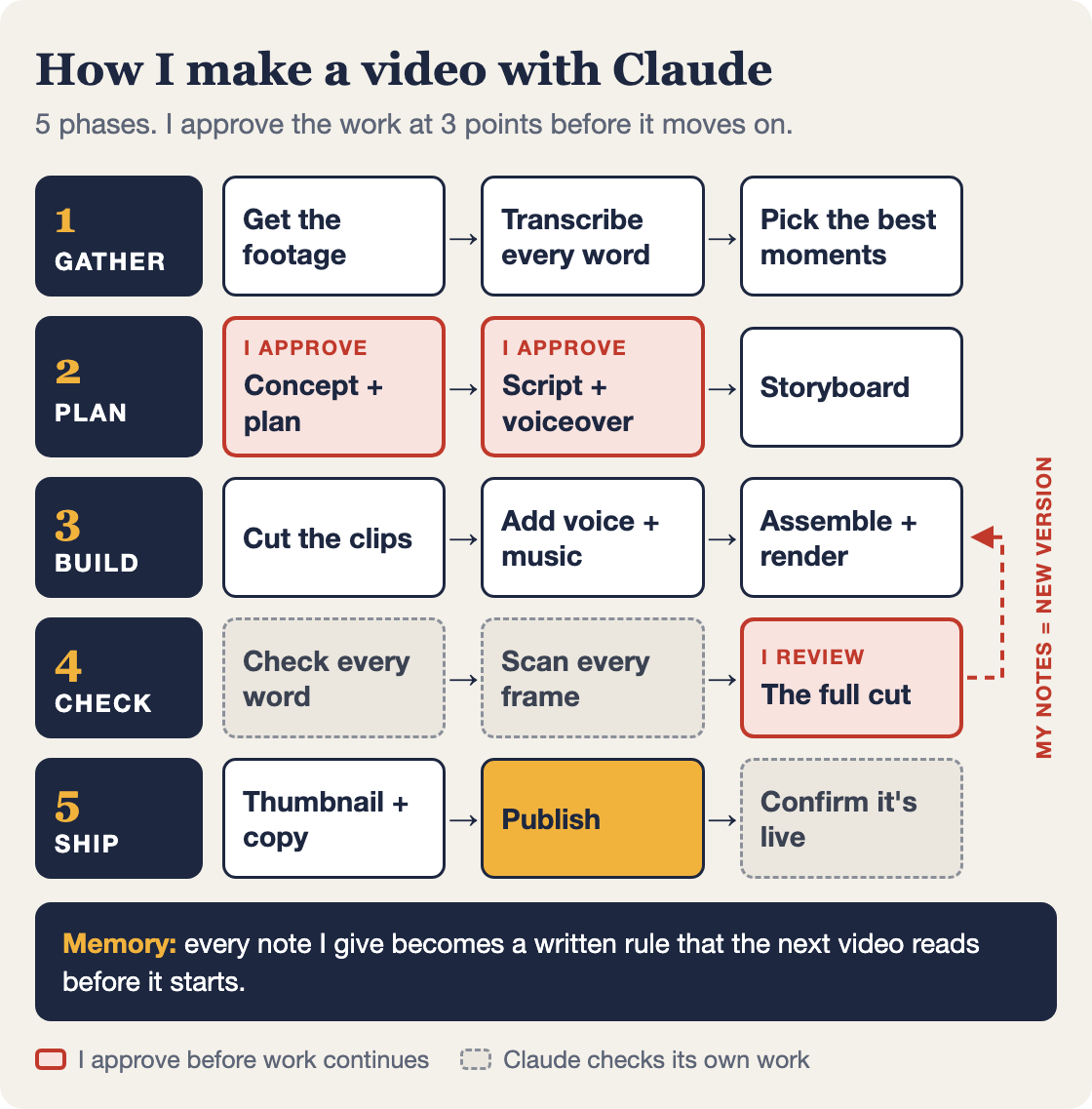
Getting there took months of trial and error. Now a typical video needs 2 or 3 rounds of edits. One recent video, a recap of a training session edited like a heist movie, took about 15 minutes of my time.
I have no background in video production. What made me effective at it was obsessing over the process, and now that process runs efficiently every time.
Then I built the process for static ads the same way.
The first batch Claude made was garbage. The ads looked like generic stock photos: a picture of a calendar on an office wall, a guy sitting at a computer, etc. After some feedback, the second round was a little better. Claude used a photo of me on stage at a marketing conference, but it picked one where my eyes were closed.
I told Claude that if I'd hired it as my agency and it had handed me those, I'd be furious. We needed a better process.
The fix was the same lesson I learned with video. I had to hold Claude to the standard I'd hold a human designer to, and set it up to succeed with the same clear brief and expectations.
One step I've added to our creative process at AdVenture Media is that my team writes a hypothesis for every ad before they make it. Too often, creative gets judged on whether it looks good, fits the brand and has a catchy headline. Ironically, few marketers are challenged to declare why an ad might be successful, or think through the second-order effects.
Our process starts with an insight about the strategy. From that, you form a hypothesis about what kind of ad would work. Then you make the ad that tests it, so every ad becomes an experiment you can learn from.
Claude needed the same step. I asked it to deliver a hypothesis for every ad before it made anything, and the ads got better right away. Once the process worked, I had 14 static ads, plus animated versions for Instagram Stories and Reels, for about 15 minutes of my time.
Here are 3 examples, with the hypothesis behind each.
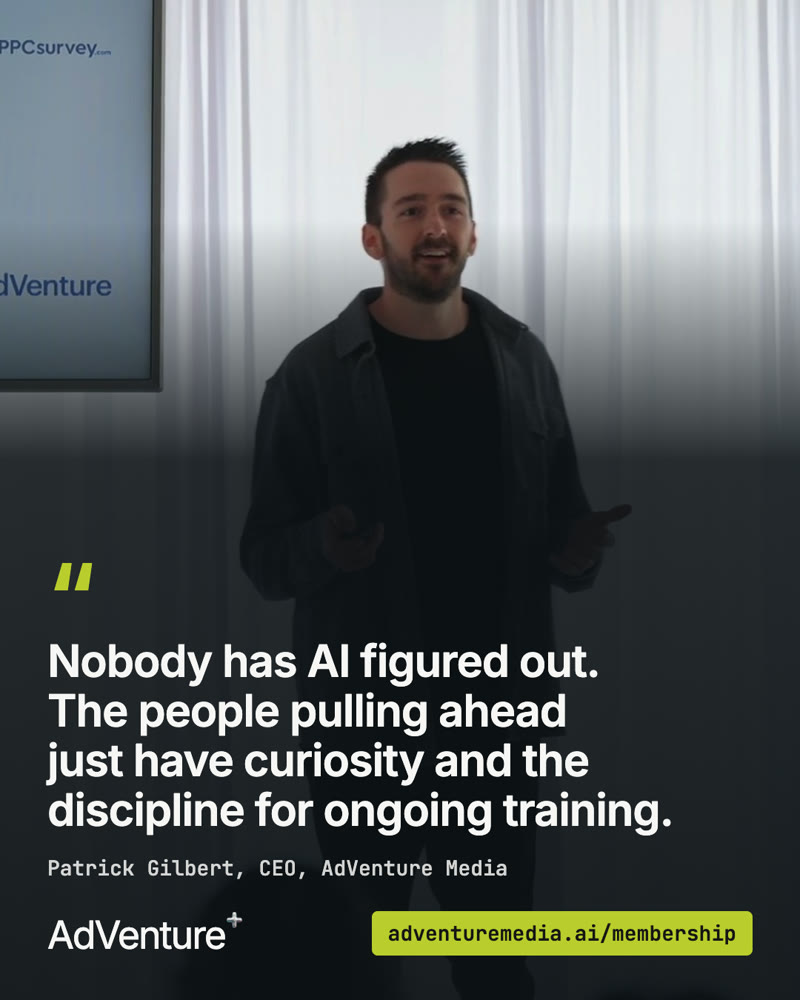
Hypothesis: A real person on stage with a blunt line about AI stops the scroll better than a product claim.
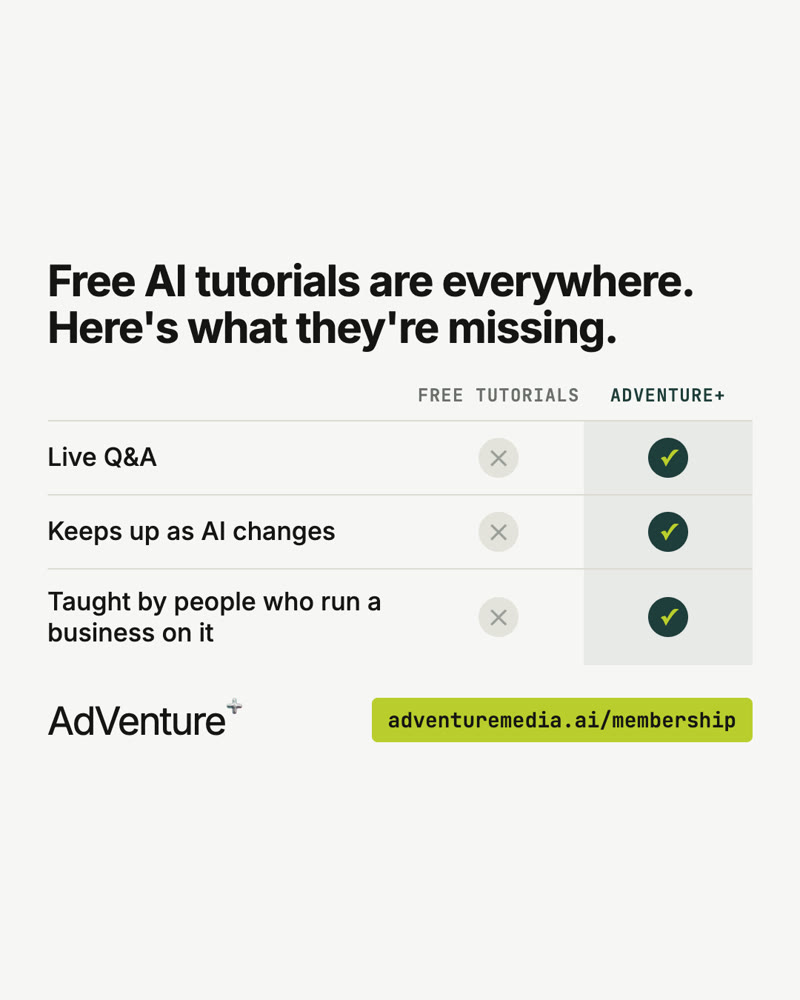
Hypothesis: People who know they can learn AI for free on YouTube will pay for what free tutorials don't give them: live answers from people who use it every day.
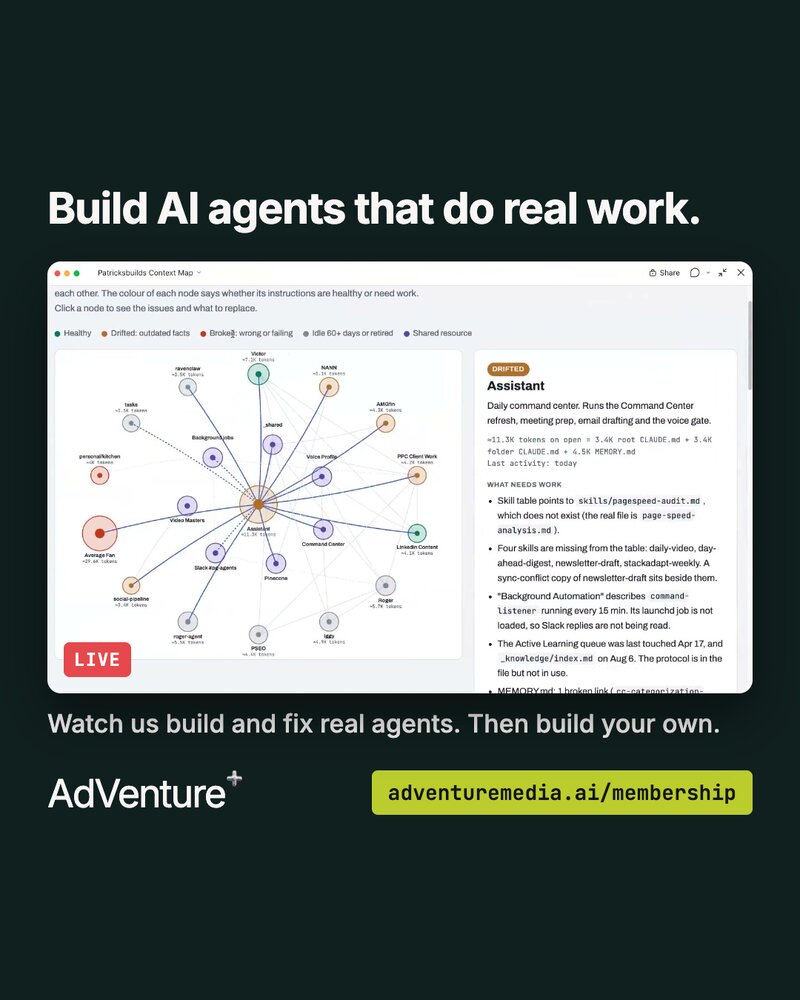
Hypothesis: People who already use AI chat tools and want to build agents will click on proof of real agent work on screen, not on a promise to "learn AI."
Once both processes worked, I wanted to fully understand the intricacies of the workflow, and I learned a few things that surprised me.
I had assumed Claude was using AI image and video models to make everything (like Google's VEO3 and Nano Banana models). These models are expensive to run, and I worried that all the rounds of revisions would drive up my costs.
Claude had found its own way around that... without me asking it to. For the videos, it wasn't using a video model at all. It first generated a handful of still images, then Claude Code edited them together with free tools: FFmpeg (a video editing program), and Whisper, which transcribes the audio for captions. It works the same way a human editor would use Final Cut Pro.
So... these aren't technically "AI videos" after all, because they were actually produced by deterministic (non-AI) tools. It just so happens that an AI agent was the one using the tools.
Confused? Welcome to the party. This is why AI education is so damn important.
The static ads were the same story. Instead of generating them with an AI image model, Claude wrote each ad in HTML and CSS, the code behind web pages, and saved it as an image.
The technical details matter less than the result. This route is faster, more reliable and much cheaper, and I only found it because I'd spent so much time on the process.
What made this work was a system with specific points where I step in and approve the work.
Engineers call this systems engineering. It means drawing the whole job out on a whiteboard: every step, what goes into it, what comes out of it and where a person checks the work before it moves on. When most people use Claude or ChatGPT, they think about the prompt instead of the whole workflow.
If you're trying to innovate, you have to focus on the process and build new systems. It's tempting to fix the one ad in front of you and ship it, because you're trying to launch the campaign later today. You can't do both at once. You have to step back, look at the whole system and turn it into something you can repeat.
I haven't launched any of these ads yet. Everything here is a plan and a hypothesis: which ads, on which platforms, and what I expect each one to do. I'll share the results when they come in.
Claude built every one of these ads. Deciding what to run, where to run it and what each ad is supposed to do is still my job.
The strategic thinking behind each decision, and knowing what you expect to happen because of it, is what makes great marketers great. It's the part AI can't replace.
Which brings me back to what I told my team on Friday. Being good at our jobs is a disadvantage, because it makes getting comfortable feel safe. The only fix I know is to keep starting from zero on purpose, before the market forces us to.
Use this workflow for your own campaigns If you want to build the video and static ad workflow from this issue for your own campaigns, AdVenture+ shows you how. This week's bonus session walked through the whole thing step by step, and the recording is in the members' library along with every other live session. Join before December 1st and you lock in the $19/month founding rate. After that, it's $29/month. |
One more thing
If this issue hit home, this video breaks down the difference between using AI to get more efficient and using it to do things you couldn't do before.
How AI Transforms Business: Efficiency vs. Innovation (The Double Helix Framework) · 8:41
I put new videos up on YouTube most weeks. Subscribing there helps more than you'd think.