AI Transformation Is a Culture Problem
Leadership teams everywhere are getting the same question from their boards, their investors and their own employees: What are we doing about AI?
At a lot of companies, the answer starts with a list. The leadership team gets access to ChatGPT or Claude, and each person is asked to write down the tasks in their department that AI could automate. The lists get combined into a spreadsheet, and the top of that spreadsheet becomes the company's AI plan.
The ideas on these lists are usually reasonable:
- Sort through résumés for HR
- Pull reports from finance's different systems
- Close the books faster
- Route new sales leads to the right salesperson
Most of them should get built. But none of them, on its own, is going to change how the company operates. They make existing work a little faster.
In our workshops, I explain this with a story about electricity.
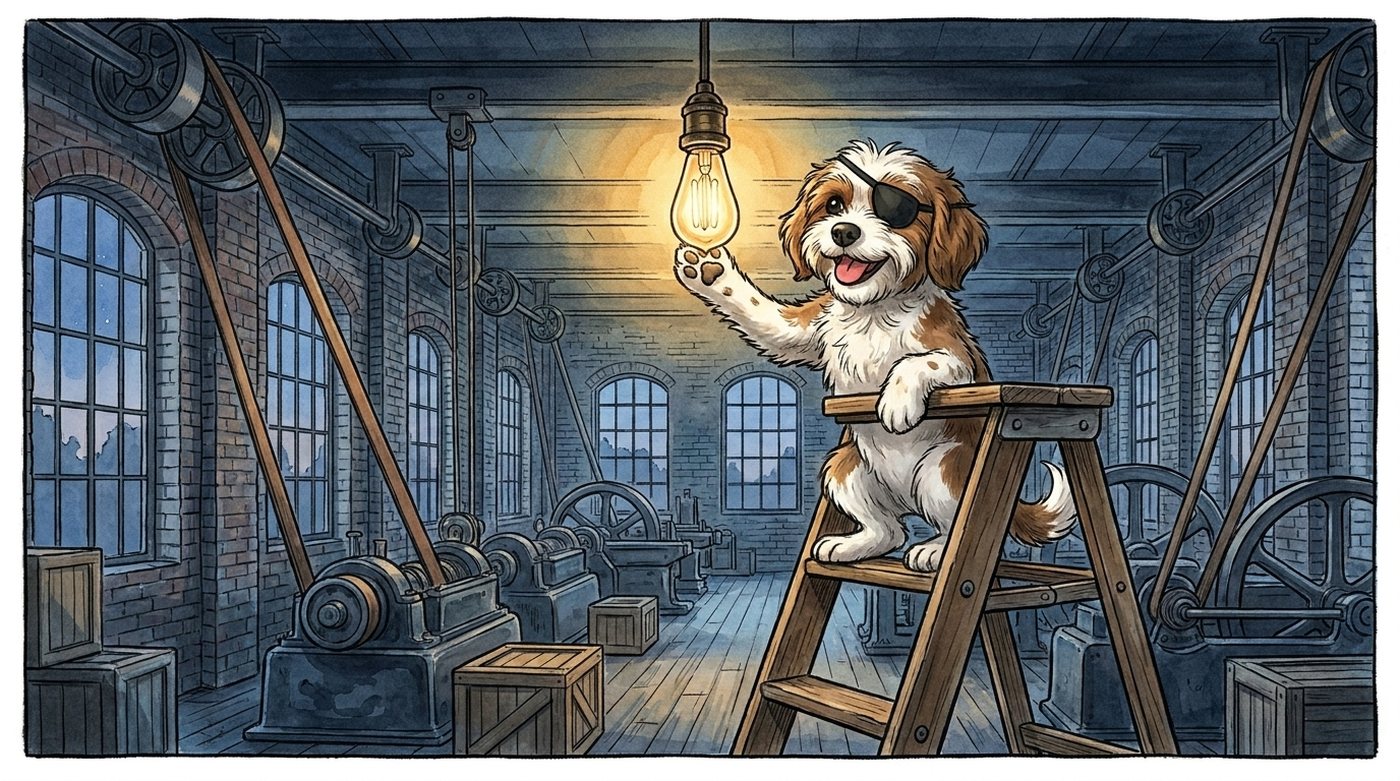
In the late 1800s, the Industrial Revolution was well underway. Factories had been running for decades without electricity. People knew electricity was important and that it wasn't going away, but nobody knew how it was going to change their business.
Then Edison's lightbulb came along, and for the first time, factory owners could see a practical way to put electricity to work in their own operations.
Until that point, factories were beholden to the sun. When it went down, work stopped. With lightbulbs screwed into the ceiling, the machines could run 24 hours a day, and productivity went up. We're doing the electricity thing. Good for us.
Most factory owners stopped there. The building, the machines and the jobs stayed exactly the same. The incumbents were slow to see what else electricity could do: even by 1899, 20 years after the lightbulb, less than 5% of the power running the machines in American factories came from electricity, according to the economist Paul David.
Meanwhile, a new generation of companies was being built with electricity at the center of everything, with different machines, different floor layouts, different jobs and entirely different business models. At the time, most people couldn't imagine what those businesses would look like.
General Electric, which grew out of Edison's own company, was one of them. For GE, electricity was the entire business. The factories that stopped at the lightbulb lost out to companies like it.
Most businesses are adopting AI the same way those factories adopted electricity. They use ChatGPT to write emails faster or Claude to summarize their meetings, check the box and move on without changing anything about how they operate.
That's why I think "What's our AI strategy?" is the wrong question. Imagine asking a company today what its electricity strategy is, or its internet strategy. Nobody has one. Every part of the business simply runs on it.
Most of what your company does is going to change, and nobody can see exactly how yet, including the CEO. Being willing to lean in before you know where it leads is the strategy.
About 18 months ago, our leadership team recognized the inevitability of AI's disruption on the agency business model, and realized that if we didn't put ourselves out of business, somebody else would. So we committed to changing everything about how our business works, from the ground up.
We had no idea what the other side would look like. Today, almost everything we do, from sales and marketing to operations and customer service, has been rebuilt with AI at the center.
And now, "AI transformation" is a service we offer to many businesses trying to do the same. After consulting with more than a dozen companies attempting a similar transformation, I've learned a few valuable lessons about what actually facilitates, or prevents, AI adoption across an organization.
This issue is my attempt to distill the most important lessons I've learned throughout that journey.
Boston Consulting Group has a useful way to describe the difference between a company that adds AI and a company that transforms with it. BCG sorts AI work into three types:
- Deploy means giving people AI tools so they can do their current jobs faster. Nothing about how the company is organized changes. In BCG's words, this "rarely creates measurable and meaningful value."
- Reshape means changing how the company does its existing work: which roles exist, how teams are structured and how work moves from one person to the next. If a monthly report used to take a team a week to assemble, you rebuild the process so AI assembles it, one person reviews it and everyone else spends that week on something more valuable. That's how the gains actually show up on the P&L.
- Invent means changing what the company sells. You build new products or services for your customers that weren't possible, or weren't affordable, before AI. An accounting firm that used to only file taxes might start offering every client a monthly cash-flow forecast, because AI makes it cheap enough to do.
Having your team write out all of their current work that could be automated with Claude is an example of Deploy.
My company would benefit significantly if our team used AI to automate their existing workflows, so they spent less time building slide decks and pulling reports. And I'm putting resources behind making that happen.
But for the long-term vision and strategy of our company, I spend much less time thinking about automating the work we do today, and most of my time thinking about all the new things we can now do that we never could do before.
The things that will drive the most value for your business three years from now are probably things you don't think are possible today. You won't find them on a list of tasks to automate.
Most leadership teams are trying to write a prescription for what their employees should start doing every day. What they overlook is the cultural and psychological side of the change, which will stand in their way far more than picking the right use cases.
You can't assume your employees will get on board with whatever directive you hand them. In my experience, employees resist AI for three reasons:
- They're afraid they're training their replacement. In Microsoft's 2024 Work Trend Index, 53% of people who use AI at work said they worry that using it on important tasks makes them look replaceable.
- They're afraid they won't be good at it. This is a skill people are being asked to learn on the fly, and some companies now grade it. (Shopify added AI usage to its performance reviews last year.) That creates a lot of fear about falling behind.
- They don't want to. A lot of people like their jobs, and they aren't thrilled about those jobs changing completely, even when you promise it's for their own good.
One realization I like to share in our workshops is that I'm never going to have to write an Excel function again in my life. I find that exciting. But it makes a lot of people uncomfortable. Plenty of people enjoy building spreadsheets. It's a puzzle they've spent years getting good at, and they're proud of it.
There's an irony here. Many of the same employees who are resisting the AI their leadership team is pushing are quietly using AI on their own terms, and keeping it from their bosses:
- A 2025 MIT study found that workers at more than 90% of companies were using personal AI accounts for their daily work, while only 40% of those companies had paid for an official AI tool.
- In Slack's 2024 Workforce Index, 48% of desk workers said they would be uncomfortable telling their manager they used AI for common tasks. The top reasons were that it might look like cheating, or make them seem less competent or lazy.
The Wharton professor Ethan Mollick has a simple model for how transformation actually happens. He says it takes three groups:
- Leadership sets the direction, makes it safe to experiment and goes first. Mollick's advice is for leaders to use AI "at every meeting" and talk about how it helps them.
- The Lab is a small group of people who are already good with AI, pulled from anywhere in the company. Title doesn't matter. These are the people who should be building the automations on your list.
- The Crowd is everyone else, experimenting in their own work. This is where most of the ideas come from.
As Mollick puts it, "Nobody has special information about how to best use AI at your company." That includes the CEO and the software vendors. So give employees room to find out how AI makes them better at their jobs.
At my company, that room came from a hackathon about a year ago. We gave everyone access to vibe coding tools (apps that write software for you from plain-English instructions) and two weeks to build a working app of their own.
We made it clear the app didn't have to be related to work. In fact, we encouraged everyone to pick a personal interest that had nothing to do with their job.
Brigid built willineedajacket.com. She gave it some basic information about her wardrobe, connected it to weather data from weather.com and got a Slack message every morning telling her whether to bring a jacket.
Andrew built Headliner, which is essentially Goodreads for the concerts you've been to. And Ash, who won the competition, built an interactive astronomy textbook full of quizzes, puzzles and games about the planets and constellations.
Before the hackathon, none of these people had ever written a line of code in their life.
We wanted it personal. People are far more creative when the stakes are low. If I had asked everyone for a list of 10 things they could automate, the pressure would have been on, and I would have gotten 10 safe answers.
People built things they didn't think they could. They were connecting their apps to other software and talking about API keys and integrations, words that meant nothing to them a few weeks earlier. For a lot of them, it was the moment they realized, I can actually do this.
Within weeks, the conversation around the office changed from Can we use AI for this? to We could just build this, and people started building tools for our clients.
The most important advice I give the companies we work with comes from my own experience getting my company to embrace AI over the last 18 months.
Whoever is leading the change, usually the CEO, has to be in the trenches with the technology, and has to be transparent, vulnerable and willing to set the example for everyone else.
I've been studying AI, and writing and speaking about it around the world, for close to a decade.
So when I share an opinion about it, my team's gut reaction is to assume I already know all of this, or that it's out of reach for them. What they don't see is that I might have learned it in the last 24 hours.
It's easy to put your leadership team on a pedestal and assume they know more than they do. They never know as much as people think. This is the most important time for a CEO to be open about what they don't know, because that's what creates a safe space for the whole company to figure this out together.
So I don't pretend to have the answers. I ask stupid questions in front of my team, and I talk openly about what I'm learning and what I'm getting wrong.
Earlier this week, we recorded a bonus session for AdVenture Plus, our membership for ongoing AI training. Isaac presented to me and 30 other attendees a new workflow he invented that lets him use Claude, ChatGPT and Gemini together on the same project.
You can watch the recording for yourself. I asked a lot of dumb questions, and I was completely comfortable admitting that I wasn't following Isaac's instructions at all. He had to explain it three different times before I understood it.
That's an intentional mentality. I've embraced it selfishly, because it's the only way I'll actually learn anything, but also because it sends a signal to everyone around me that this is a safe space to ask dumb questions, because we're all learning this together.
Humility has worked for big companies before. In 1999, Jack Welch, then the CEO of GE, realized his company was behind on the internet. So he paired more than 500 of GE's top executives with younger, less experienced employees who could teach them how the web worked, and he took a mentor himself. It became known as reverse mentoring, and companies have been copying it ever since.
Whatever form it takes at your company, the leadership team has to be willing to learn in public.
So the next time the board asks about your AI strategy, give them two answers.
For the next 90 days: everyone gets the tools and learns to use them, and a small group of your best AI users, whatever their titles, starts building the most valuable automations your team identified.
For the long term: the leadership team learns alongside everyone else, people have room to experiment and fail, and the company is actively looking for things it can do that it never could before.
Or, in one sentence a CEO can say out loud: We're changing how we work, and I'm going first.
I wrote about our hackathon in more detail in Never Always, Never Never.
AdVenture Plus is free through October 31. It's where we keep teaching as the tools change. Members get the full recording of Isaac's session from this week, Claude Basics (a 14-lesson course recorded from one of our Claude Fundamentals workshops) and the full recording of Build an AI Agent in 60 Minutes, our first live session. Join at adventuremedia.ai/membership.
More from me this week
Here's the recap of that first live session, where we built an AI agent from scratch in under an hour.
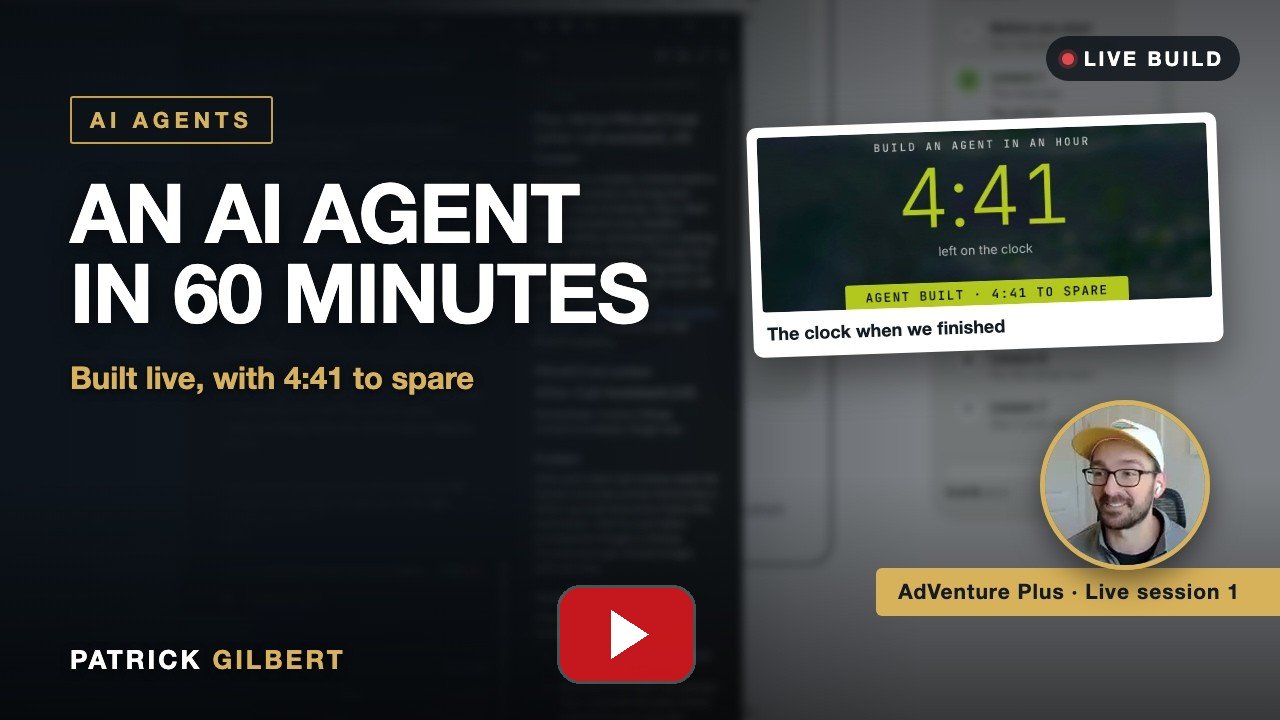
We Built an AI Agent in 60 Minutes (With 4:41 to Spare) · 1:20
I put new videos up on YouTube most weeks. Subscribing there helps more than you'd think.