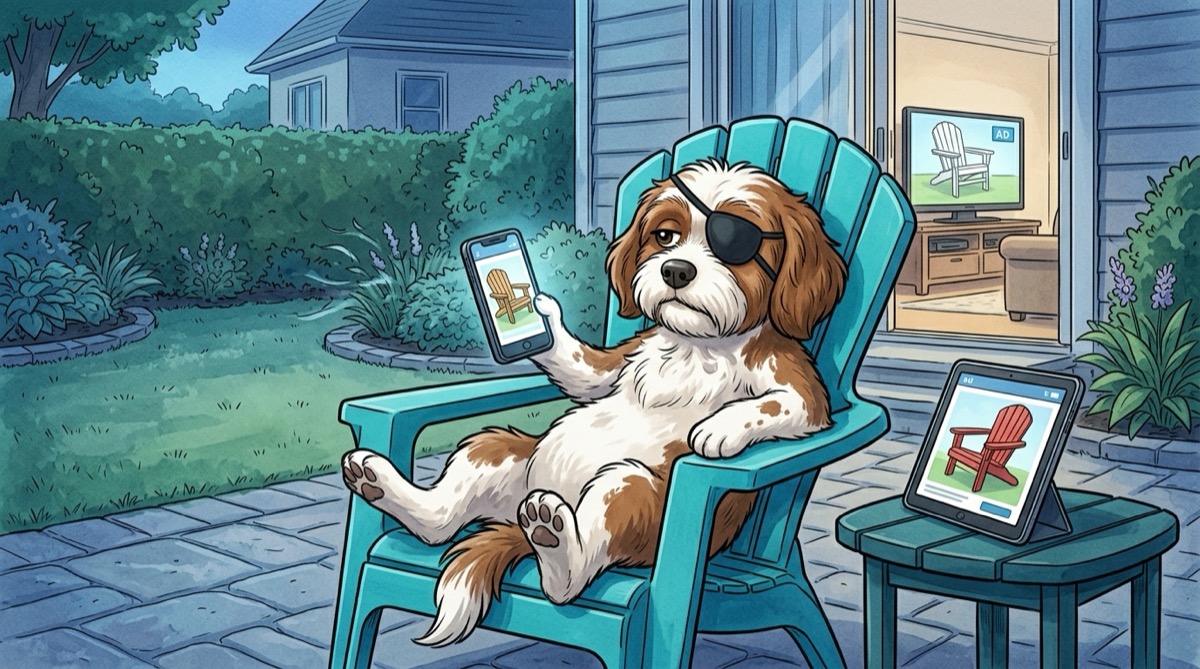
In for a Penny, In for a Pound
We're hosting both sides of the family for Labor Day weekend, and a few weeks ago I stood on our back patio, phone in hand, and realized we didn't have enough seating.
So I did what everyone does. Standing right there on the empty patio, I Googled "poly adirondack chairs," the heavy weatherproof kind that survive a Long Island winter, not the $30 stackable ones that crack in July. The first result was a Google Shopping ad from Birch Lane.
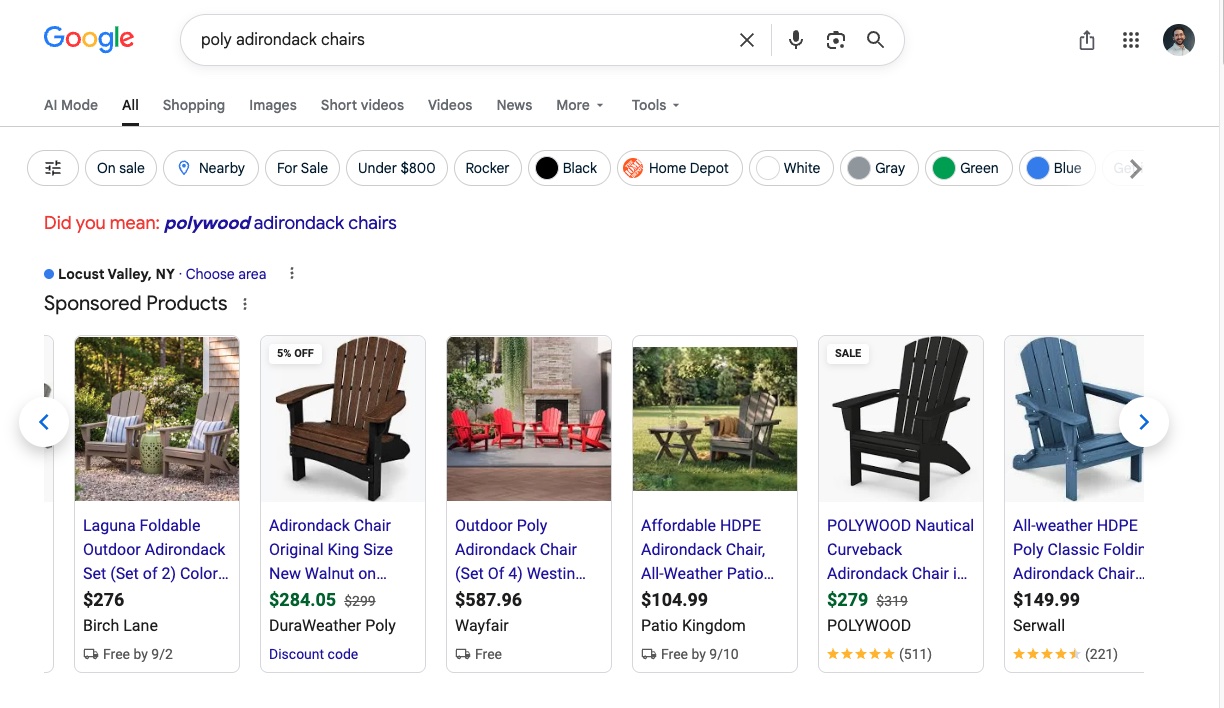
I clicked it, browsed for seven minutes or so, weighed slate gray against teak, and left without adding anything to my cart.
As far as Birch Lane could tell, I was gone.
But the marketing side of my brain knew I had just opened Pandora's box, and that I was about to get bombarded with patio furniture ads everywhere I looked. So out of curiosity, and as a bit of a sadistic test, I opened Instagram that night and started counting.
Twenty minutes of scrolling produced 13 patio-furniture ads from 9 different brands:
| Brand | Ads |
| Polywood | 3 |
| Birch Lane (the only site I visited) | 2 |
| Yardbird | 2 |
| Home Depot | 1 |
| Frontgate | 1 |
| Article | 1 |
| Three brands I'd never heard of | 3 |
| Total | 13 |
It didn't stop at Instagram. Over the next few days, display ads for outdoor furniture followed me across ESPN, the news sites I read, and the weather app I check every morning. Then the television joined in. An ad for patio furniture played before my daughter's cartoons on Disney+, and another one wrapped itself around a YouTube video on the living room TV.
One visit to one website, and the entire internet knew I was ready to spend several hundred dollars on patio furniture.
You've probably heard of retargeting: you visit a brand's website, and that brand's ads start following you around the internet. That's real, and it explains the two ads I saw from Birch Lane.
It doesn't explain the other eleven. I had never been to Polywood's website, or Yardbird's, or the sites of brands I couldn't have named the day before, yet suddenly all of them were paying to reach me. So what happened?
Google and Meta each have a pixel — a small piece of tracking code — installed on virtually every website in the world that matters. Birch Lane's site has both. Your site almost certainly does too.
The moment I landed on that Birch Lane product page, both platforms logged the same conclusion: this person is very likely in the market for premium patio furniture. Otherwise I wouldn't have landed there from a Shopping ad.
That signal is one of the most valuable things an ad platform can hold, so they monetize it as fast and as often as they can, selling my attention to every brand willing to pay for a shopper who is probably shopping.
The same is true of your website. Every person who visits is telling Google and Meta that they're probably in the market for whatever you sell, and by installing those pixels, you granted the platforms the right to act on that information.
If that strikes you as unfair, consider the question that has always made it feel fair to me. Have you ever wondered why Google Analytics is free? Do you think Google is willing to fund an extremely expensive and robust analytics platform, one that serves as the source of truth and guiding strategic measuring stick for millions of businesses worldwide, out of the goodness of their heart?
Of course not. There are tradeoffs. The tradeoff is that they use your website visitor data to make their ad platforms more robust. You can complain about this all you want, but these are the terms of the deal that no one wants to talk about. I'm not saying I support it, so don't shoot the messenger. This is just how the digital world works. (And don't for a second think that you should try to run ad campaigns without these pixels properly installed.)
And the deal cuts both ways. The same machine that sold my patio-furniture intent to eight competing chair brands is the machine Birch Lane uses every single day to buy visitors that other websites identified first. The pixels aren't evil, and the deal isn't a scam. (Never always, never never.) The deal is simply bigger than most businesses realize when they sign it.
A week later, I walked past Brinkmann's, the hardware store down the block from my house, which keeps a row of adirondack chairs lined up on the sidewalk out front. They've probably been there every summer for a decade, and I had never once noticed them.
Of course I noticed them now, I was in the market for them. And I immediately started weighing the benefits: they're already assembled, and I could pick them up today and have them on the patio this afternoon.
That is mental availability, the ease with which a brand comes to mind once the buying moment arrives, doing its work. And a sidewalk full of inventory is the oldest form of physical availability there is: being easy to actually buy.
The chairs at Brinkmann's also explain why Meta was so aggressive about filling my feed with so many different vendors. Meta isn't rooting for Birch Lane, or Polywood, or any one of them in particular; Meta is competing with my hardware store.
If I walk down the block and buy my chairs in person, no Meta advertiser gets the sale, and Meta gets no credit for producing it. When that happens often enough, advertisers become less profitable, they spend less on ads, and Meta makes less money. So Meta's job is to make sure that when I do buy, I buy from somebody on their platform.
And remember, Meta only knows one thing about me: I visited Birch Lane's site and left without buying. They don't know why. Maybe it was the price, maybe the style, maybe the shipping time, maybe one of a million reasons I'd never choose Birch Lane at all. So they show me variety, as many styles and price points and vendors as they can, to maximize the odds that one of them fits.
Let's run a quick thought exercise on what this journey costs the brand that started it.
Based on my experience working with clients in similar categories, I would assume Birch Lane paid about $3 for my Google Shopping click. Let's assume their average order value is around $600. Furniture margins look generous on paper, but after the cost of goods, the freight on an 80-pound box, and the returns that plague online furniture, a retailer clears maybe $200 of actual profit on an order like that.
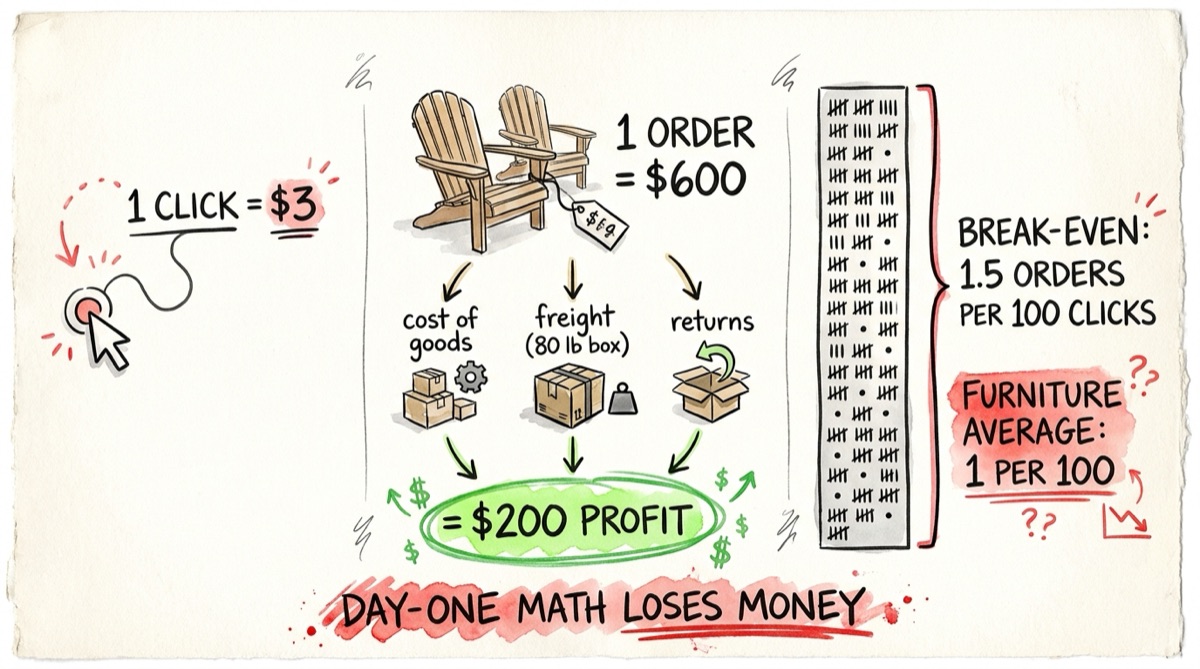
The diagram does the math: Birch Lane needs about one and a half orders per hundred clicks just to break even, and furniture sites convert about one. On the day of the click, that math loses money.
But nobody buys $600 of chairs in one session. Last week I wrote about the messy middle, Google's research showing that buyers no longer walk a straight line from awareness to purchase; they loop between exploring their options and evaluating them, sometimes for months, before money changes hands.
A premium piece of furniture is the definition of that kind of purchase. Nobody impulse-buys it, everybody researches it, and Google's own data says the journey keeps stretching: shoppers who use AI shopping features now interact with nearly three times as many touchpoints before buying as shoppers who don't. So the share of buyers who convert on any single session, especially the first one, the session Birch Lane paid for, is a small fraction of that already-thin average. The Google Shopping click didn't buy Birch Lane a customer; it bought them an introduction.
The moment I clicked that ad, Birch Lane was 100% of my consideration set, the entire universe of brands I was considering. Within 48 hours they were 2 of 13 ads in my Instagram feed and one of nine brands I could suddenly name, and by the end of the week they were one of ten options, once the chairs down the block entered the picture.
If Birch Lane goes dark after that first click, no retargeting, no social presence, nothing between my first session and my tenth, then every one of those sessions becomes a fresh opportunity to lose me, and the odds that my eventual purchase lands with them collapse toward their share of the noise. And their own paid click is what started the auction: they paid $3 to tell eight competitors I exist.
There's an old idiom for the posture this demands: if you're in for a penny, you're in for a pound. If you're going to pay for the first click, you have to budget for the journey that click starts. The retargeting, the social ads, the YouTube presence, the email flows, the review sites, all the unglamorous connective tissue that keeps you visible while a buyer loops.
A few years ago I sat across from the owner of an e-commerce store that sells men's neckties, a veteran who had built and sold multiple businesses in the category over three decades. He was paying $5 per click to sell a $50 product, spending five times more on Google than on Meta because he didn't trust any ad he couldn't directly attribute a sale to, and watching his profitability evaporate as clicks got more expensive and conversion rates sank.
He didn't need a better keyword list; he needed to show up in the moments between the clicks, especially the moments when his customers drifted into competitor territory. He rebalanced his budget to roughly 50/50, and within weeks revenue began climbing and, more importantly, margins stabilized. I tell the longer version of that story in the book.
Only about 5% of any market is actually in the market to buy at any given moment, an idea I covered in Issue #8, and the pixel is simply the machine that finds those people, which is why nine different brands were paying to be in my Instagram feed the same night I clicked.
And in Issue #5 I argued that brand loyalty is mostly a story marketers tell themselves; Google's messy middle study proved it experimentally, with a third of shoppers abandoning their stated favorite the moment a competitor showed up mid-journey with a decent offer. The platforms are the reason the competitor shows up.
As for my chairs: I bought them from Brinkmann's on a Tuesday, on the spot, and borrowed a friend's pickup truck to take them home.
The truth is I had become too overwhelmed by all the different choices, and I just wanted the whole debacle over with. These stupid chairs were one of many obstacles I needed to get out of the way before this Labor Day BBQ. And the BBQ is just one of many things occupying space in my brain over the next few weeks. I also happen to have a job, a child, a dog, three different fantasy football leagues starting up, and a new season of Ted Lasso. My car needs an oil change, my dog needs a grooming, and my primary babysitter (my mother-in-law) is taking a 10-day trip to Italy next month. There's a lot on my mind, and buying the absolute best adirondack chairs ultimately wasn't my top priority. I needed to make an easy decision and move on.
And so I did. I'm sorry to Birch Lane, and to all the other brands that invested in serving ads to me over the last week and wound up disappointed. If just one of you had been more aggressive, blocking out all the noise, I might have gone with you.
Birch Lane paid $3 to start a journey that ended in a sale they will never see in any attribution report, won by a hardware store whose entire advertising strategy is a sidewalk. And Brinkmann's didn't outspend anyone. Their chairs were standing on that sidewalk before my journey ever began, so the moment I was in-market, I couldn't miss them. Birch Lane needed to pay for that kind of presence; Brinkmann's got it by existing on my block.
The buyer's journey is longer, messier, and more crowded than the one your ad account describes. You can pay to stay visible across all of it, or you can pay once, hand the platforms your best signal, and let someone else finish what your click started. The brands that win are the ones still standing there at every session: in the feed, on the TV, and on the sidewalk. In for a penny, in for a pound.
Prefer to listen? The audiobook is on Spotify and Audible.
Next week: the issue I owe you on AI search, where exploration and evaluation move inside tools like ChatGPT, and your brand either shows up or it doesn't.
One more thing
The study I leaned on today proved that a third of shoppers abandon their favorite brand mid-journey. This video is about the other side of that coin: the loyal customer you imagine usually isn't the one paying your bills.
What Marketers Get Wrong About Buyer Personas (The Harley-Davidson Truth) · 10:02
I put new videos up on YouTube most weeks. Subscribing there helps more than you'd think.