The Messy Middle
I grew up working at Jay's Appliances, a small family-owned appliance store on Long Island. Customers would often walk in asking for Kenmore appliances, Sears' private-label brand. Sears didn't manufacture Kenmore products; they contracted with companies like Whirlpool, slapped a Kenmore badge on the front, and invested heavily in advertising to establish Kenmore as a premium brand. Most shoppers had no idea the brand was exclusive to Sears, so we were trained to say: "Kenmore only makes labels and price tags. Let me show you the exact refrigerator you saw at Sears. This one has a Whirlpool label and costs 20% less."
That happened to be the truth. But what if we were lying? What could they do, drive all the way back to Sears to fact-check us? Buying decisions were made right there in the aisle, with limited information and whatever the salesman chose to add, and the funnel that governed marketing for a century was built on exactly that world: awareness, then consideration, then conversion, in a clean and orderly line.
The internet ended the linear marketing funnel. Today's consumers carry an infinite shelf of information in their pockets: reviews, price comparisons, product specs, and now AI assistants to do the sorting for them. Nobody has to live with uncertainty anymore. Google knew this was happening, they could see it in their own data, and they set out to prove it, publishing the results in 2020 as Decoding Decisions: Making Sense of the Messy Middle. It's the research I teased at the end of last week's issue.
The question at the center of it: what happens when consumers are no longer limited to the handful of products available at their local store, or to whatever fits in their shopping cart? How do people decide what to buy, and from whom, when they're bombarded with an endless stream of information, including all the reasons to purchase and just as many reasons to hesitate?
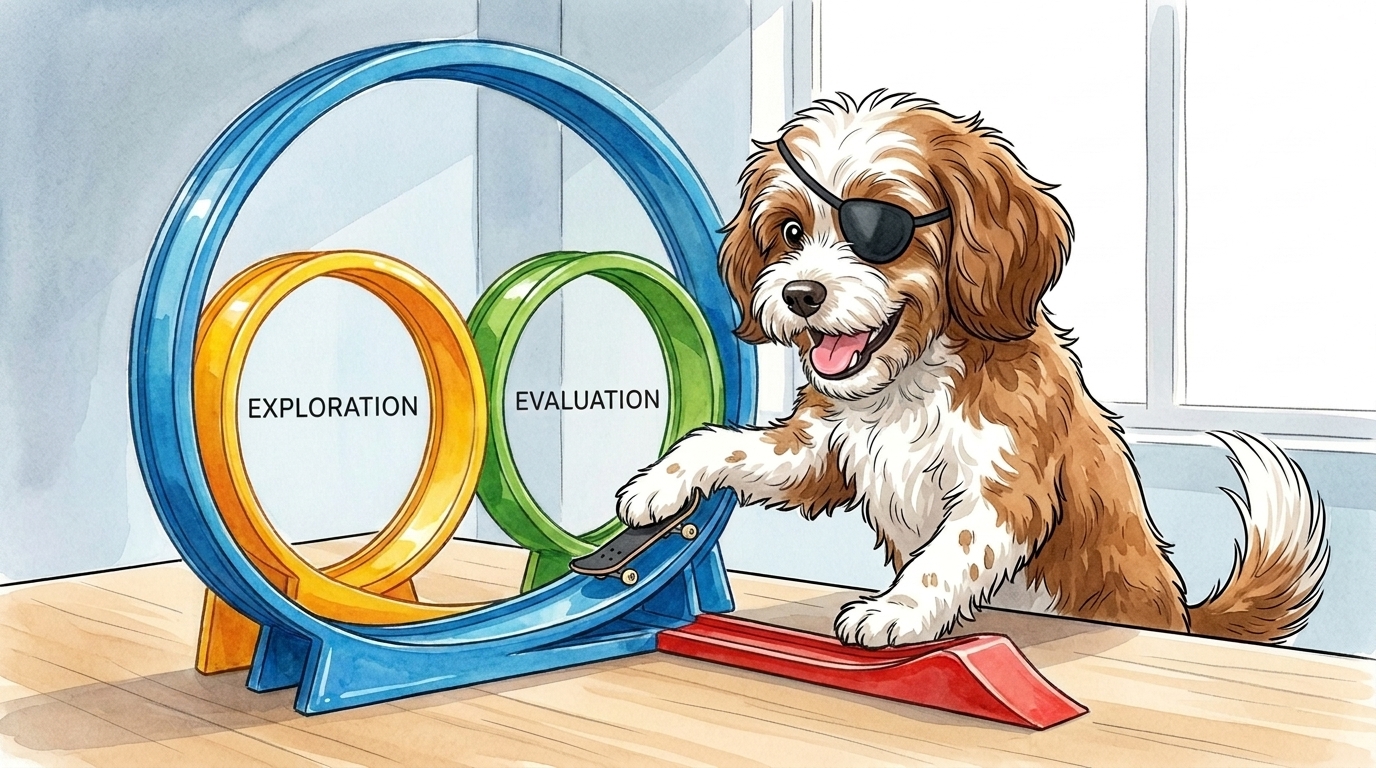
What they found is that the clean stages of the funnel have collapsed into a swirling loop of exploration and evaluation. Here is the map they drew:
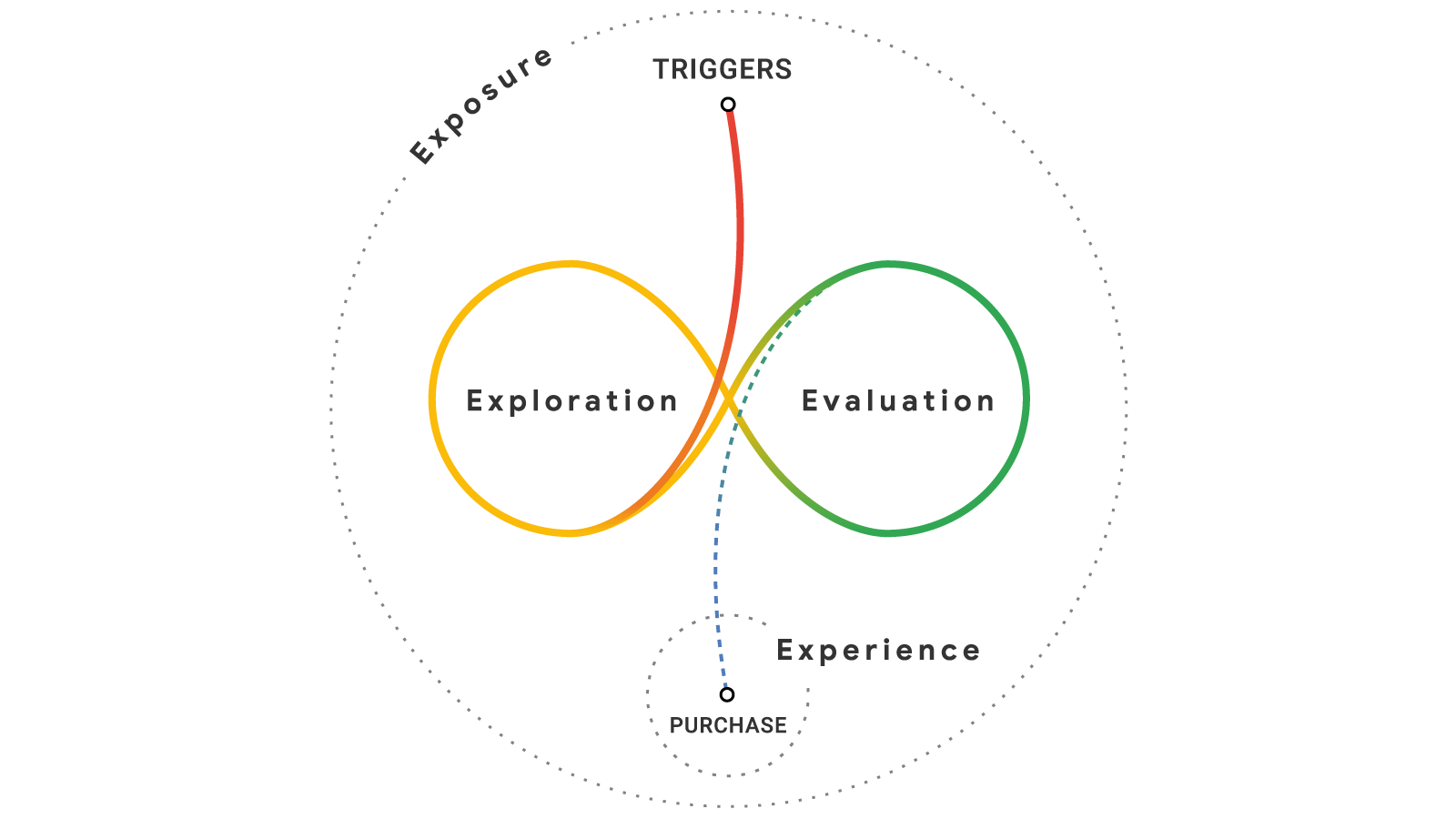
What happens in the middle is what defines the whole model. Between the moment something triggers a purchase and the moment money changes hands, consumers loop between two mental modes. In Google's words: "Exploration is an expansive activity, while evaluation is inherently reductive."
During exploration, consumers cast a wide net. They scroll through search results, review sites, and social media, gathering brands and product details into a mental portfolio. Then comes evaluation, the narrowing-down process, where they weigh price, quality, and reviews to filter out the less promising options. And then, more often than not, something sends them right back into exploration.
The toggling isn't indecision. It's how the brain copes with the paradox of choice: too many options leave us frozen, so we switch into evaluation mode to simplify the decision and conserve mental energy.
The model has no stages. There's no fixed entrance, no set order, and no polite march from top to bottom. A buyer can enter anywhere, loop for minutes or months, and buy at any point in between. So resist the urge to read the messy middle as a new funnel with rebranded steps. The whole point is that the steps are gone.
Think about the last time you replaced a winter jacket. The zipper on your old one broke on the first cold morning of November. That's the trigger. That night you searched Google for "best winter jackets," watched two YouTube reviews of North Face models, and skimmed a Reddit thread where strangers argued about fill weight. This is exploration. By the weekend you had three tabs open, comparing warmth ratings, return policies, and prices. This is evaluation. Then a Reddit commenter mentioned Canada Goose, a brand you'd never considered, and back into exploration you went. A week later you finally made your purchase decision, and if you're anything like the shoppers in Google's study, it wasn't the brand you started with.
To stress-test how people behave inside the loop, Google simulated 310,000 purchase scenarios across 31 product categories, from cereal to SUVs to vacation packages, using real shoppers who were actively in-market. Each participant named their top two brand preferences in a category. Then they were shown basic information about competing brands, things like logos, shipping times, and Trustpilot reviews, and then they were asked again to name their top two brand preferences in that category.
You would assume that nearly everyone would list the same two choices. But one-third of them switched their brand preference, sometimes within minutes of naming their original favorite. In categories like car insurance and internet providers, preferences were even more volatile. Even in smartphones, the stickiest category most of us can name, nearly 20% of consumers changed their minds on the spot.
If you read Issue #5, where I argued that brand loyalty is mostly a fallacy marketers tell themselves, this is the experimental version of the same truth. Consumers may think they're loyal, but when a competitor shows up mid-loop with a decent offer, they're surprisingly willing to pivot.
Even if someone has always bought Nike running shoes, if Adidas shows up in their Instagram feed while they're researching, pops up again in Google Search, and serves a compelling YouTube ad just as they're comparing options, that loyalty is suddenly on shaky ground. It's not that Nike became worse. Adidas became unavoidable.
It might still be hard to imagine any one person getting swayed this way. But extrapolate it across tens or hundreds of thousands of consumers, and even a small percentage willing to try an alternative becomes a significant shift in market share.
The brands that consistently showed up during the messy middle, appearing again and again as consumers explored and evaluated, were the ones that outperformed. Google's data showed that visibility often outweighed historical preference and even product superiority. They call it the power of showing up, and regular readers will recognize it as the engine behind mental availability and physical availability: being easy to think of in as many buying situations as possible, and easy to buy when the moment arrives.
It sounds obvious to say that showing up matters, but it's one of the most overlooked truths in marketing, because we forget how much longer the buyer's journey has become. Consumers are bombarded with ads from every direction; if somebody so much as opens Instagram in the middle of your checkout process, they're likely to be hit with a competitor's ad. Continuing to show up, in every format, across a longer and more diversified journey, is where the battle is actually won.
Showing up is half the study. The other half is what tips the decision once you're in the loop. Consumers aren't weighing every option with perfect logic. Their brains take shortcuts, and Google identified six that consistently shape which brand wins:
- Category heuristics. The rules of thumb shoppers use to simplify complex choices. Higher megapixels means a better camera, more blades means a better razor. Not always accurate, but confidence-building enough to move forward.
- The power of now. A product that ships tomorrow feels more appealing than one that ships in five days, even when everything else is identical. Amazon built an empire on this insight.
- Social proof. Five-star ratings, glowing reviews, bestseller badges. The flip side matters too: thin or mixed reviews create enough doubt to push a consumer back into exploration.
- Scarcity bias. "Only 2 left in stock." One of the oldest tools in the persuasion toolkit, and it still works because the underlying psychology hasn't changed.
- Authority bias. Borrowed credibility. The dentist recommending toothpaste, the expert endorsement that gives people permission to believe.
- The power of free. The word "free" is a magnet for attention, sometimes irrationally so.
That last one produced my favorite finding in the study. When travelers were offered a free checked bag by a competing airline, the number who switched from their preferred carrier spiked by 75%, and that included customers who had no intention of checking a bag. The perceived value of free was enough to flip them, even when they weren't going to use it. In certain categories, with these tactics stacked together, Google's researchers were able to shift brand preference from 75% down to 10%.
This is where marketing strategy meets tactical execution. The job is to understand every touchpoint a buyer might hit as they loop, and to work the levers at each one that influence the decision: user-generated content on social, blog content, a YouTube channel, PR, Reddit threads, ChatGPT answers, billboards. A single buyer might touch Google Search, an Instagram ad, a creator's video, and a review site inside one purchase, and the brands that win are the ones showing up at each stop with a message built for it. The real argument here is an argument for media planning: which channels you invest in, and what you say in each.
Now zoom back out to the full map.
Triggers are the sparks that shift a consumer from passive to active: running out of detergent, seeing an ad, spotting a friend's new gadget, even the change of seasons. Regular readers know these by another name, category entry points, the buying situations a brand attaches itself to so it comes to mind when the moment arrives.
Purchase is the moment of commitment, but it's rarely the finish line anymore. More often it's the start of another cycle.
Experience feeds directly back into future decisions. A great experience creates advocates. A poor one leaves consumers more open to competitors the next time they enter the messy middle.
And then there's exposure, the ring drawn around the entire model, and the piece marketers most misunderstand. Exposure isn't a phase or a step. In Google's words, it's "a continuously shifting backdrop that influences decisions at every moment," made up of ads, packaging, word of mouth, a glimpse of your product on a store shelf. Exposure is the modern evolution of awareness, and failing to maintain it is one of the primary reasons even great marketing campaigns fail to deliver long-term growth. Awareness evolved from a stage you pass through into a backdrop that never turns off.
In last week's issue I described a call with a prospect whose budget has been 90% bottom-funnel Google and Meta for eight years, and my advice came in three steps: build your bottom-funnel infrastructure first, raise the ceiling of your funnel with the broadest reach you can afford, and connect the dots in the messy middle. The first step wins the purchase moments the loop spits out, and platform expertise, knowing the best tactics and strategies inside Google and Meta, is table stakes. The second step is exposure: branding, distinctive assets, your top-of-funnel strategy, the always-on backdrop that determines whether you're in anyone's loop to begin with. And the third step, the phrase I borrowed from Google, is a mixture of media planning and savvy creative strategy: choosing which channels to invest in, and what message reaches the audience at each one.
Because your buyers are not just wandering anonymously through search results. Once you make the shortlist, they do their homework on you specifically. They search YouTube for a demo, and either one exists or it doesn't. They check Trustpilot. They open your Instagram to see whether the brand is alive. They Google you and read whatever ranks.
New research keeps validating the concept. Google's 2026 holiday playbook confirms the additional complexity AI shopping assistants have added to the mix: shoppers who use AI features interact with 2.8x more touchpoints than shoppers who don't, AI Mode searches run 3x longer than traditional ones because people ask detailed, multi-layered questions instead of typing keywords, and 81% of social media users turn to Google Search to evaluate things they discovered on social.
The journey has a newer step, too. When a buyer has whittled the shortlist down to two or three brands, they increasingly take the finalists to an AI tool, ChatGPT, Google, Claude, and ask whether they should buy. Something answers, whether or not it's accurate, and whether or not you've ever thought about what that answer contains. Being referenced at all, and having accurate, on-brand information surface in response to those prompts, is now another crucial part of the messy middle.
It is the job of the marketing strategy team to understand every touchpoint that could matter in that journey and make sure the box is checked, because each unchecked box is a place where a buyer quietly falls out of your funnel and into a competitor's. This is why paid media alone cannot grow a brand. You can run the best Google Shopping campaigns on the planet and still lose the customer during evaluation, because the customer's evaluation doesn't happen inside your ad account.
The goal of marketing, much of the time, is simply to stay in the consideration set: the short list of brands a buyer would actually consider when the moment comes. Google's messy middle study proved why: the power of showing up mattered more than almost any other factor they sampled. Consumers are fickle, irrational, and unpredictable, so being chosen is a game of musical chairs. The whole game is surviving every round, because if you're still standing when the music stops, probability says you'll be picked often enough to grow.
I've now spent six issues arguing that performance marketing can't live exclusively at the bottom of the funnel, and this is the issue that spells out what the alternative looks like. Notice that none of it says brand always or performance never. (Never always, never never.) It says the buyer stopped walking a straight line, and the brands that win are the ones still standing there at every bend.
Personal carve outs
This issue landed later than my self-imposed Saturday morning deadline. I flew home from San Diego late Friday night under the silly assumption that my 18-month-old daughter would sleep on the plane, leaving me a quiet stretch to finalize this newsletter. That didn't happen. I'm incredibly grateful to my fellow passengers, who patiently endured the spectacle she and her toddler cousins put on between San Diego and JFK. The deadline never stood a chance.
The second note is that I wanted to give this issue extra attention, because it carries some sentimental value. In the summer of 2020, between the time I finished writing Join or Die and the day it was published, my longtime colleague Avery Niman forwarded me this research paper with the message, "You might find this interesting."
I remember exactly where I was when I read the 96-page report, and I knew in that moment that it would be the basis of my next book. It became my obsession for the next five years. I don't know how to say this without being too cheesy, so I'll say it plainly: this was the first topic that made me want to write a second book.
Prefer to listen? The audiobook is on Spotify and Audible.
Late in the book I argue that the messy middle has become messier still. More than 1 billion people a month now run their searches through AI Mode, and exploration and evaluation are migrating into AI assistants, where your brand either shows up or it doesn't. Showing up there is a discipline of its own, and it's next week's issue.