My AI-Assisted Marketing Audit Process
Fact #1: Most marketing advice on the internet is awful.
Fact #2: AI models are trained by ingesting all the available information on the internet.
Therefore, AI tends to give marketing advice that seems logical, but is actually bad.
This week, I audited one client's entire marketing program with Claude, pushing it to explain its reasoning at every step. The client is paying far more for each new customer than it can afford, and the Google Ads account looks like the main culprit. Claude agreed, and at one point it told me to turn off the best ads in the account.
This issue is a breakdown of two things: my audit process (the decision trees I work through), and the strengths and weaknesses of AI as part of that process.
“Never Always, Never Never” is the phrase I use for my often-contrarian views on marketing strategy: the nuance that lives in the details and often runs against public opinion and best practices.
That’s what makes AI a great sparring partner for a problem like this. It hands me the answer that sounds logical and follows best practices, and I get to argue with it.
The client is a company that sells and installs home elevators. (Well, I've actually changed the business and its search terms so the client can't be identified, but every number here is real.)
For full disclosure, we've been working with this client for about three months, and most of our work so far has gone into the campaigns themselves: the in-account optimizations you'd expect from good Google Ads management.
There have been real improvements, but each new customer still costs several multiples above management's target, so the larger marketing strategy has to be reassessed. We're not going to solve this company's problems by optimizing the Google Ads account into oblivion.
Comparing the last few months with the same stretch a year earlier:
- Ad spend was up 75%.
- Leads were down 13%.
- Each new sale we could trace back to Google Ads cost about $13,000, almost three times as much as a year earlier. Management's target is about $1,800.
Yikes!
So where do you start? If you asked most marketers, or asked an AI tool straight out of the box, you'd probably get questions like these:
- What happened to the cost per click, and are we bidding on different keywords than last year?
- Did we launch a new campaign type, or did Performance Max (Google's automated campaign type) start spending its budget somewhere new?
- Did the conversion tracking change?
- Did new competitors start showing up in the auctions?
These are all good questions, and I'd want an answer to every one of them. But every one of them is about the Google Ads account, which is only one piece of the marketing strategy, and trying to fix a business by diving into the weeds of one piece is a huge mistake.
My questions start completely outside the ad account, with the four numbers I wrote about in Issue #9. They sit above every campaign and every channel, and for a business that sells through leads, they are:
- Website traffic: visits from every channel, paid and free.
- Cost per session (CPS): total ad spend divided by all of those visits.
- Conversion rate: the share of visits that turn into a lead.
- Close rate: the share of leads that become customers, and what each one is worth.
CPS is a foreign idea to most marketers (and, in my experience, is never referenced by an out-of-the-box LLM audit). They’ve been trained to judge cost per click (CPC) one campaign at a time.
We (AdVenture) believe this is wrong. Customers show up through every channel at once, and a business invests in all of its traffic, one way or another, even the traffic that shows up as “free” in Google Analytics (you might not have paid for an organic click, or a click from your email newsletter, but some sort of investment, at some point, facilitated it).
If cheap and free visits make up most of your traffic, an expensive Google search click barely moves your CPS. However, if paid search has to bring in nearly everyone, the same price per click can sink your business.
All four of this company's numbers were in a bad place:
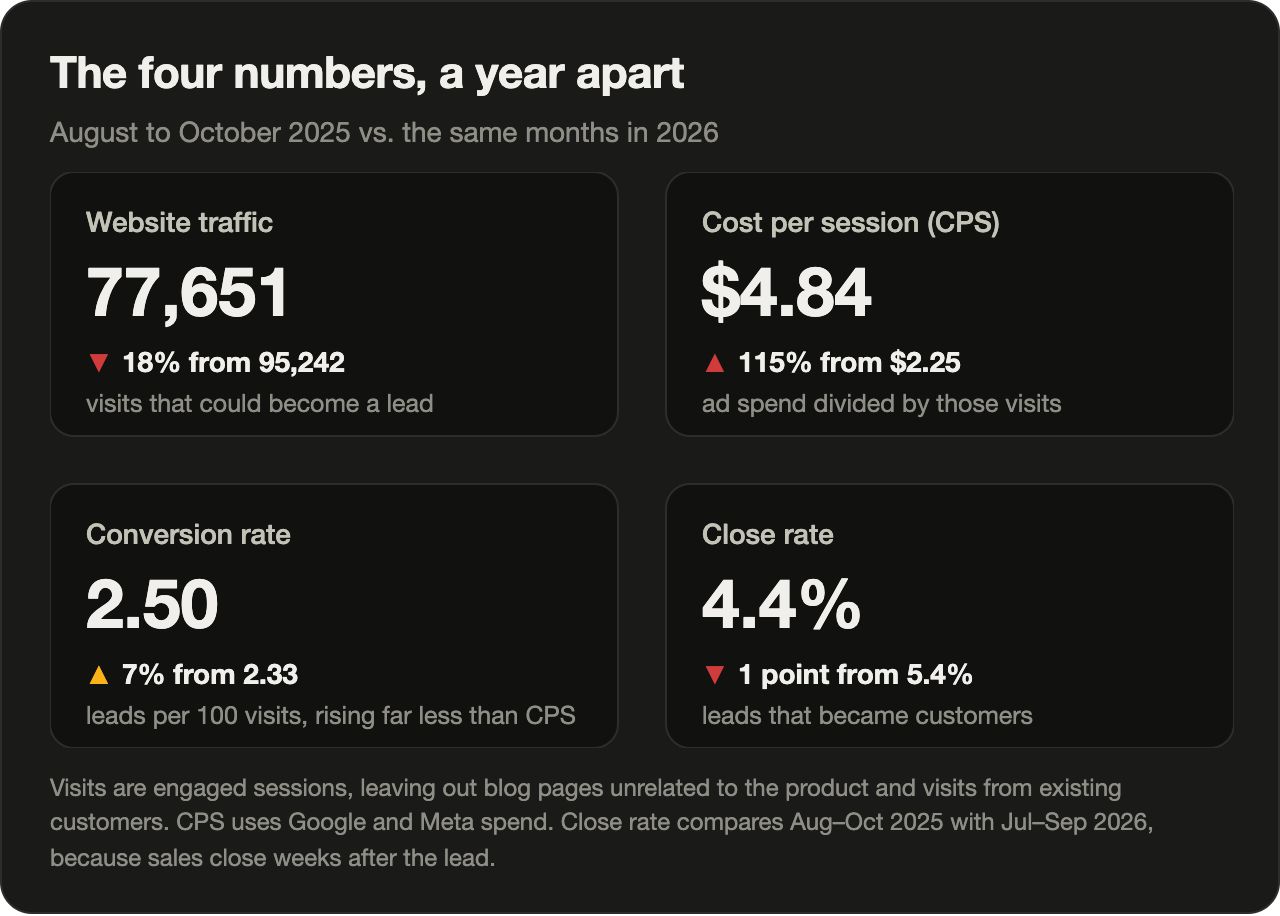
That includes the conversion rate, even though it technically went up. Better traffic costs more, so a rising CPS is fine as long as the conversion rate rises with it. Here, CPS more than doubled and the conversion rate rose just 7%. As far as I'm concerned, the conversion rate might as well have gone down, because it isn't pulling its weight.
I tasked Claude with uncovering the details behind the traffic decline:
“Claude, analyze the traffic decline. Break it down by source, and then evaluate segments of sources by their value. For example, if organic traffic is down, is it from high-intent organic keywords, branded keywords, or low-intent blog traffic? Take this approach to every channel, and assess the urgency behind this 18% traffic decline.”
Within 90 seconds, Claude reported the largest drop came from blog pages unrelated to elevators that almost never produced a lead. So the 18% drop in traffic probably wasn't what was hurting the business.
The bigger problem, we found, was cost per session. The company was getting far less cheap and free traffic than it used to, while the Google search clicks it bought instead nearly tripled in price:
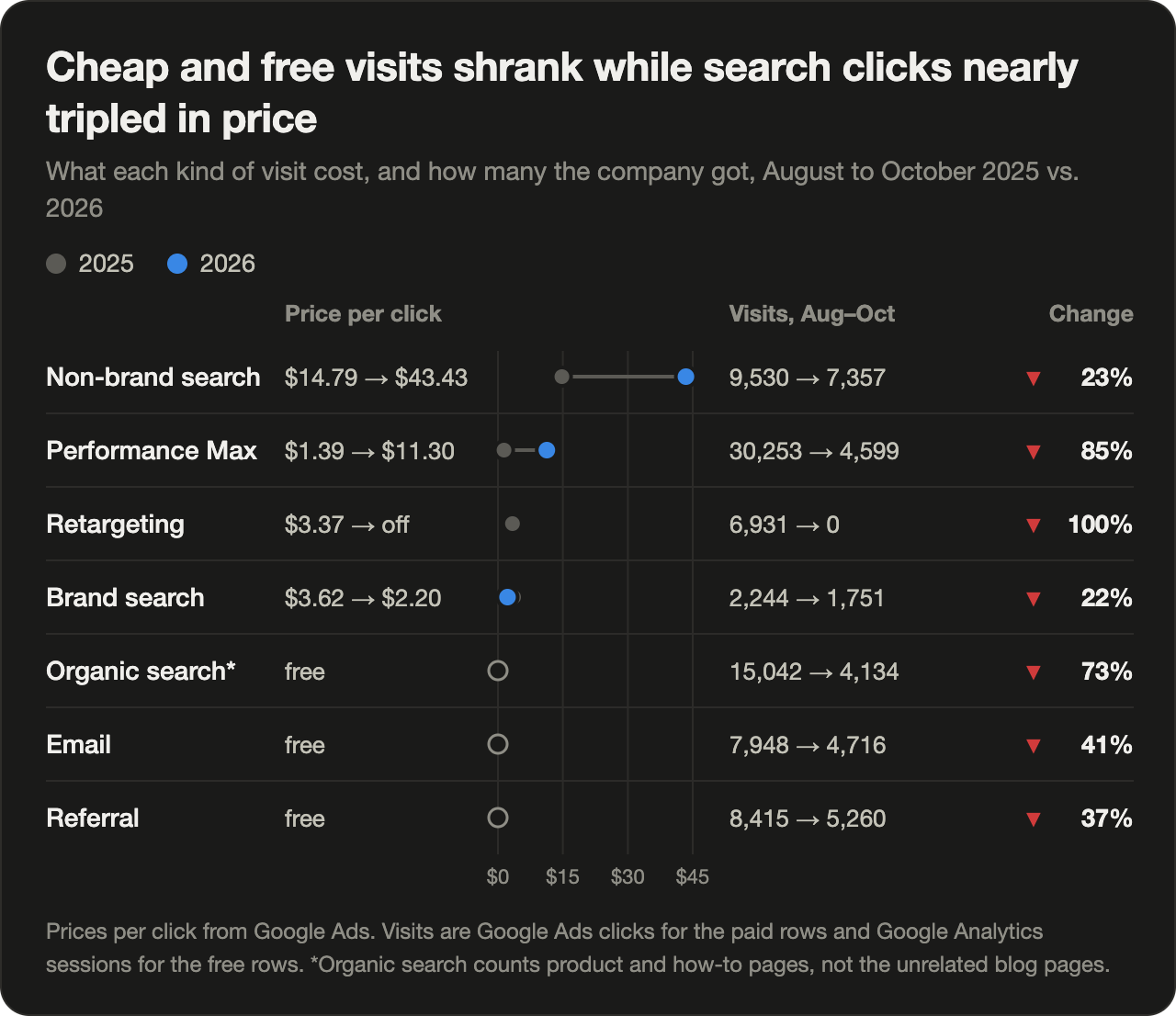
Non-brand search ads (ads on searches for what the company sells, not its name) went from about $15 a click to $43 and from 66% of the ad budget to 85%.
Claude looked at the same data and came back with a clear answer: the non-brand search campaigns were the problem, and it recommended turning them off. Since June, they had spent about $420,000 and produced 13 sales, roughly $32,000 each.
On paper, it had a point. But an expensive click isn't automatically a bad one. (Never always, never never.)
This is where we need to pull our heads out of the sand. One of this company's main products is the vacuum elevator, a see-through tube that runs on air pressure and fits into an existing house without a shaft. Most people have never heard of one.
So before we determine that Google Search is a failure, why don’t we… I don’t know… look at the keywords like rational human beings and determine whether it should or can work at all.
In other words, forget about the data for a minute. Real people are typing words into Google and clicking on your ads. What are those words and who are those people? Do we think they’re our target audience? Do we think they might be potential customers? Here’s what they searched:
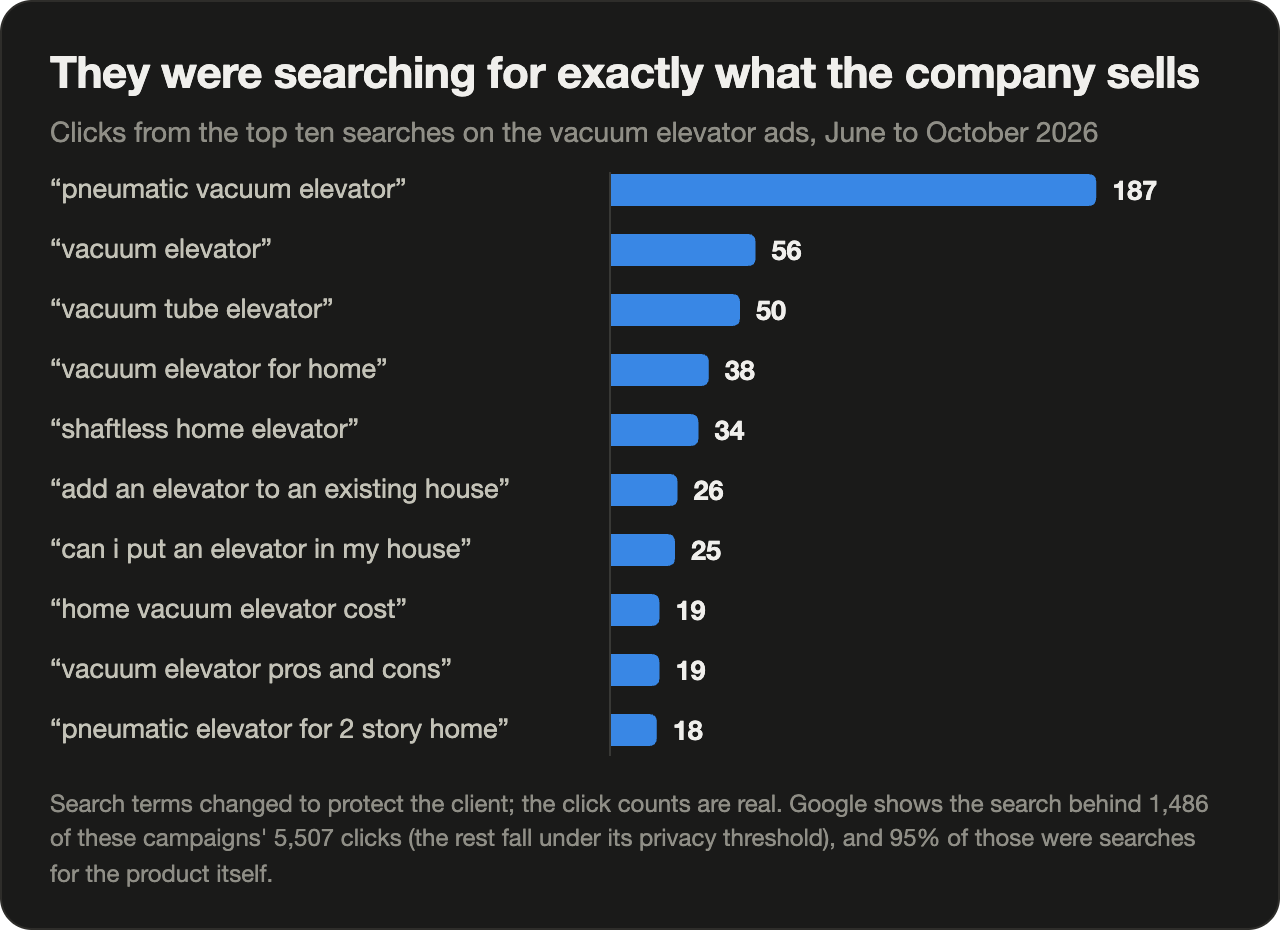
95% of those clicks came from people searching for exactly what this business sells. And once they landed on the website, they engaged with it at about the same rate as people who had searched for the company by name (aka branded search):
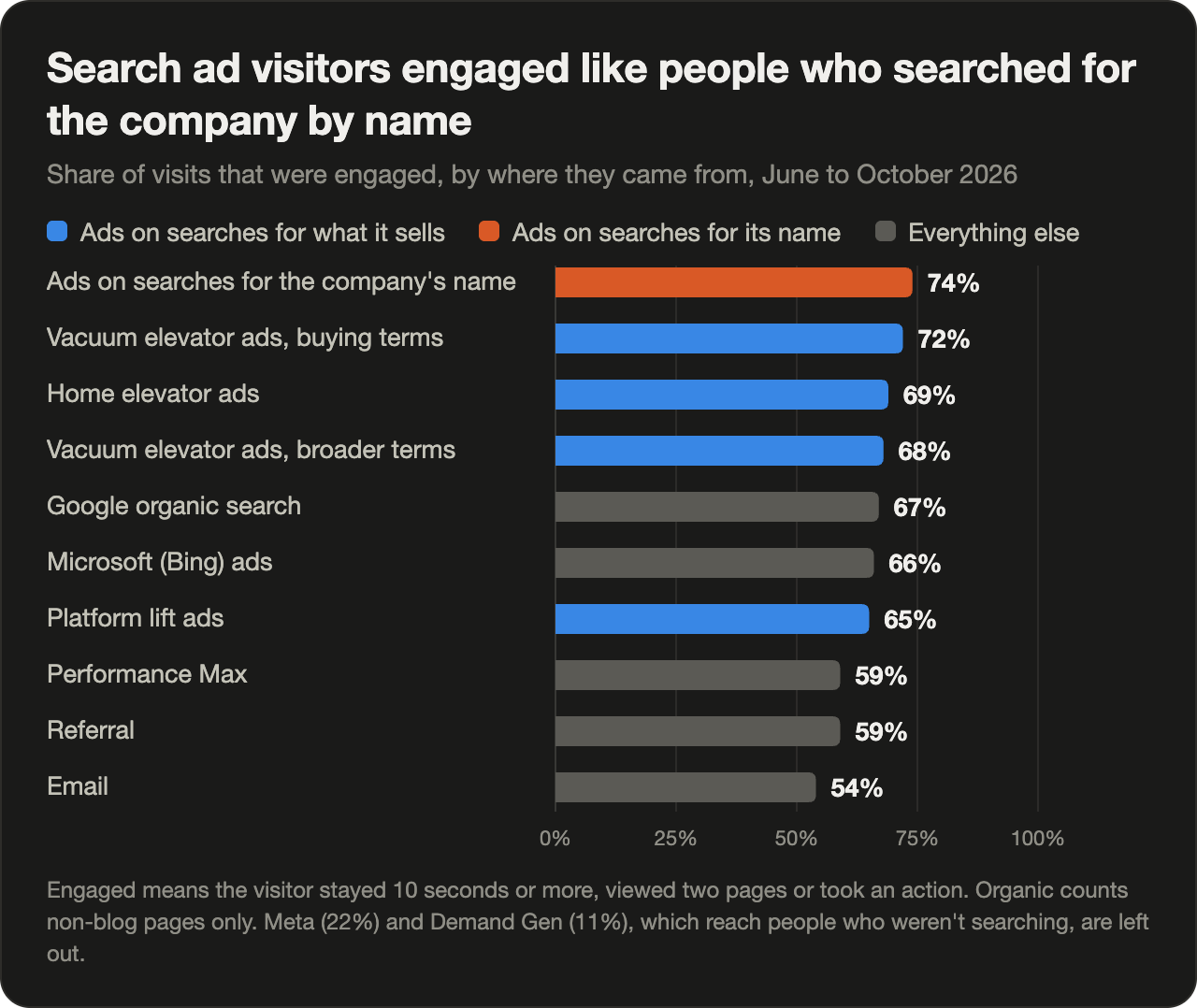
So… I asked Claude to look me in the eyes and tell me that's bad traffic.
Before you touch your search campaigns, ask one question: are they bringing in people who are in the market for exactly what you sell? If the answer is yes, and you still can't turn those people into customers at a profit, stop trying to fix it with a different search campaign. The problem is everything around it.
To be fair, it’s concerning how far this initiative is from profitability. It may seem unattainable, especially in the short term. And it does seem like a wise decision to turn this off.
But then what?
This company needs to grow. They need to invest in marketing. If they can’t profitably convert the highest quality traffic on the internet (bottom-funnel Google Search), they need to do some soul searching and take responsibility for the fact that their broader marketing engine is broken.
But nobody wants to do that. That sounds slow and expensive. Worse, it forces us to admit we’ve made some poor management decisions over the last few years. We prefer to blame external forces (the agency, Google, the government), and we desperately want a fast and cheap solution.
So after cycling through our third or fourth agency, we decide Google Ads doesn’t work for us and chase the next shiny object: “What’s this AEO stuff I’ve been hearing about? Let’s try that. And maybe, I don’t know, Reddit Ads? UGC?”
Brother, stop ignoring the problem. Google has introduced you to people who need exactly what you sell, but for some reason, don’t want to buy from you. Let’s address that.
I couldn't believe Claude wanted to turn those campaigns off, but I also wasn't surprised. I've been in this industry long enough, and read enough audits written by real people, to know that plenty of agencies would reach the same conclusion: call the campaigns bad or mismanaged, ignoring the fact that these are exactly the right keywords.
That's the training data I mentioned at the top: years of public blog posts and audit templates making these same recommendations, which plenty of people still follow.
If Google Ads is finding the right people, but it’s not profitable, the problem is everything around the click. These are the levers that move a conversion rate, and I check them in order:
- Who's clicking (the audience): fine, as the searches and the engagement just showed.
- Where they land (the landing page): 70% of the people searching for a vacuum elevator were sent to general home elevator pages with no form on the page itself. Visitors from the same campaigns converted nearly four times as well on a page built for vacuum elevators.
- What they're asked to do (the offer): every page asks for the same thing: “request more information.” Nobody has tested a stronger first step, like booking an in-home consultation, or a lower-commitment CTA like a price estimator or “build your own elevator” tool.
- Who else they're looking at (competition): new competitors started showing up in the same auctions this year, and one now appears in more than a quarter of them. When people have more options to compare, fewer of them pick you the first time.
- What brings them back (follow-up): retargeting, the ads that follow people around the internet after they visit a website, had been switched off for a year.
Very few people buy something the first time they hear about a business, especially something they're going to build into their house. Said differently: it would be crazy to expect someone to search for a vacuum elevator, click an ad from a company they've never heard of and spend tens of thousands of dollars after one visit to the website.
(FWIW, it’s rare for an LLM to recommend “path reports” or “time lag” as part of the audit process. Claude doesn’t recognize how insane it would be for someone to accept a marriage proposal on the first date.)
You need to introduce yourself earlier, and you need to remind people you exist after they leave. Basically, invest in the interactions that happen before and after that expensive non-brand Google search click.
So I asked Claude to analyze the conversion journeys, and it pulled the paths leads took in both periods.
The percent of leads from new vs. returning visitors was about the same.
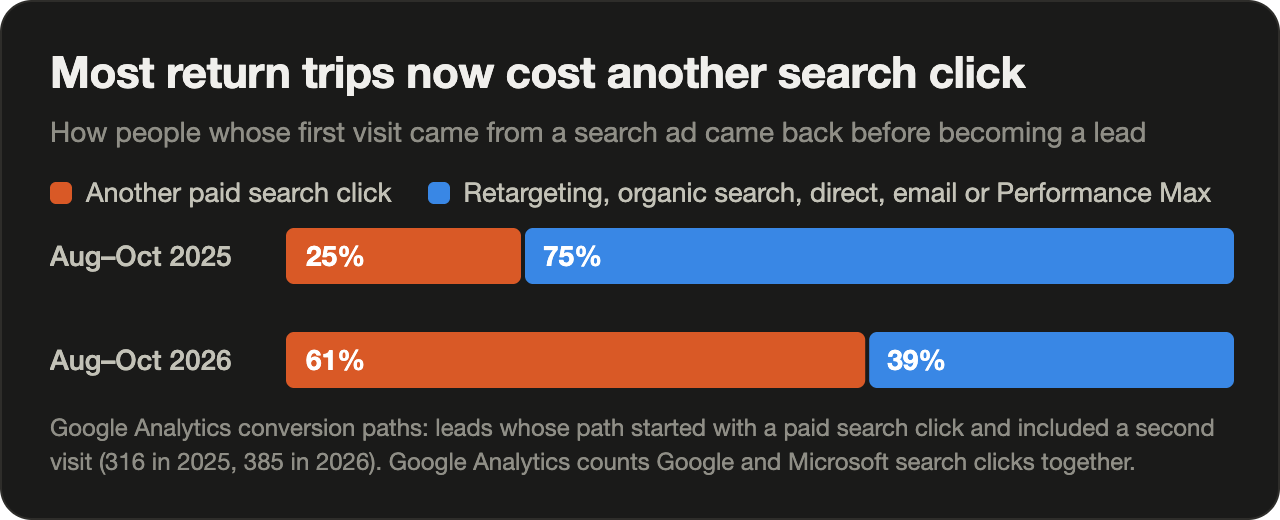
However, what changed was how they came back. Last year, three out of four came back through something cheap or free. This year, 61% came back by clicking another search ad:
Here's an illustration of what that does to the math, using this company's Google prices for each kind of click:
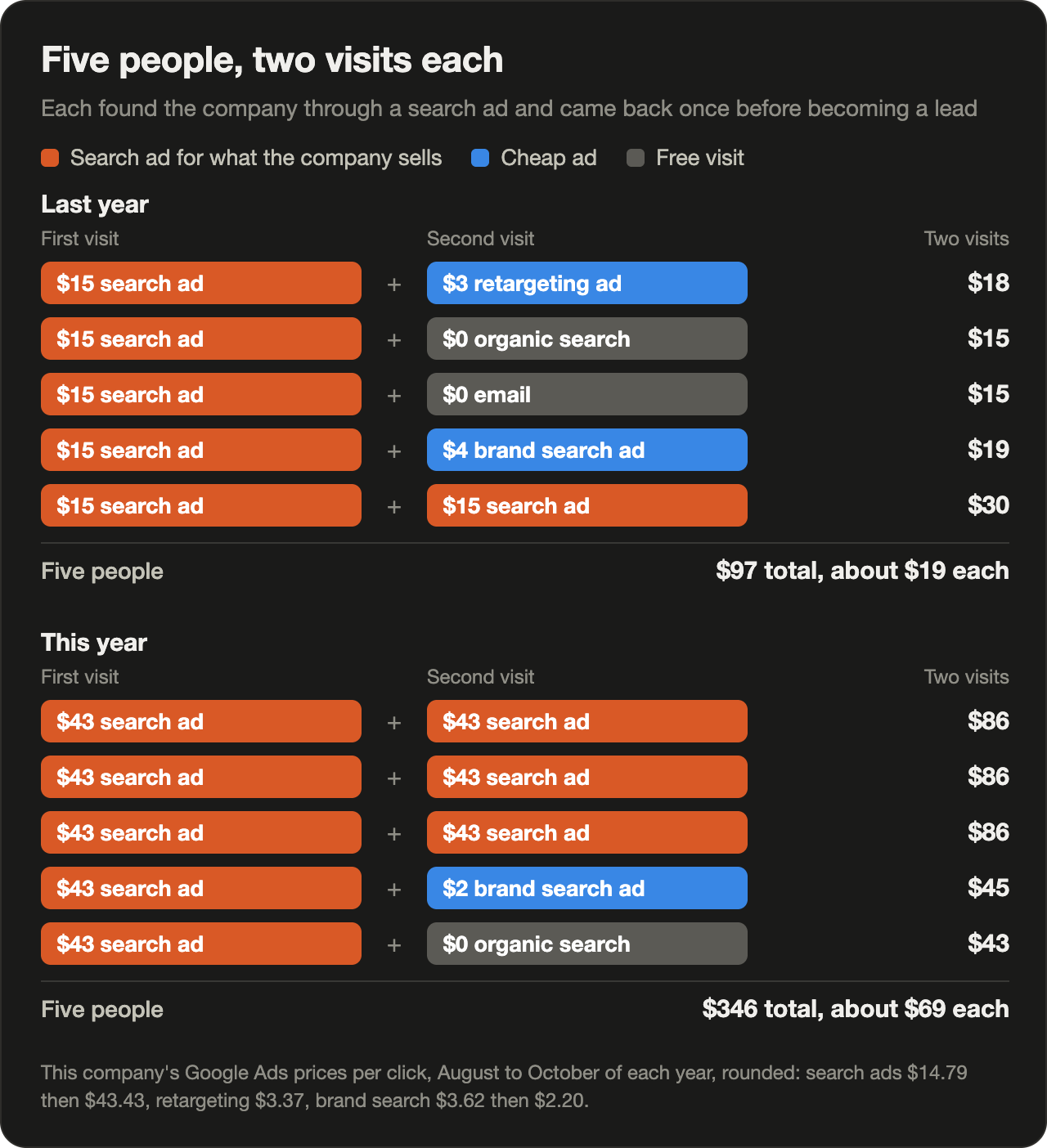
Last year, most of those second visits were cheap or free. This year, most of them cost another search click, and that click nearly tripled in price at the same time.
That's why you should think about users instead of sessions. The person who clicks a non-brand search ad is the same person who later clicks a retargeting ad, searches for the company by name and opens its emails. You can pay $43 every time that person comes back through a search ad, or pay it once and bring them back for a few dollars.
Search isn't the villain, you just can't afford it when nothing cheap is feeding it.
So the way to fix the non-brand search campaigns is to fix everything around them. Claude's suggestion was to turn retargeting back on, which is a good idea, but not enough on its own.
What we're recommending is cheap advertising on both sides of the expensive click. After the click, retargeting brings people back for a few dollars. Before it, video ads on YouTube can introduce the company to people who haven't searched yet, so more of them recognize the brand when they do.
Here's what that path costs at this company's prices:
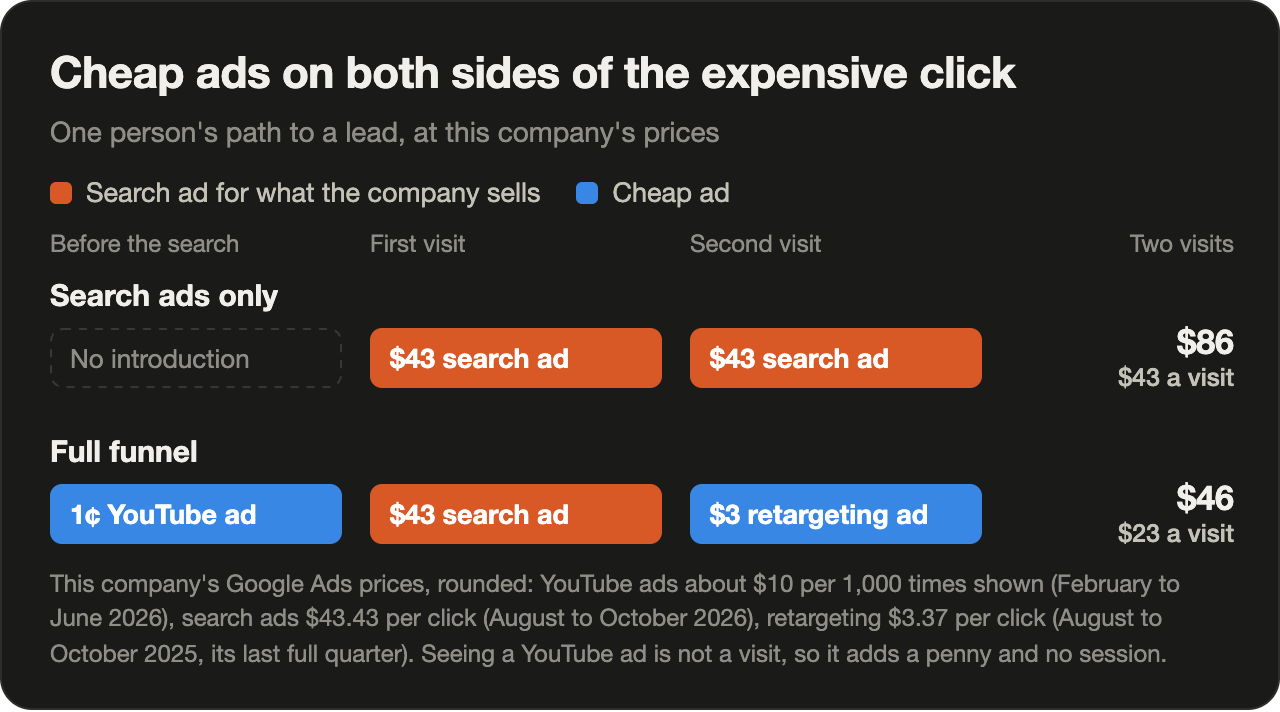
Same person, same $43 click, and the cost per visit drops by almost half. That's what a full-funnel marketing program buys you. The cheap ads before and after the expensive click bring down the blended cost per session, and because more of the people clicking already know who you are, more of them should turn into leads, which raises the conversion rate per user.
Do that across the whole audience, and the entire marketing program starts moving toward profitability, including the search campaigns Claude wanted to turn off.
In other words, do some goddam brand advertising! Market your message to the 95% of your target audience who are not ready to buy today, but might be in market tomorrow. This is how you change the economics of your performance marketing (see Issue #8 for more on this).
Most of the businesses I talk to have this exact problem. They've over-indexed on paid media while the cheaper traffic quietly evaporated around them, so cost per click, cost per session and ad spend keep climbing while every other number falls.
They keep trying to fix it inside search campaigns that are already doing their job (acquiring high-intent, bottom-funnel traffic), when what they need is a full-funnel marketing program, where the cheap channels and the expensive ones work together.
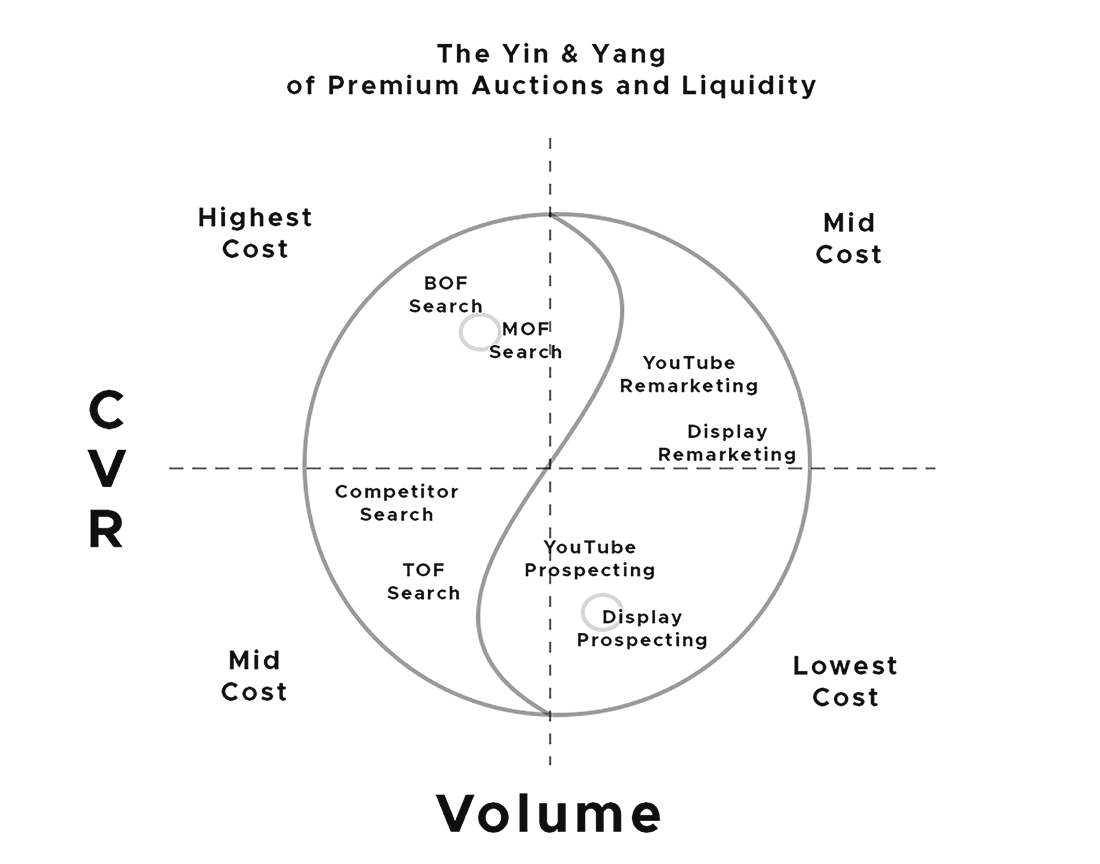
(By the way, I've been writing about this for years. My first book, Join or Die—published in 2020—has a whole chapter dedicated to this exact point, called "The Yin and Yang of Premium Auctions and Liquidity." In it, I emphasize the need to balance high cost-per-click traffic with quality traffic that can be obtained from cheaper channels.)
As for AI's strengths and weaknesses: I could not have done this audit without Claude. The real benefit was speed. It went through two years of data from four ad and analytics platforms at lightning speed. It also handled the calculations and surfaced ideas I didn't have, and transformed the data into useful visualizations that made it easier to interpret (the visuals you see in this email are just a fraction of what Claude presented to me).
This entire analysis took me a few hours (while I did other work). If not for AI, I’d still be banging my head against my desk trying to derive the first insight from a clunky GA4 table.
But a lot of Claude’s judgment was wrong! If I hadn't been the one directing it, it would have made a series of really bad calls, starting with turning off the best traffic the company buys today, and the analysis would have died on the spot.
For the last 18 months, we've been building a strategic second brain that serves as our operating system for analysis and optimization. It's called Sherpa, and its job is to know all of our internal decision trees and processes, so it can speed up the entire measurement and analytics process.
We improve Sherpa in two ways. The first is working in it directly: giving it feedback and adjusting its logic. The second is working outside it, directly with Claude or ChatGPT, to keep learning the biases of each new frontier model. This audit was the second kind. I worked directly with Claude's Opus 5.5 model, and the session logs, where I pushed it to explain its reasoning and reflect on where it went wrong, will be extremely valuable for improving Sherpa's backend.
I've since turned the whole audit into a Claude skill (a set of written instructions Claude follows), so the rest of my team will be able to run it on any account, starting from my questions instead of the internet's.
I wrote an entire book about why no part of your marketing works on its own: Never Always, Never Never.
Upcoming live workshops, all on Zoom
- The AI Video Workshop for Beginners, Tuesday, December 15. Make AI images and video with Webby-nominated director Dave Spector, our Creative Director, and leave with a first draft of your own commercial.
Also coming up:
- Mon, Nov 23: Claude for Design
- Tue, Nov 24: Claude for Beginners
- Tue, Dec 1: Claude Code for Beginners
Keep your AI skills from going stale AdVenture+ is our membership for people who already use AI at work and want to keep getting better at it: our Claude courses, live builds and deep dives on Zoom, and the recording of every past session. Join before December 1 and you lock in the $19/month founding rate. After that, it's $29/month. |
If you'd rather watch than read
This video is about what I call the first date fallacy: expecting people to buy the first time they meet you. About half of this company's leads came from people who had visited before, so it felt like the right one to end on.
The #1 Mistake Google and Meta Advertisers Make (The First Date Fallacy) · 3:25
I put new videos up on YouTube most weeks. Subscribing there helps more than you'd think.