December Isn't the Main Event Anymore
As the leaves start to turn, retailers are hunkering down for the most important sale period of the year.
When I joined AdVenture Media in 2015, the most important date on every client's calendar was the last day a customer could order and still get the package by Christmas Eve, usually around December 20th. Every client, whatever they sold, had the same plan: stay on sale and spend aggressively right up until that date.
That plan made sense at the time. In 2014, the year before I joined, U.S. online retailers sold 38% more in December than they did in November, according to the Census Bureau. December was the main event, and November was the warm-up.
Then retailers spent the next decade pulling Black Friday earlier:
- 2011: Target and Macy's open at midnight on Thanksgiving night.
- 2020: Walmart launches "Black Friday Deals for Days," starting online on November 4th, 24 days earlier than normal.
- 2022: Amazon adds a second Prime event in October and pitches it as the start of holiday shopping.
- 2025: Best Buy kicks off its holiday sales on Halloween.
Yesterday (October 23rd), I got an email from an apparel brand I shop with often, announcing the official start of its Black Friday sale.
Black Friday went from a single morning to a season that starts in October, and shoppers adjusted. If everything you want is on sale in November, you buy it in November.
As a result, December's lead over November has been cut in half. Last year, December online sales beat November's by just 17%, compared with 38% in 2014, and those two years are a fair comparison because Thanksgiving fell on November 27th in both.
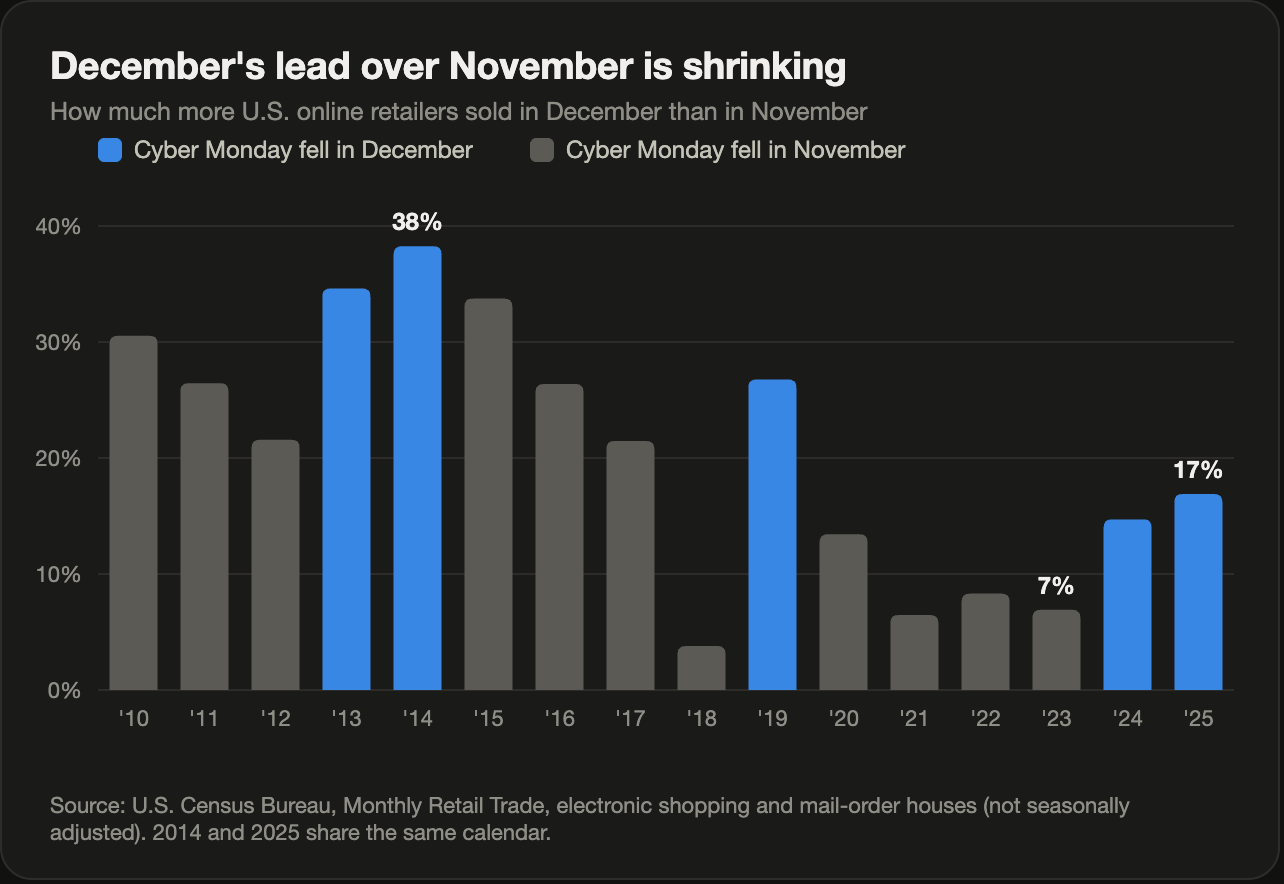
This year, the gap will likely be even smaller, because Black Friday and Cyber Monday both fall in November (Thanksgiving is on November 26th). The last time that happened, in 2023, December beat November by just 7%.
I pulled the data from our entire portfolio of retail and ecommerce clients. Using early November as the baseline, here's how the typical account's conversion rate (the share of visitors who buy) moved last holiday season:
- Black Friday through Cyber Monday: 27% above the baseline
- The three weeks after Cyber Monday: right back to the baseline
- The last week of December: 13% below the baseline, worse than an ordinary week in early November
The 2024 season followed the same pattern.
Ad spend doesn't follow the same pattern. Last year, more than half of the accounts we audited were spending more per day in the first three weeks of December than they had from Black Friday through Cyber Monday.
This is a trap a lot of marketers fall into. They see conversion rates and ROAS (revenue per ad dollar) jump over Black Friday weekend, then keep their foot on the gas into December as if they're playing with house money. When daily conversion rates start to drop, it's easy to justify by pointing to the season's average ROAS, or to time lag (the days or weeks between someone clicking an ad and buying). In reality, it's negligent and irresponsible.
So why has November become the critical holiday month?
One possible reason is that a lot of Black Friday revenue has nothing to do with gifts. As soon as Labor Day hits, I start hesitating on any nonessential purchase, knowing full well that almost everything in the universe will be steeply discounted within a month or two. Those purchases have very little to do with the December holidays.
But if it's December 15th and I still haven't found the right Christmas gift for my wife, I'm not sitting around waiting for a 15% coupon. I'll pay full price if I have to, because the delivery window matters more than a good deal.
The people still shopping in December are mostly in that position, so they buy from Amazon or drive to a store. Curbside pickup peaked on December 23rd last year, when it accounted for 39% of online orders at retailers that offer it, according to Adobe. A December discount mostly goes to gift buyers who were going to buy anyway, and it comes straight out of your margin.
So this year, for most of our clients, we'll build through November, push hard from Black Friday through Cyber Monday, and on December 1st, the day after Cyber Monday, reset spending to early-November levels. If the data tells us otherwise, we'll turn it back up. (Never always, never never.)
A lot of retailers spend weeks debating the exact discount: 20% or 25%, sitewide or select products. That obviously matters, but I've come to think being on sale matters more than the size of the discount, because being on sale at all establishes perceived value.
In late August, a premium brand we work with went on sale at 25% off, and its conversion rate doubled over the first three days. Even at a discount, it was still more expensive than most of its competitors.
Consumers are smart enough to realize that your Black Friday sale is probably the best discount they'll see from you all year. If you offer 20%, most will assume that's the lowest you'll ever go, and if you offer 10%, they'll assume the same thing.
There's a lot of nuance to this, but my point is that you don't need to give up all your margin trying to undercut everyone in the market.
If you've followed my advice for the last 11 months, you've hopefully been running a full-funnel strategy (reaching people long before they're ready to buy, not only when they're searching) that builds mental availability and brand salience, so that when your target audience is finally in the market, they're more likely to notice you and choose you, even if you're not the absolute cheapest option.
After all, as Les Binet and Peter Field put it, the whole point of marketing is to create demand for your products so you don't have to discount, or at least not as much as the next guy.
One way AI can help your BFCM execution
Deciding when to be on sale depends on what everyone else in your category is doing, and from Black Friday through Cyber Monday (BFCM), that changes every day.
We built an AI pricing agent for that premium brand to answer exactly that question. Every morning, it searches Google Shopping for the brand's main products, pulls the live price from every competitor and emails a report to their team and ours at 7 AM.
Here's one product over the last 5 weeks:
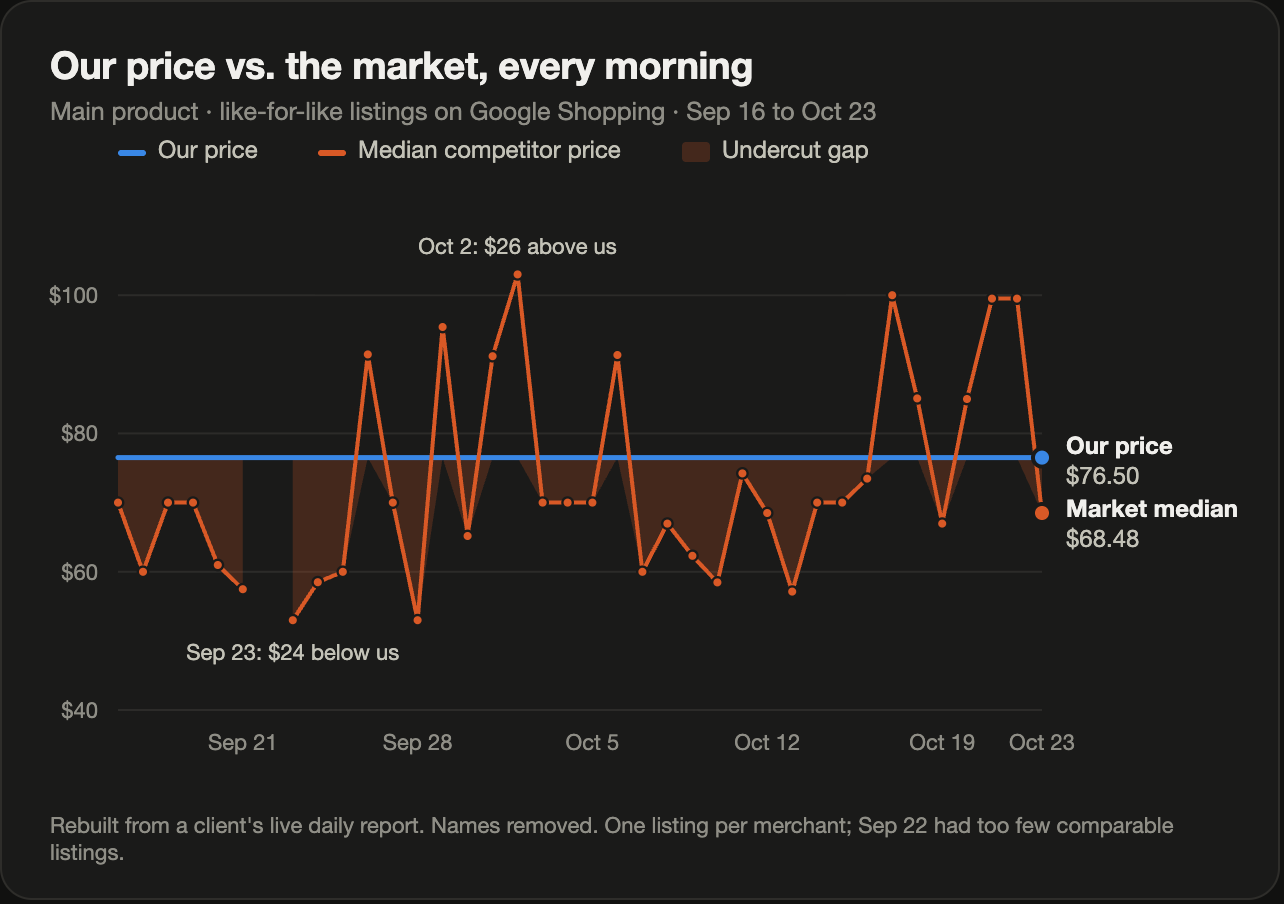
On September 23rd, the typical competitor was $24 cheaper than us, and on October 2nd they were $26 more expensive, which is the kind of swing a weekly check would miss.
And here's part of the lineup on October 23rd, when 10 of the 16 comparable listings were cheaper than ours, even though we were on sale too:
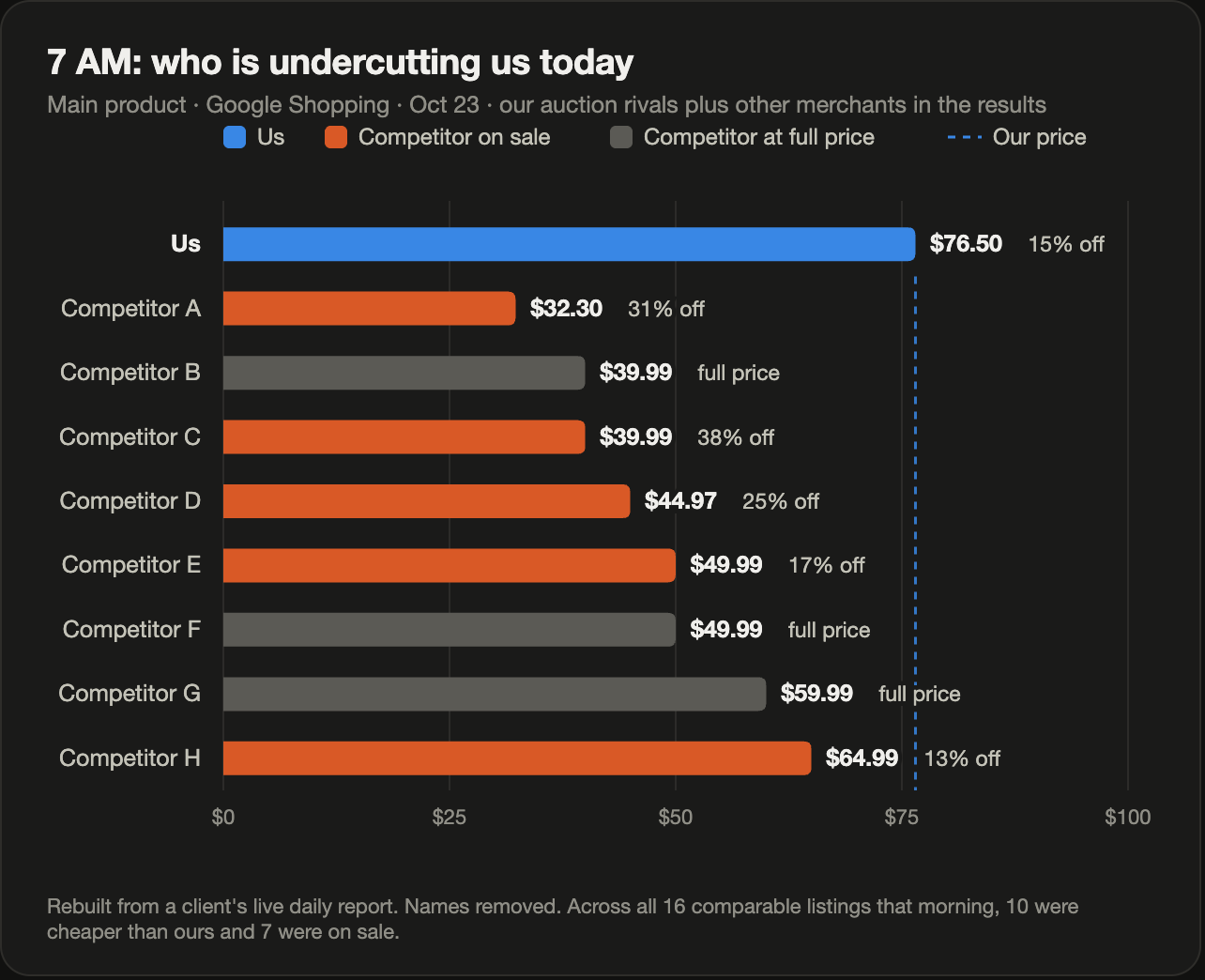
When the biggest retailers in the category go deep on discounts, we know before the day starts that orders will be harder to come by. When nobody else is on sale, we probably don't need to be either. That's how you avoid the two most expensive mistakes of Black Friday week: being on sale when you don't need to be, and missing the day everyone else goes on sale.
A few years ago, a custom tool like this would have cost more to build than it was worth to a single brand. With AI, we can build one for every client who needs it.
If you're interested in developing this pricing agent for your business, or any other solutions that can help you be better prepared for the upcoming sale period, feel free to reply to this email for more information about how we can help.
Build your own agents with AdVenture Plus The pricing agent in this issue is the kind of thing we teach people to build in AdVenture Plus, our membership for ongoing AI training. Yesterday's live session was about where the instructions you give an AI agent should live so it actually follows them, and the full recording is waiting in the Vault. Plus is free through October 31st. Join before December 1st, the day after Cyber Monday, and you lock in the $19/month founding rate. After that, it's $29/month. |
If you'd rather watch than read
We've built other tools like this for clients. Here's a budgeting tool we built for a $7M brand.

How We Built a Custom Marketing Budgeting Tool for a $7M Client Using AI Vibe Coding · 17:38
I put new videos up on YouTube most weeks. Subscribing there helps more than you'd think.