The Best Ecommerce Marketing Books Worth Actually Reading

Most ecommerce marketing book lists are recycled. The same ten titles appear everywhere, usually without explanation of why they matter or how they connect to each other. This list is different.
Books below were selected because they change how you think, not just what you do. Some are academic. Some are practitioner-focused. A few are contrarian. All of them have influenced how the team at AdVenture Media approaches ecommerce strategy, and all of them will sharpen how you see the market.
A note on organization: this list isn't ordered by popularity or Amazon ranking. It's ordered by how foundational the ideas are. Start at the top if you're building from scratch. Jump around if you already have strong instincts and want to pressure-test them.
---
The Core Reading List
Never Always, Never Never: Strategic Marketing in an AI World by Patrick Gilbert
Many ecommerce marketing books treat strategy as a checklist. Never Always, Never Never treats it as a set of tensions you have to manage, not resolve. Drawing on Byron Sharp's research and Ehrenberg-Bass Institute findings, the book argues that most ecommerce brands are making systematic, predictable errors: over-targeting their best customers, under-investing in reach, and misreading their own attribution data.
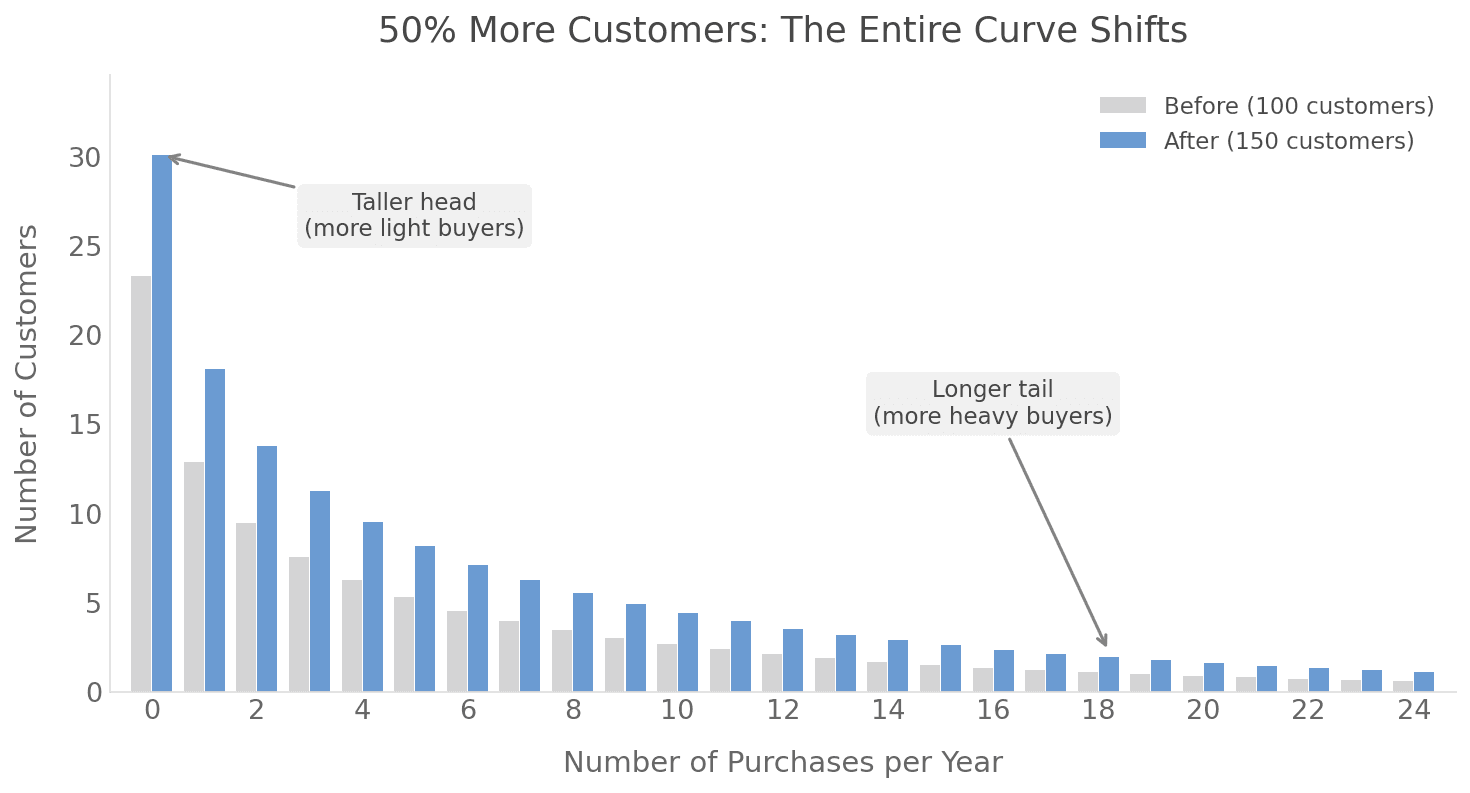
Two chapters are particularly useful for ecommerce operators. The chapter on light buyers makes the case that most of a brand's revenue comes from occasional, low-frequency purchasers rather than loyal superfans, which inverts the logic behind most loyalty-first marketing strategies. The chapter on physical availability argues that being easy to buy is just as strategically important as being memorable, and that every friction point in your checkout flow, channel presence, or fulfillment experience is a competitive disadvantage you've chosen to accept.
Its title captures the central argument: marketing is full of principles that are almost always true and almost never false, but rarely absolutely either. Knowing when to follow the evidence and when the evidence doesn't apply to your specific situation is the actual skill.
Brand Growth and Reach
How Brands Grow by Byron Sharp
Published in 2010 by Oxford University Press, this is the book that rewired how serious marketers think about growth. Byron Sharp's argument is direct: brands grow by reaching more buyers, not by deepening loyalty among existing ones. Mental availability and physical availability are the two levers that matter. Loyalty tactics, by contrast, produce much smaller returns than most marketers expect.
For ecommerce, this is uncomfortable reading. It challenges the entire retention-first, LTV-maximization playbook that DTC brands spent a decade building. Sharp's data shows that heavy buyers are already buying near their ceiling, and that the real growth opportunity sits with the vast pool of light buyers vs loyal customers who purchase infrequently and without much deliberation. If your Google and Meta campaigns are built almost entirely around lookalike audiences of your best customers, this book will make you rethink that.
Ehrenberg-Bass Institute research underlying this book is the most rigorous body of evidence in marketing science. The conclusions aren't comfortable, but they hold up across categories and geographies.
Messaging and Positioning
Building a StoryBrand: Clarify Your Message So Customers Will Listen by Donald Miller
Released in 2017 by HarperCollins Leadership, this is the most practically useful book on ecommerce messaging you can read in a single weekend. Miller's argument is simple: most brands make themselves the hero of their own story, when the customer needs to be the hero. His StoryBrand Framework organizes messaging around seven universal story elements, giving brands a repeatable structure for landing pages, emails, ads, and product descriptions.
It consistently appears on Shopify's recommended reading lists and roundups like DelightChat's 2026 ecommerce books guide for a reason: it works at the execution level. Experienced brand strategists sometimes find the framework formulaic, and that criticism is fair. But for founders and marketers who are struggling to explain what they sell and why it matters, this book eliminates the guesswork. Rated approximately 4.7/5 on Amazon, it has earned that score.
Consumer Psychology and Persuasion
Influence: The Psychology of Persuasion by Robert B. Cialdini
First published in 1984, this book should not still be relevant. The fact that it is says something about how slowly human psychology changes relative to marketing technology. Robert B. Cialdini identified the core triggers of persuasion, including reciprocity, social proof, authority, and scarcity, decades before ecommerce existed, and every single one of them shows up in modern conversion rate optimization.
When you add urgency countdowns, review counts, trust badges, or free-gift-with-purchase thresholds to your product pages, you are applying Cialdini's framework whether you know it or not. Reading the source material helps you apply these principles with more precision and avoid the cheap, transparency-breaking shortcuts that erode brand trust.
Predictably Irrational by Dan Ariely
Published in 2008, Dan Ariely's central argument is that consumer irrationality is not random. It is systematic and therefore predictable. Price anchoring, the power of free, relative value comparisons, and the pain of paying are all forces that shape purchase decisions in ways that have nothing to do with product quality.
For ecommerce brands, this is a pricing and UX handbook disguised as a behavioral economics book. How you present your pricing tiers, the order you list your options, whether you show the crossed-out original price, and how you frame your shipping costs all trigger predictable psychological responses. Understanding those responses lets you design purchase flows that work with human psychology rather than against it. Pairs well with Cialdini, and together the two books cover most of what actually drives conversion.
Organic Growth and Word of Mouth
Contagious: Why Things Catch On by Jonah Berger
Jonah Berger's 2013 research identifies six factors that make products and ideas spread: social currency, triggers, emotion, public visibility, practical value, and stories. His STEPPS framework is the organizing structure, and it is genuinely useful for ecommerce brands thinking about organic growth, referral programs, and shareability.
This book is not primarily about paid advertising. It is about why some products get talked about and others don't. If your referral program is underperforming, if your UGC is thin, or if your product simply doesn't generate word-of-mouth despite being genuinely good, Berger's framework helps diagnose why. The answer is usually that the product or its positioning lacks social currency or public visibility, both of which are fixable.
Experimentation and Scaling
Hacking Growth by Sean Ellis and Morgan Brown
Published in 2017, Sean Ellis and Morgan Brown's book introduced the growth team model to mainstream business audiences. Their argument is that growth should be treated as a disciplined experimentation process, not a department or a campaign calendar. Cross-functional teams, rapid testing cycles, and analytics-driven iteration are the mechanisms.
For ecommerce brands running structured A/B tests on landing pages, email sequences, and ad creatives, this book provides the operational framework. The experimentation mindset it promotes pairs naturally with The Lean Startup and is particularly useful for brands that have found product-market fit and are now trying to scale acquisition efficiently. This is not a brand strategy book. It is an execution book, and it is honest about that.
The Lean Startup by Eric Ries
Eric Ries introduced the build-measure-learn loop in 2011, and it remains the most widely adopted framework in startup-stage ecommerce. His core argument is that companies fail by overbuilding before validating, and that fast, cheap experiments eliminate waste by testing assumptions before they become expensive commitments.
For ecommerce founders launching new products, new channels, or new offers, the minimum viable product thinking in this book is essential. It also applies directly to landing page strategy: rather than designing your ideal checkout flow in month one, test the cheapest version that still works, measure what breaks, and iterate. The validation-first mentality cuts through the sunk-cost traps that kill early-stage DTC brands.
Blue Ocean Strategy by W. Chan Kim and Renée Mauborgne
W. Chan Kim and Renée Mauborgne's 2005 argument is that competing in crowded markets is fundamentally less profitable than creating uncontested market space. Their strategy canvas tool helps brands identify which features the entire category competes on and where genuine white space exists.
For premium ecommerce brands, this book is most useful as a positioning exercise. If every competitor in your category is competing on price, selection, and fast shipping, there may be entirely different axes, community, craftsmanship, sustainability credentials, or service quality, on which you can build a defensible position. This pairs with the concept of differentiation vs distinctiveness: Blue Ocean finds the strategic territory; distinctiveness makes it memorable.
Ecommerce Growth Strategy by Kunle Campbell
Released in 2023, this is the most operationally current book on the list. Kunle Campbell's argument is that sustainable ecommerce growth requires a brand-led engine that connects acquisition, retention, and customer lifetime value rather than treating them as separate functions. Goodreads describes it as a practical guide for thriving in ecommerce, and that description is accurate.
Every other book on this list was written before modern ecommerce existed or was written about adjacent domains. This one was written specifically for DTC operators navigating rising CPAs, platform dependency, and post-iOS 14 attribution chaos. It is increasingly cited by ecommerce practitioners precisely because it engages with the current environment rather than retrofitting older frameworks to it.
---
How to Actually Use This List
Don't read these sequentially unless you're building your foundation from scratch. If your immediate problem is messaging, start with Building a StoryBrand. If your paid media is plateauing, start with How Brands Grow and the chapter on light buyers in Never Always, Never Never. If you're pre-launch and still validating, The Lean Startup comes first.
Books that will change your thinking most are probably the ones that challenge what you already believe. If you're a performance marketer who has never questioned the value of hyper-targeting, Byron Sharp's work will be uncomfortable. If you're a brand-first thinker who dismisses conversion optimization, Cialdini and Ariely will recalibrate you.
The real skill isn't reading any one of these books. It's holding multiple frameworks at once and knowing which one applies to your specific situation at any given time. That's what brand vs performance marketing decisions actually look like in practice, and it's what separates marketers who grow brands from those who just manage campaigns.
For more on how these ideas connect to modern measurement challenges, the post on why ROAS misleads ecommerce brands covers the attribution side of the same problem these books diagnose from the strategy side.
 Patrick Gilbert
Patrick Gilbert is the CEO of AdVenture Media and author of Never Always, Never Never and the bestselling Join or Die. He has been ranked among the top 5 PPC experts worldwide and has delivered keynotes at Google events across three continents.
More about Patrick →Enjoyed this?
Subscribe for more articles on strategy, AI, and what's actually working in marketing.
No spam. Unsubscribe anytime.