Aldi Sells Almost Nothing You Have Heard Of and Grows Anyway

Aldi carries roughly 1,800 SKUs per store. A typical Walmart Supercenter carries somewhere north of 100,000. Aldi's shelves are more than 90% private label, brands you have almost certainly never seen anywhere else. And yet, at the end of 2025, Aldi was the third-largest U.S. grocer by store count, with 2,614 locations, a target of 3,200 by 2028, and aggressive expansion across 31 states planned for 2026 alone.
Conventional marketing playbooks say this shouldn't work. Byron Sharp's research at the Ehrenberg-Bass Institute shows that brand growth comes from reaching as many buyers as possible, including the light ones who only buy occasionally. National brands spend billions building the mental structures that make their products easy to think of at the moment of purchase. Aldi has almost none of that. No Heinz. No Tide. No Oreos.
So why is Aldi winning?
Because Aldi is not playing the same game.
The Decision Happens Before the Shelf
Most grocery strategy is built around the assumption that shoppers decide what to buy at the shelf. National brands fight for that moment. They build mental availability so that when a shopper reaches the pasta aisle, their brand surfaces first. They pay for eye-level placement. They design packaging to win at a glance.
Aldi's model short-circuits all of that. What matters most at Aldi isn't which brand of coffee creamer to buy. It's whether to go to Aldi at all.
If a shopper has already chosen Aldi, the brand question collapses. There is no Hellmann's to compare against. There is Aldi's private label, and there is not buying mayonnaise today. Aldi substitutes its own curation and price promise for the mental availability of individual brands. Shoppers don't need to recognize the product. They need to trust the store.
This is why the 2025 rebrand mattered strategically. Consolidating roughly 90 separate store-brand names down to approximately 26 made Aldi's own name more visible across the shelf. That message was deliberate: the brand doing the work here is Aldi, not the product label.
What Aldi Gave Up (And Why That's the Strategy)
This model has a real cost, and Aldi accepts it explicitly.
Byron Sharp's work on category entry points shows that brands grow by being mentally accessible across a wide range of buying situations. A brand linked to many different occasions, moods, and needs wins more purchase moments. Aldi's limited assortment actively shrinks the number of those occasions. If you need a specific SKU, a niche product, or a national brand your child will accept, Aldi might not be your store.
Light buyers, the occasional shoppers who make up the majority of any brand's revenue base according to Ehrenberg-Bass research, are especially vulnerable to this friction. A shopper who only visits a grocery store for one or two specific items will simply go elsewhere if Aldi doesn't carry them.
Patrick Gilbert covers this tradeoff directly in Never Always, Never Never: limiting physical accessibility narrows the number of potential customers willing to do business with you. Every decision that adds friction, whether that's a missing product, an absent payment method, or a closed channel, reduces the likelihood of conversion for some portion of potential buyers. Aldi's model is a deliberate application of that logic. It accepts lost occasions in exchange for sharper economics on the occasions it does capture.
1,800 SKUs instead of 100,000 means less inventory complexity, faster stocking, smaller stores, and dramatically lower operating costs. That price advantage is not incidental. It is the product.
Physical Availability, Scaled Differently
In Never Always, Never Never, the chapter on physical availability makes the point that being easy to buy requires presence, relevance, and prominence at the moment a buyer is ready to purchase. For most brands, that means broad distribution across as many channels as possible.
The store's interpretation of physical availability is unusual. Rather than placing its products everywhere, it places its stores everywhere. Aldi opened nearly 200 locations in 2025. It planned more than 180 additional openings in 2026. By the end of 2028, the company is targeting 3,200 U.S. stores.
Geographic density, not product breadth, is the bet. Get close enough to enough shoppers, make the price gap obvious enough, and you don't need to compete at the level of individual product choice. You compete at the level of the shopping trip itself.
This is a fundamentally different physical availability strategy from, say, Coca-Cola's model of being within arm's reach of desire across every channel, vending machine, restaurant, and gas station fridge. Aldi's version of availability is: be in your neighborhood, be cheaper, be fast. That's enough for a significant share of grocery trips, even if it never captures all of them.
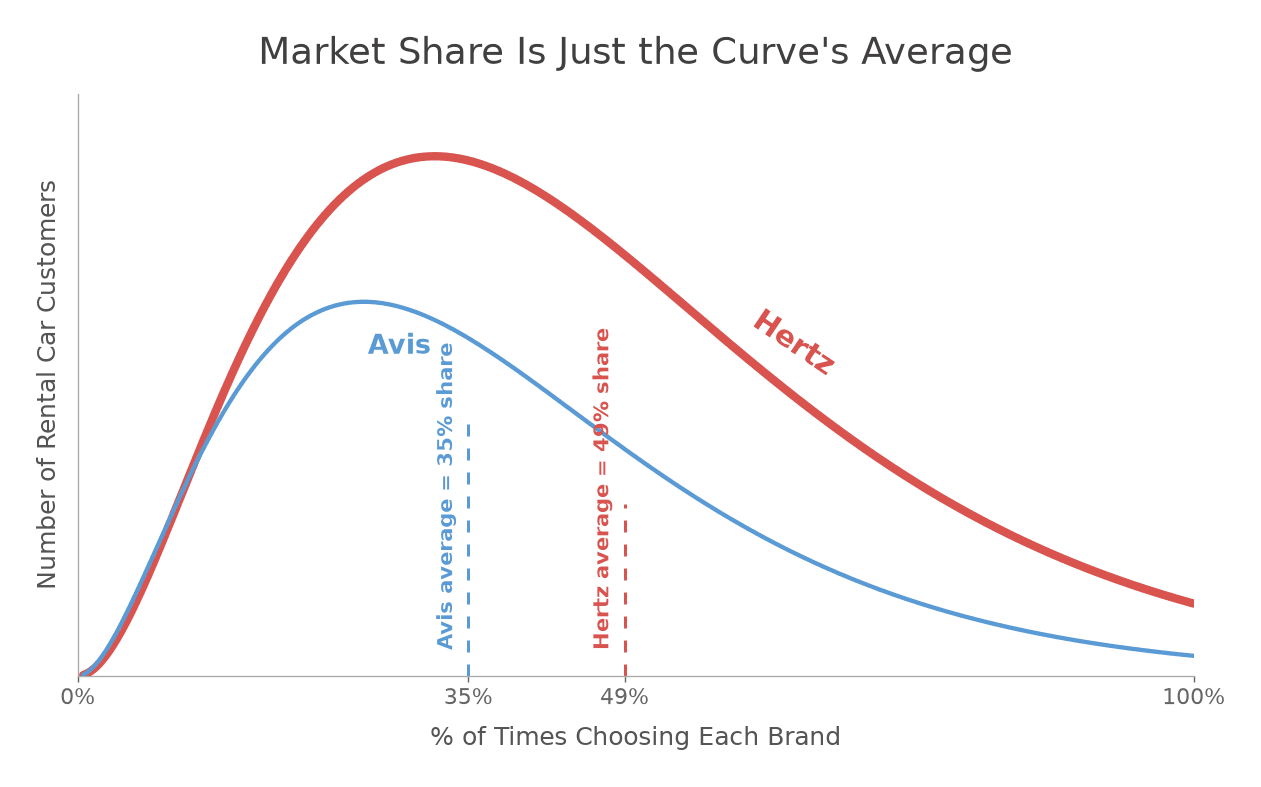
At 2.8% U.S. grocery market share through early October 2025 (per Numerator data cited by CNBC), Aldi is not a dominant player by share. But its store-count growth tells a different story. It is building density fast, and grocery shopping has strong habitual patterns. Once Aldi is the closest, cheapest option on a shopper's route, inertia works in its favor.
The Mental Availability Aldi Actually Builds
Aldi does not build mental availability for its products in the way that consumer packaged goods brands do. But it builds very clear mental availability for the retailer itself.
Ask most shoppers what Aldi stands for. They will tell you: cheap, no-frills, good enough. That is a remarkably coherent brand position, and it is one Aldi has reinforced consistently for decades. Founded in Germany in 1946, the company opened its first U.S. store in Iowa in 1976. Fifty years of the same basic value proposition creates a strong memory structure.
Ehrenberg-Bass frames mental availability as the ease with which a brand comes to mind across relevant buying situations. Aldi's buying situation is specific: when price is the dominant factor in a grocery trip, Aldi surfaces easily. It does not try to surface for premium shoppers, brand loyalists, or specialty-category buyers. It surfaces for the shopper who wants to spend less on groceries this week.
Narrowing the set of category entry points is a real constraint compared to what most national brands target. But it reaches a very large set of shoppers, particularly when inflation puts price pressure on household budgets. Aldi's recent growth is partly a function of how well its positioning aligns with economic conditions that push consumers toward value formats.
The grocer also uses social media more tactically than most people realize. Instagram and Facebook polls let shoppers choose Barissimo Coffee Creamer flavors, tying social content directly to private-label product development. Shoppers who voted for a flavor have a reason to notice it on the shelf.
The Comparison That Clarifies Everything: Aldi vs. Walmart
Walmart's grocery strategy is built on breadth. National brands, store brands, specialty items, and everything in between. Walmart's physical availability covers nearly every product a shopper might want. Its mental availability spans virtually every grocery buying occasion.
Aldi's strategy is the opposite. Fewer SKUs, more stores, lower prices, private label almost exclusively.
Both are growing. Both work. They are not competing for the same shopper on the same trip. Walmart wins when a shopper needs 40 different items from 20 different categories and wants to choose from multiple brands in each. Aldi wins when a shopper wants to spend less and is willing to trust the store's curation in exchange for lower prices and a faster shopping experience.
This is what Never Always, Never Never keeps returning to as a structural principle. No universally correct marketing strategy exists. What matters is whether the strategy chosen is internally consistent, and whether the tradeoffs it requires are ones the business model can sustain.
Aldi's tradeoffs are consistent. Narrow assortment funds low prices. Low prices fund store-count growth. Store-count growth funds physical availability. Physical availability drives repeat visits. The model compounds.
Walmart's tradeoffs are also consistent, just different. At AdVenture Media, when we look at competitive positioning questions like this, the first question is always: what does this brand actually give up, and does it know it? Aldi knows exactly what it gives up.
The Private Label Bet Has a Second-Order Effect
Controlling the product means controlling the innovation cycle. Aldi doesn't negotiate with national-brand manufacturers to run a limited-time SKU. It decides internally. That speed advantage is real.
It also means Aldi captures the full margin on every sale rather than sharing it with a brand manufacturer. That margin advantage compounds across more than 90% of its assortment.
Collapsing roughly 90 private-label names into approximately 26 in 2025 was partly an efficiency play and partly a brand-building move. Fewer names means more recognition for each one. More recognition for each one means the trust shoppers extend to Aldi-the-retailer transfers more cleanly to Aldi-the-product. Distinctive brand assets work harder when concentrated rather than scattered across dozens of sub-brands most shoppers will never learn.
This is one of the more underappreciated aspects of the strategy. National brands spend to build mental availability for their products. Aldi spends to build mental availability for its name, then extends that name across a growing but curated product range.
What Aldi's Growth Actually Proves
Aldi's growth does not disprove Ehrenberg-Bass. It illustrates a specific condition under which the standard playbook can be modified.
Byron Sharp's research on light buyers and mental availability describes how brands grow when competing for share within a category where many brands are available. Aldi has restructured the category so that comparison mostly does not happen at the product level. When you walk into Aldi, you are not choosing between Aldi's coffee creamer and International Delight. You already chose Aldi by walking in the door.
That is why the standard argument that brands must build broad mental availability across many category entry points applies differently here. Aldi's category entry point is the shopping trip, not the product. Win the trip, and you win the basket.
For other retailers, the lesson is not that private label always wins or that assortment depth is always a mistake. It's that the unit of competition matters. Aldi competes at the level of the trip. Whole Foods competes at the level of the experience. Costco competes at the level of the membership. Each model implies a different set of availability and awareness strategies.
For brands (not retailers) trying to understand this: Aldi's model is a real threat precisely because it competes at a level where your brand equity is largely irrelevant. Your mental availability doesn't help you if the shopper never reaches a shelf where you exist.
A related version of this dynamic appears in our analysis of Costco's Kirkland Signature strategy, which uses a similar private-label trust transfer but with a membership model layered on top. The mechanics are different, but the underlying principle, building retailer trust strong enough to substitute for brand trust, is the same.
You might also find the analysis of Trader Joe's so-called anti-marketing approach useful here. Trader Joe's runs a comparable limited-assortment, high-private-label model, but positions on experience and discovery rather than pure price. Three different models, same core insight: if you control the trip, you control the basket.
The Takeaway
Aldi's strategy is not a rejection of marketing science. It is an application of it at the retailer level rather than the product level.
Build mental availability for the store. Make the store physically available to more shoppers by opening more locations. Control the product to capture the margin and accelerate innovation. Keep the assortment narrow enough to preserve the economics that make the whole model work.
Accepting this model means giving up category entry points for shoppers who want a brand you don't carry. Some light buyers will go elsewhere for specific trips. Aldi bets that the shoppers it does capture will come back often enough, and spend enough per trip, to offset those losses.
Through 2025, that bet is paying off. Whether it holds as Aldi pushes toward 3,200 stores by 2028 and faces stronger competition for the value-seeking shopper depends on whether it can maintain price discipline and assortment quality as it scales.
For now, Aldi has built the third-largest grocery chain in America almost entirely out of products you have never heard of. That is not a marketing failure. It is a different definition of what marketing is supposed to accomplish.
 Patrick Gilbert
Patrick Gilbert is the CEO of AdVenture Media and author of Never Always, Never Never and the bestselling Join or Die. He has been ranked among the top 5 PPC experts worldwide and has delivered keynotes at Google events across three continents.
More about Patrick →Enjoyed this?
Subscribe for more articles on strategy, AI, and what's actually working in marketing.
No spam. Unsubscribe anytime.