
Over the last few issues, I've introduced you to the Customer Demand Curve: most of a brand's customers are light buyers who purchase once or twice, a small handful are heavy buyers out on the long tail, and the shape of that curve is remarkably consistent across nearly every category.
The responses have been fantastic. One reader sent a question I suspect many of you were quietly asking:
"The label of 'heavy buyers' comes across to me as desirable. The psychology of the light buyer makes a lot of sense, but how do we attract or influence a heavy buyer? Are they already an existing customer? Is the situation that we're trying to increase their AOV or purchase frequency? Or maybe the success of keeping a heavy buyer comes from the very beginning, when the business plans the customer experience, and the longevity of that client is reliant on how well your brand interacts with them first-hand. What do you think?"
My answer, in reality, is none of the above.
Could any of those things generate heavy buyers? Sure. But the real answer is that if you focus on new customer acquisition, you will generate new customers who slide in across the entire customer demand curve. Most of them will be light buyers. Some of them will be heavy buyers. You don't get to choose which is which, and you don't need to.
Let me show you what I mean.
This year, approximately 15 million people will travel to Disney World for the very first time.
For many of them, this will be their first and only trip to Disney. A handful will come back at some point in the distant future. Others will come back sooner. Some will decide to make it an annual tradition. And a small percentage will become Disney fanatics: the ones who visit multiple times per year, join the Disney Vacation Club, book trips on the Disney Cruise Line, get married on Disney property, and become very, very heavy buyers of various Disney vacation experiences.
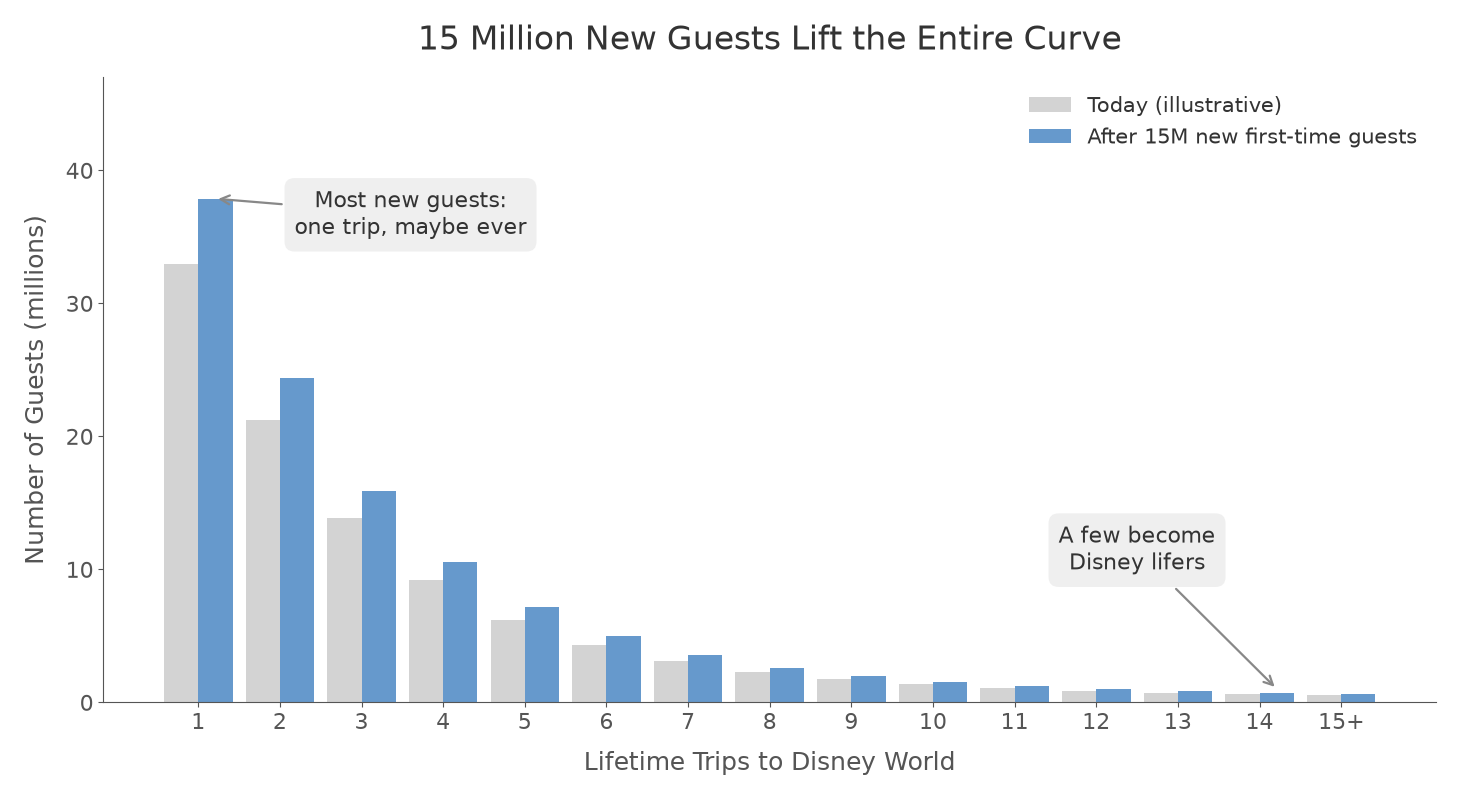
Look at what happens to the curve. Disney isn't acquiring 15 million "light buyers" or 15 million "future fanatics." They're acquiring 15 million new customers of all shapes and sizes, knowing most will visit once, and trusting that the curve will do what it always does.
So who is Disney's ideal buyer persona? Who is most likely to become a heavy buyer?
"Families with young kids" is probably your answer. I'd agree. Disney would probably agree too. But does Disney cater exclusively to this audience? Heck no. If you don't believe me, look at the money they've invested in making Disney Springs the premier shopping and nightlife destination in the Orlando area: a massive city of bars, restaurants, and outlet stores that is, frankly, a nightmare to navigate with young kids. Or look at the Epcot World Showcase, an incredible destination for adults who want to go on a bar crawl disguised as a culture tour.
Walt Disney's original vision was to deliver fun experiences for the entire family: the children, the teenagers, the adults, the grandparents. Are families with young kids probably their best customers? Yes. Both things can co-exist.
And importantly: Disney still turns a profit from the people who show up once and never return. Trust me.
Another example: Shopify exists to make it possible for anyone to start an ecommerce store. Literally anyone. And if it truly is that easy, it follows that a lot of people will sign up for Shopify with really bad business ideas and shut their stores down within a few months.
Wall Street often penalizes Shopify for that churn. I think that's a mistake, because their entire business proposition is accessibility. If your weird neighbor wants to set up a store selling artisanal dog sweaters, then closes up shop after a few months, Shopify should be happy to have had them as a customer for that time.
Because for every batch of short-term customers who churn, a Gymshark or a Kylie Cosmetics or a Mattel rolls around and generates tens of millions in revenue for Shopify each year. And in between Gymshark and your weird neighbor's dog sweater store sit millions of ecommerce stores generating healthy revenue who will never leave the platform.
Who is Shopify's heavy buyer persona? Gymshark? Mattel? The mid-level merchants? I'm honestly not sure. And that's exactly what makes them such a great business.
Shopify generates some level of profit from all of these customers ... even your weird neighbor with the dog sweaters.
One final example, on a much smaller scale. I'm very loyal to a jeans brand called Mugsy. I've been a heavy buyer for about ten years because I find them to be the perfect blend of style, fit, comfort, and value. You could argue I'm exactly the guy who fits their target demo. But does that mean other people "like me" are likely to become heavy buyers too? Not necessarily.
I've recommended Mugsy to all of my closest friends. Many of them bought a pair, and they're happy with the purchase. But I'm the only one who became (and stayed) a heavy buyer.
My buddy Marc and I are basically the same person, and therefore, we get targeted by all the same brands on Instagram. Let's assume neither of us had ever heard of Mugsy before, but their Instagram ads convinced both of us to independently buy a pair of their jeans in 2016.
Now fast forward. If we analyzed the LTV of that 2016 customer cohort, we'd likely see something that looks like this:
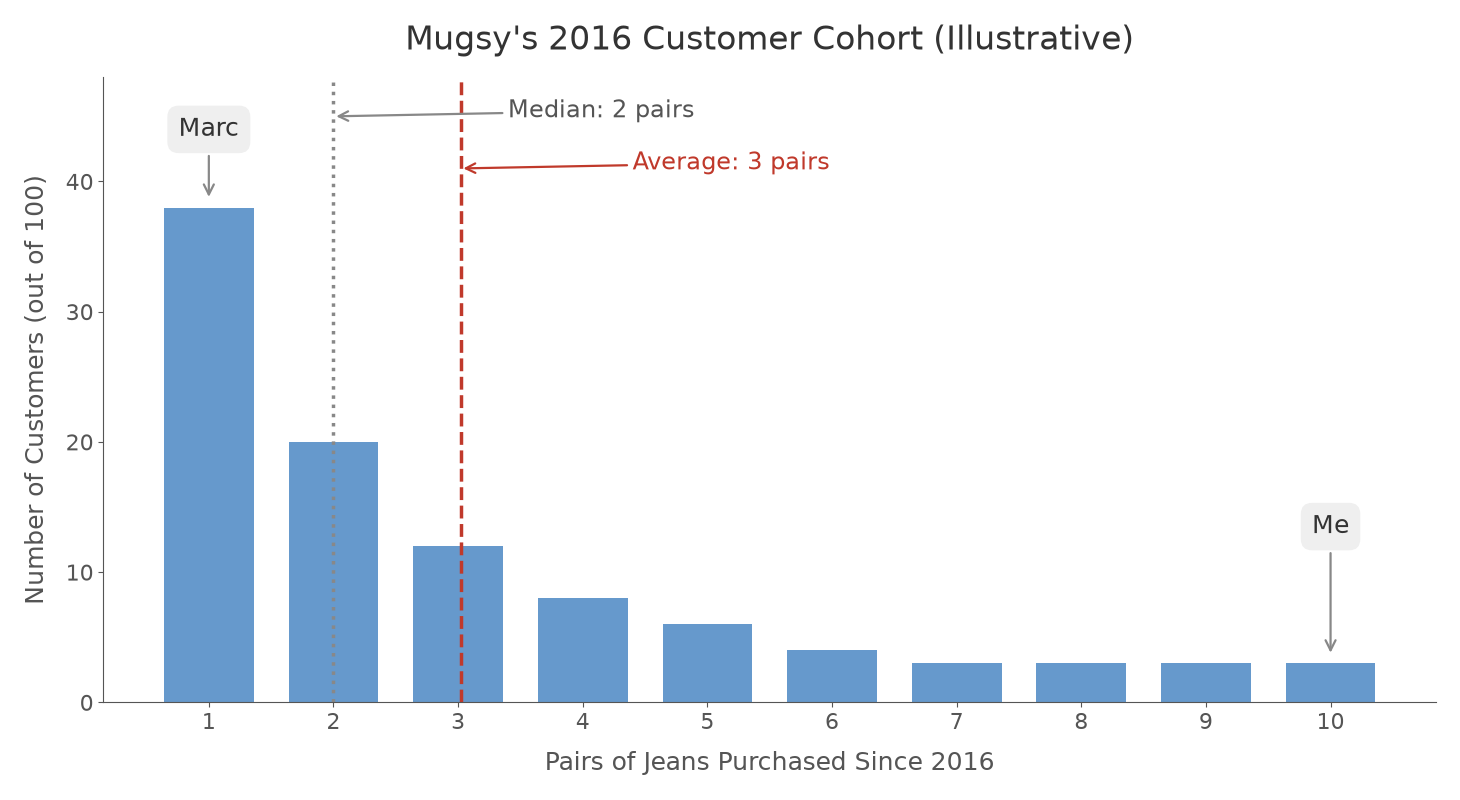
You could never have predicted this at the beginning. Marc and I are so similar that you would have assumed we'd have a similar LTV. And even now, you wouldn't be able to retroactively explain why our actual buying patterns were so different. It just ... is.
This is a frustrating reality of marketing. But unfortunately, not everything can be distilled into a mathematical equation. Consumers are random, irrational, and unpredictable.
In short: focus on new customer acquisition. Assume most of your new customers will be light buyers. But some of them will become heavy buyers! That's how you build a successful (and profitable) brand.
And understand that this only works in one direction. Market to light buyers, and some of them will become heavy buyers. Market only to your heaviest buyers, and the light buyers never show up. Let me explain.
Imagine if Disney World were only interested in acquiring lifelong Disney Vacation Club members who'd visit the parks four to six times a year, stay at the most expensive resorts, and buy annual passes. That would be a huge mistake. Disney is smart enough to make a one-time vacation incredibly accessible to people from all walks of life. And when 15 million new guests walk through the gates this year, a handful of them will fall in love immediately and decide to become Disney lifers.
This is exactly what my wife's family experienced in the mid-90s. They took a trip to Disney assuming it would be their "one" Disney vacation. Before that first vacation ended, her parents decided to sign up for the Disney Vacation Club (essentially a long-term timeshare).
They've been back at least once a year for the last 30 years ... and the rest of us got sucked in indoctrinated as we married into the family.
We're all headed there in a few weeks. About 18 of us. That initial light buyer has certainly paid dividends for Disney.
Keep the questions coming. This issue exists because one reader hit reply.
Personal Carve Outs
This is something new I'm trying: a short personal section at the end of (some) issues. Just things from my world worth sharing.
Last week, Google Ads featured me in an official social media post promoting some of the new features rolling out in the platform.
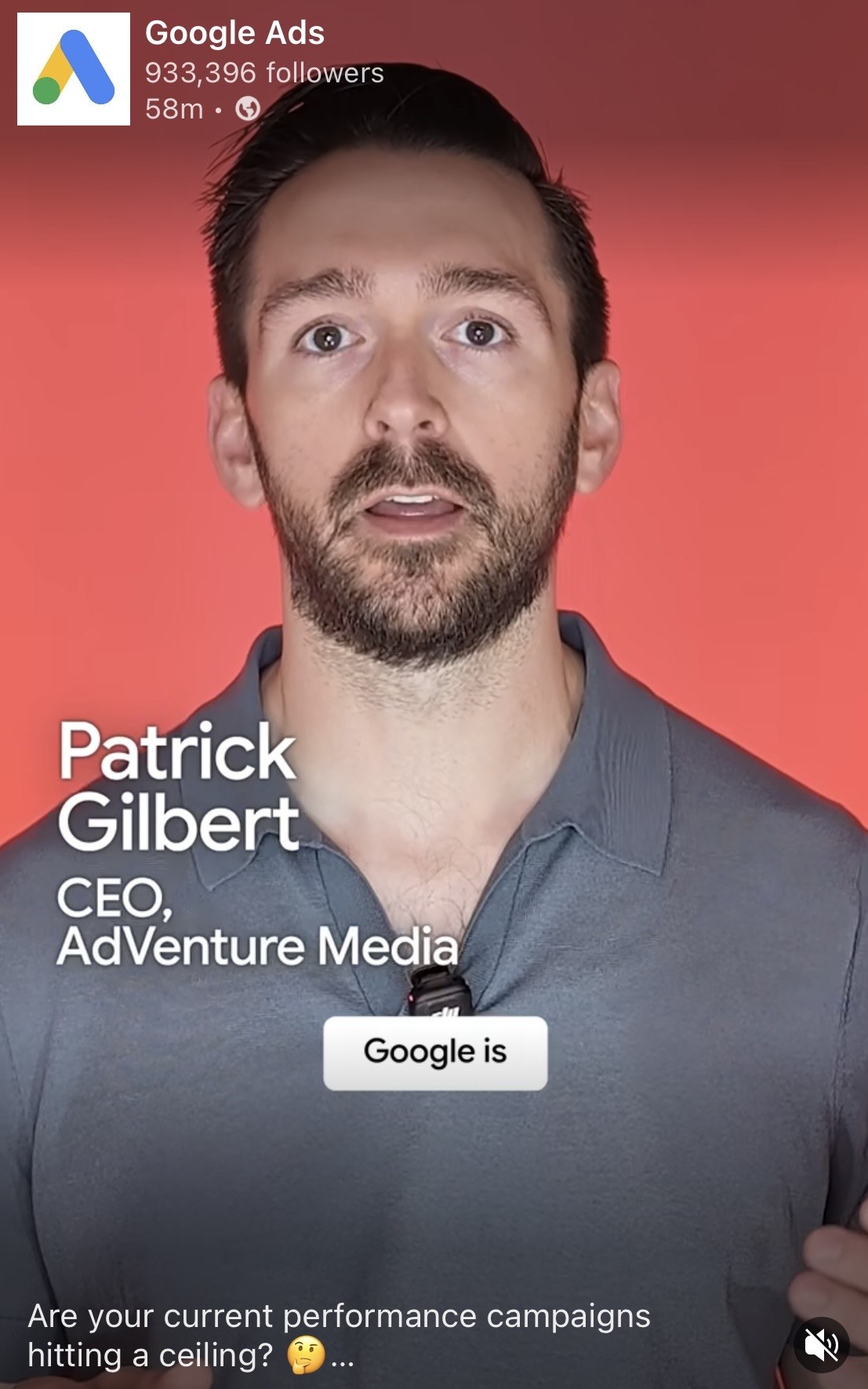
I've done a handful of these collaborations with Google over the last two years. This one took place at Brandcast, an event highlighting the current and future state of the YouTube advertising platform, and it was an amazing event. I've always been very bullish on YouTube ads, and I'm excited about a lot of what's rolling out in the Google and YouTube Ads interfaces right now.
But here's what blew my mind about this particular shoot. Usually I show up to a studio with a full film crew, lighting rigs, sound equipment, and wires draped across the floor. This time I walked into a big empty room in one of Google's New York offices and found one guy with a ring light and a Google Pixel phone. He shot and produced the entire thing in a matter of minutes. And it looks great.
It is not lost on me how special these invitations are. Getting to participate in them is a personal milestone, and this one was a lot of fun.
Watch the full video on LinkedIn
I'm hosting a new AI workshop on June 22
One more thing I'm excited about. On Monday, June 22, I'm hosting a brand new workshop: The AI-First Leader.
Over the last three months, we've run AI workshops teaching people how to use Claude Code, Claude CoWork, and Claude for Design. More than 700 people have come through them, and they've been incredible. But they all share the same focus: helping individuals get proficient with the tools.
This one is completely different. It's built for leaders, and it's not just about how you personally adopt AI. It's about how you instill an AI-first culture across your entire organization. We work through it on three levels (organizational, team, and individual), with live exercises where you audit your own business on the spot.
It's the first workshop we've built for leaders instead of practitioners, and if you're running a team or a company, this is the one I'd want you in. Monday, June 22, three hours, virtual: save your seat here.
This issue continued the Customer Demand Curve conversation from Chapters 8 and 9 of Never Always, Never Never. If you know someone still chasing their heaviest buyers, forward them this email.