The Best Retail and Shopper Marketing Books Worth Actually Reading

The Best Retail and Shopper Marketing Books
Most retail marketing reading lists are just lists. They aggregate titles, summarize back-cover copy, and call it curated. This one tries to do something different: explain why each book matters, what it actually argues, and how the ideas connect across the shelf.
Books here fall into two broad camps. The first camp explains why retail works the way it does — the behavioral science of how shoppers decide, the economics of shelf space, the mechanics of brand memory. The second camp explains what to do about it: how to adapt strategy to a world where physical and digital availability are inseparable, where attention is earned rather than bought, and where the old arbitrage era is definitively over.
Start with the first camp. The "what to do" answers only make sense once you understand the "why."
---
The Core Reading List
Never Always, Never Never: Strategic Marketing in an AI World by Patrick Gilbert
Never Always, Never Never belongs at the top of this list because it's the only book here that addresses what retail and shopper marketing actually look like in an environment where AI governs ad delivery, platform algorithms determine visibility, and the messy middle of the customer journey has become genuinely chaotic.
Patrick Gilbert's treatment of physical availability is one of the book's sharpest contributions. He frames physical availability not as a distribution checkbox but as a competitive position, one that extends from shelf placement into digital channels, checkout flows, payment options, and cross-channel retargeting. A greenhouse experiment described in the book illustrates the point precisely: a single site visit triggers an immediate competitive response from every brand in the category. If you're not paying to stay visible in the moments after that first touchpoint, competitors will fill that space. A consumer who was 100% yours at the moment of first contact becomes one consideration among several within 48 hours.
Gilbert also connects Byron Sharp's physical availability doctrine to the realities of AI-driven advertising platforms in a way that Sharp's own work, predating those platforms, couldn't anticipate. That's what makes it the most current entry on this list.
---
How Brands Grow: Part 2 by Jenni Romaniuk and Byron Sharp
Published in 2015 by Oxford University Press, How Brands Grow: Part 2 extends the evidence base from Byron Sharp's original work into emerging markets, services, durables, luxury brands, and, in the revised edition, B2B categories. If the first How Brands Grow established the core doctrine, this one tests it against categories where marketers traditionally assumed the rules were different.
The central argument holds: growth comes from expanding penetration through broad reach, not from doubling down on loyalty. For retail specifically, that means distribution breadth and shelf prominence matter more than most brand managers want to admit. Romaniuk and Sharp give you the empirical scaffolding to make that argument internally, along with the data to push back when someone insists that retention is cheaper than acquisition.
This is the theoretical backbone for everything else on this list. Read it before you read the execution-focused titles.
---
Why We Buy: The Science of Shopping by Paco Underhill
Paco Underhill published the original edition in 1999, and the core observations still hold. The 2008 updated edition from Simon & Schuster carries a 4.4-star Amazon rating across 738 ratings, which for a retail-specific book with no celebrity author is meaningful sustained interest.
Underhill's method was simple and radical: he watched people shop. Not surveys, not focus groups. Direct observation of how real shoppers move through stores, what they pick up, what they ignore, where they hesitate. His findings shaped modern retail design. The "butt-brush effect" (shoppers abandoning a product when they're repeatedly bumped from behind) is one of the most cited retail insights in the field, and it came from watching people in real stores.
One limitation worth acknowledging: some observations reflect the retail formats of the late 1990s. E-commerce and hybrid shopping behavior have changed the context. But the underlying point, that physical availability is not just about stocking a product but about how easily shoppers can actually find and reach it, translates directly into digital UX, checkout friction, and mobile commerce design. Specific examples age; the framework doesn't.
---
Influence: The Psychology of Persuasion by Robert B. Cialdini
First published in 1984, revised in 2021, Robert B. Cialdini's Influence is one of the most cited books in marketing for a simple reason: it named the mechanisms that were already working before anyone understood why.
In retail and shopper marketing, the relevant principles are scarcity, social proof, and authority. These aren't abstract concepts. They're the logic behind "only 3 left in stock," customer review counts, and endorsed product displays. Cialdini didn't invent these tactics; he explained the behavioral science underneath them, which makes the book useful across physical retail, e-commerce, and digital advertising contexts.
His 2021 revised edition added a seventh principle (unity) and updated examples. Either edition works. The original is leaner.
---
Predictably Irrational by Dan Ariely
Dan Ariely's 2008 HarperCollins book made behavioral economics accessible to a general business audience before that was a common category. Its core argument: human decisions aren't random or rational. They're systematically biased in predictable ways. For retail, that means choice architecture, pricing presentation, and the framing of offers all affect purchasing behavior in ways that have nothing to do with product quality.
Ariely's work on anchoring is particularly useful in retail pricing contexts. His research on the effect of a "free" offer on consumer behavior (people will make economically irrational choices to get something free) explains everything from buy-one-get-one promotions to free shipping thresholds.
Some of Ariely's specific studies have faced replication scrutiny since publication. The broad framework remains widely accepted. Treat the specific studies as illustrative rather than definitive.
---
Decoding the New Consumer Mind by Kit Yarrow
Published in 2014 by Jossey-Bass/Wiley, Kit Yarrow's book tackles a question that every retail marketer asks but few answer with evidence: how has digital life actually changed the way people shop?
Yarrow's argument is psychological rather than technical. Shoppers are more anxious, more impatient, and more overwhelmed than they were a decade before the book's publication, and those traits shape how they respond to stores, product displays, and brand messaging. Strongest as a lens on the emotional state of the modern consumer rather than as a tactical playbook, it pairs well with Why We Buy. Underhill shows you how people move through stores; Yarrow explains the mental state they're in when they do it.
---
The Retail Revival by Doug Stephens
Doug Stephens published The Retail Revival in 2013 through Portfolio/Penguin Random House, and while some of its specific predictions about digital disruption have since played out (or not), the strategic frame remains relevant: physical retail only survives if it offers something e-commerce can't replicate.
Stephens's argument for experiential retail, stores as destinations rather than distribution points, looks prescient given the post-pandemic reinvention of brick-and-mortar. He isn't a shopping-science researcher in the Byron Sharp mold; he's a retail strategist, and the book reads that way. It's better for macro strategic thinking than for in-store execution detail.
Senior retail executives making channel and format decisions will get the most from this book. It's less relevant for shopper marketers working at the shelf or campaign level.
---
Blue Ocean Strategy by W. Chan Kim and Renée Mauborgne
Blue Ocean Strategy, published in 2005 by Harvard Business Review Press, appears on almost every business reading list, which is either a sign of genuine utility or a sign that list-makers default to it. In this context, it earns its place for one specific reason: it forces the strategic question that retail brands almost never ask.
W. Chan Kim and Renée Mauborgne's core argument is that competing in an existing category (red ocean) is structurally less valuable than creating an uncontested space (blue ocean). For retail, that's the difference between a brand fighting for the same shelf position as ten competitors and a brand redefining what the category even means.
Not a shopper marketing manual, and the frameworks are broad. But the strategic discipline it builds, asking "what would it take to make competition irrelevant?", is a useful counterweight to the execution-focused books on this list.
---
How These Books Fit Together
These books form three distinct layers.
At the behavioral science layer, Cialdini, Ariely, Underhill, and Yarrow explain how shoppers actually think and behave. These books answer the question "why do people buy what they buy?" and form the foundation.
At the brand growth layer, How Brands Grow: Part 2 and Never Always, Never Never translate behavioral science into marketing strategy. Mental availability and physical availability are the organizing concepts. Romaniuk and Sharp provide the evidence base; Never Always, Never Never updates it for an AI-driven media environment.
At the strategic disruption layer, Stephens and Kim and Mauborgne ask bigger questions about where retail is going and how brands should position themselves before the category shifts underneath them.
Most retail marketers read too much of the third layer and not enough of the first two. Execution problems that show up in campaigns, in shelf strategy, and in channel allocation almost always trace back to a shallow understanding of shopper behavior and brand growth mechanics, not a shortage of retail trend content.
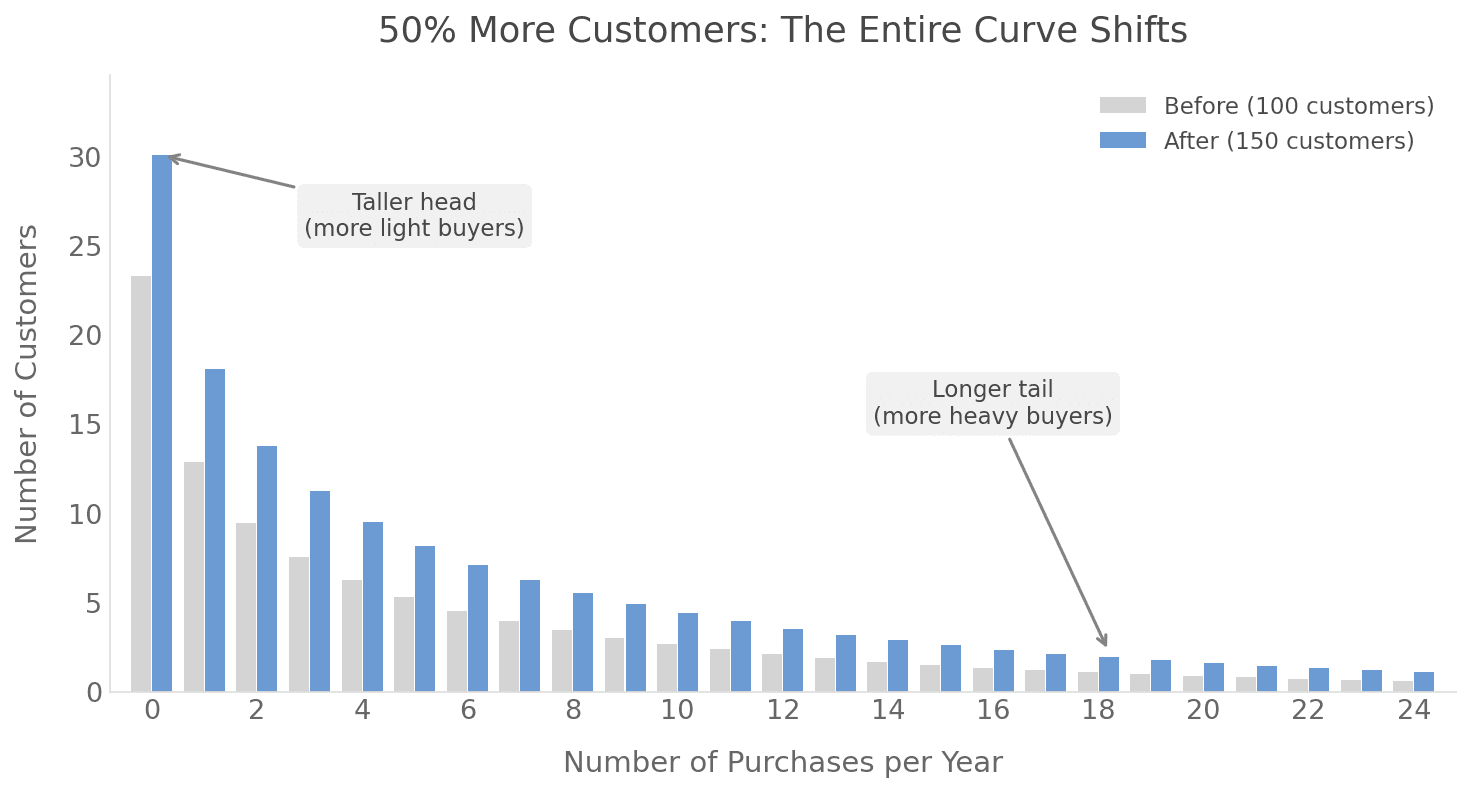
What the chart above shows matters for retail specifically. Light buyers, people who buy your brand once or twice a year, are the majority of most brands' volume. They're not loyal, they're not engaged, and they will absolutely substitute if your brand isn't physically available at the moment they're ready to buy. Physical availability isn't just a logistics decision. It's where brand growth is won or lost.
At AdVenture Media, the distinction between brands with strong physical availability strategies and those treating distribution as an afterthought shows up clearly in campaign performance data, particularly in categories where the purchase cycle is long and the consideration window is narrow.
One More Worth Reading
Readers who've worked through the core list and want to go deeper on the digital side of physical availability will find the post on why Warby Parker abandoned pure DTC a clean case study in how a brand that built its identity around direct-to-consumer eventually had to reckon with the costs of limited distribution. The lesson is the same one Never Always, Never Never makes explicit: restricting your availability isn't positioning. It's a tradeoff, and you need to be honest about what you're giving up.
For the measurement side of retail marketing, the marketing mix modeling glossary page covers the methodology that's become the most defensible way to attribute sales across retail channels.
Where to Start
If you're new to retail and shopper marketing: Why We Buy first, then How Brands Grow: Part 2. Those two books will reframe almost everything you thought you knew about shelf strategy and consumer behavior.
Practitioners looking for the most current thinking on how physical and digital availability interact in an AI-driven environment should start with Never Always, Never Never. Behavioral science will make more sense once you've seen how it applies to modern channel strategy.
Senior executives thinking about format, channel, and competitive positioning should add Stephens and Kim and Mauborgne, but read the others first. Strategic vision without behavioral grounding is just guessing with better slides.
 Patrick Gilbert
Patrick Gilbert is the CEO of AdVenture Media and author of Never Always, Never Never and the bestselling Join or Die. He has been ranked among the top 5 PPC experts worldwide and has delivered keynotes at Google events across three continents.
More about Patrick →Enjoyed this?
Subscribe for more articles on strategy, AI, and what's actually working in marketing.
No spam. Unsubscribe anytime.