
Career Advice
I know that you know somebody who needs to read this.
In January 2025, Mike Rhodes launched a new course called Build the Agent. It taught PPC marketers how to use AI to build their own tools: reporting dashboards, web apps and automations that make the job much easier.
I've known Mike for a while, and we've always supported each other's work. He was the first person to teach me about the concept of an agent back in 2024.
Anyway, Mike has always seen these things coming, and his Build the Agent course was a unicorn in early 2025. Nothing else like it existed at the time. (Anthropic wouldn't release Claude Code, its AI coding agent, to the public for another few months.)
I felt then what I feel now: our agency was ahead of the curve on AI, but we'd fall behind the moment we stopped running as fast as we could. So I wanted in.
But my daughter had just been born, and I missed the sign-up completely. A few weeks later, I emailed Mike to ask whether I, and maybe a few people on my team, could jump in late.
He gave all of us access, for free, to his course that sold for $2,000 per seat. It was one of the kindest things anyone had ever done for me. (Hope you don't mind me sharing that detail, bud!)
The lectures ran about two hours each. The live sessions were at 3 a.m. New York time, but everything was recorded, so I figured I'd find the time.
But I dragged my feet. Becoming a new parent is a crazy time for anybody, and whatever headspace I had left belonged to my actual job. Putting on my student cap for two hours at a stretch felt impossible, so I kept telling myself I'd get to it eventually.
Then the guilt set in. Seeing the course emails in my inbox gave me anxiety, so I avoided them, and before long I was avoiding even the thought of how much I was avoiding them. It was like having a gym membership I wasn't using: the longer I stayed away, the harder it was to walk back in.
When I finally sat through Lecture 1, it was mostly an overview of the AI tools available at the time. Mike recommended one called Wispr Flow, which turns your voice into text anywhere you can type.
Lecture 2 is the one I'll never forget. It was around 5 a.m., I had just given my daughter a bottle, and she was asleep in my arms while I sat at the kitchen counter with my laptop open, working through the lecture by talking into Wispr Flow with my one free hand.
(FWIW, I'm currently sitting in that same spot. Although my now-giant daughter is asleep upstairs, and my left hand is free to cradle a wine glass. My goodness, how time flies.)
Lecture 2 was where we built our first web app, a live reporting dashboard, in an AI coding tool called Cursor. I followed Mike's instructions and used his prompts word for word, and Claude's Sonnet 3.5 model wrote the code.
Like magic, the dashboard on my screen looked just like the one in Mike's demo. I had "coded" an app! But part of me was unimpressed with myself. I had followed his instructions to the letter and didn't understand a thing I had actually done.
Then Mike told us to change the dashboard however we wanted, based on any idea we had.
I panicked a bit. He was essentially saying that anything was possible, and I had never done anything remotely close to this, so I couldn't think of a single interesting thing to build. After a few minutes of staring at the screen, I tapped the Wispr Flow button and muttered, "Change the bar chart color from blue to purple."
I pressed enter, Claude went to work, and the dashboard updated right in front of me.
It was an unbelievable feeling. I didn't fully understand what I was doing and didn't have a set of instructions to follow, but I gave the AI a vague command and it ran with it. This would soon become known as vibe coding: you describe what you want in plain English, and the AI writes the code.
It's comical that my landmark lightbulb moment was tied to something as insignificant as the color of a bar chart. But that was the moment I realized I was capable of doing this, and I was hooked.
By the time I finished the course, I was building things on my own—some spun off from Mike's ideas and some with nothing to do with marketing. I'd lie in bed at night thinking about what I could build next.
Most of what I made in those early days was worthless slop, and the few good things went out of date as soon as better models came out.
But those weeks taught me fundamentals, like how a project's code files are organized and how to set up the API keys and access tokens that let one piece of software talk to another. They paid off because I kept building long after the course ended.
I knew right away that this would change my career and the agency.
I couldn't wait for my team to feel what I felt. I told everyone that this course had completely changed how I saw AI and that they should find the time to dig into it, and everyone was excited. This is awesome. I can't wait to dig in.
Then, a lot like me, everyone got busy. Weeks turned into months, and the course sat there, the same way it had sat in my inbox.
Eventually, I sat down and wrote an email to the whole company with the subject line Career Advice.
I opened it as their CEO, admitting that I had failed to be direct and clear about our AI strategy.
We had spent a ton of time talking about AI, sharing our side projects and reiterating how important all of this was to our futures. Everyone was dabbling, some more than others. We even had an "open credit card" policy: if anyone wanted to experiment with an AI tool or take a course, we'd make the investment, no questions asked.
But it was all too vague. "Do more AI stuff" is not a directive, and I'm ashamed that I once thought excitement alone would be enough to move an entire company in a different direction.
That was on me, and our leadership team immediately vowed to set clearer directives and initiatives, including mandatory group trainings.
I was neither surprised or disappointed that others had not jumped into the course material. I was also guilty of dragging my feet.
Then I took off my CEO hat and wrote to them as someone offering career advice rather than as their boss. I asked them to imagine telling a career coach something like this:
My CEO keeps encouraging us to learn AI. They got us free access to a $2,000 course he swears by. It sounds interesting, but I'm just too busy right now. Maybe next year, I guess.
Any competent career coach would tell you that you're insane not to find the damn time to take advantage of that.
I also wrote that everyone is always busy, and that never changes. The real question is when you're going to make time for the things that can have an exponential impact on your career.
As your manager, I can sit here and prescribe everything that I think you need to do to keep up. Mandatory trainings, enforced workflows, etc. And we will now do that to a degree, but is that the reality you're satisfied with? I also don't have a crystal ball and don't know where this is going, so we'd all benefit from going out on our own and attempting to figure this out together.
Years from now, you don't want to look back on this period and realize that, when it was time to take AI seriously, you only did what your boss required of you. We're still early, and there's so much to learn and so much value in learning it.
I have some version of this conversation all the time, and not just with my team. Almost everyone I talk to knows AI matters. They just can't seem to find the time for it.
I've offered close friends a free ticket to one of our AI workshops. They're thrilled, and they ask when the next one is. When I tell them it's this Friday, they have a conflict, so they ask me to send the full schedule. I send it, and I never hear from them again.
Underneath all of it is the same belief: I'm smart. I'll figure this out when I need to.
I think that's because we picture learning AI the way we learned every other tool at work.
And what if you're your own boss? Who will hold you accountable?
Six months ago, the CEO of an insurance company hired us for an AI transformation project: teach her leadership team how to use Claude, then keep working with them to build AI workflows into their day-to-day.
So far, it's going great, and her team has impressed me. I was recently on-site for one of our sessions, and before the day wrapped up, she brought me into her office and shut the door.
"Patrick, I have a confession. I've never logged a single session with Claude. I'm terrified because I now see everyone else at the company using it and I feel like such an idiot. You need to help me."
It was inappropriate for me to laugh, but I couldn't help myself.
"Sure," I said. "Sit down and open up Claude. You have an account, right?"
"I think so," she replied.
I don't blame her for falling into this trap. She runs a 300-person company, and finding the time is hard. But she was one of the few willing to admit it and do something about it.
After about 90 minutes of me describing concepts and spoon-feeding prompts, she was looking at an interactive P&L dashboard. "Wow. This is amazing!"
Then I asked how she'd make it more useful. She drew a blank.
"What if you changed the colors to match your branding?"
"How do I do that? I don't know if we have the brand guidelines loaded into the system or anything..."
"You don't need that. Just give Claude your website and tell it to figure it out."
"It's that easy?"
"Yes."
This was her lightbulb moment, and just like mine, it came when a bunch of bar charts changed color before her eyes. She now uses Claude daily (and is an AdVenture+ member!).
My first year out of college, I was living in Hershey, Pennsylvania, and I knew a career in marketing meant I needed to seriously upgrade my Excel skills.
So I signed up for a 28-lesson online course with practice data, one lesson a night for about two months. That's where I learned pivot tables, VLOOKUPs and conditional formatting.
I never took another Excel course. Sure, I picked up a few tricks over the next decade, but what I learned in those few months held up, because Excel barely changed.
That's how most people think about learning AI. Find a free weekend, finish the course, check the box, add proficient in AI tools to the résumé and move on.
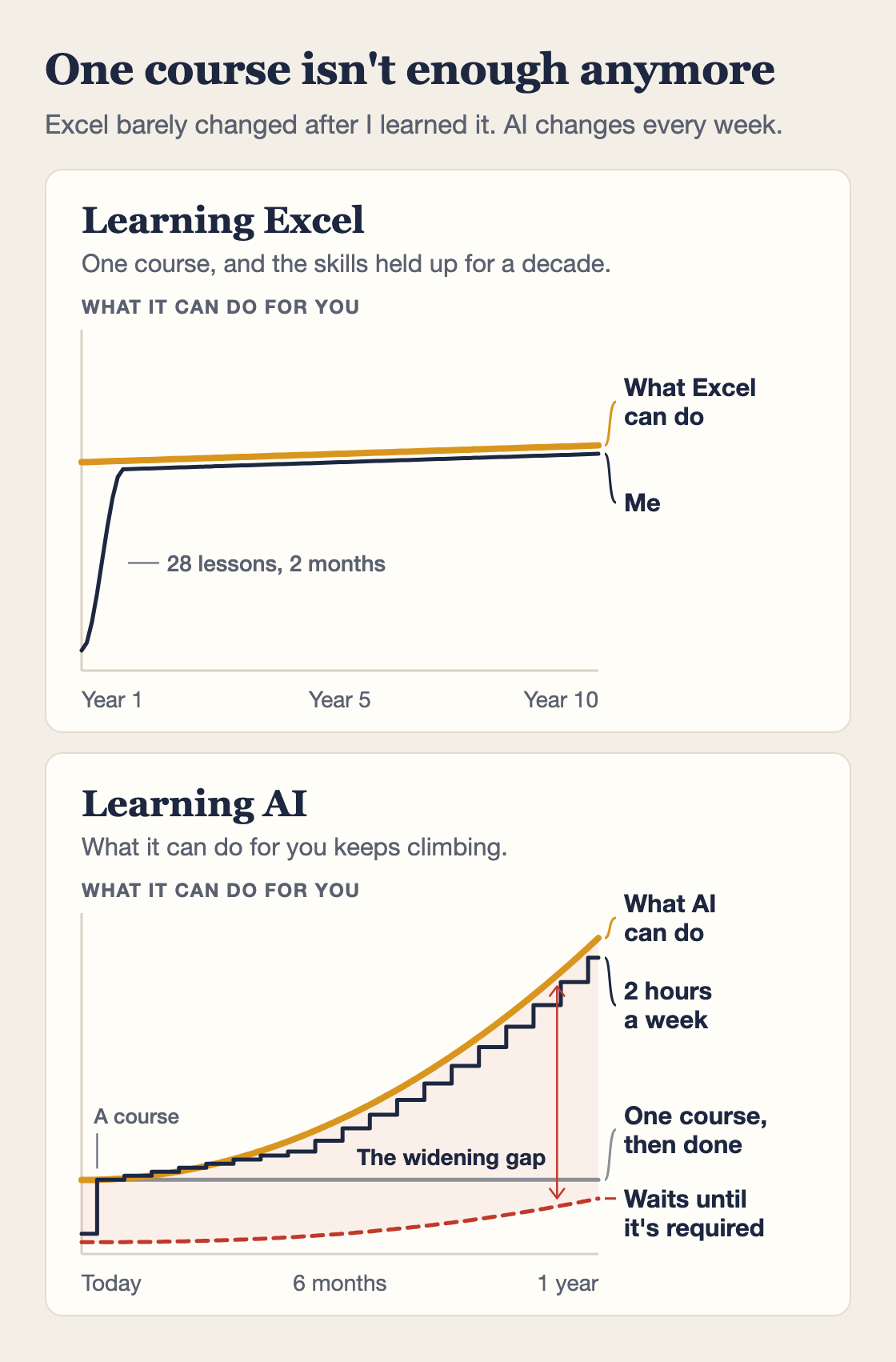
But AI isn't Excel. Whatever it can do for you today, it will do far more a month from now.
AI is improving on an exponential curve. If you only do the bare minimum, you'll still get better, but your curve will be much flatter. The gap between what's possible and what you're capable of gets wider every month.
In Lewis Carroll's Through the Looking-Glass, Alice and the Red Queen run as fast as they can, and when they finally stop, Alice realizes they're under the same tree they started at. The Queen explains:
"Now, here, you see, it takes all the running you can do, to keep in the same place. If you want to get somewhere else, you must run at least twice as fast as that!"
AI works the same way. Anyone can still pick this up, but putting it off and stopping after one course are the same mistake. Both treat AI like Excel, something you learn once.
Learning AI is a lot more like getting in shape. Nobody goes to the gym four times a week in January and then declares their fitness done for the year. If you care about your health, you change your habits until the training routine is part of your life.
That's why ongoing AI training, in shorter bursts, will do more for you than locking yourself in a room for 48 straight hours this weekend. The weekend covers more ground faster, but the routine is what keeps you from getting comfortable with what you already know.
That 5 a.m. Mike Rhodes lecture was one great workout. But what changed my career was showing up again and again afterward, the late nights and the worthless slop included, until building with AI was simply part of how I work.
You have to commit to this. It's as important as any other habit you're trying to build.
I've believed for a long time that the people who come out of this period ahead will be the ones who made learning AI a habit before anyone required it of them.
If someone came to mind when you read the first line of this email, that's my career advice for them.
2 new live workshops
- The AI Video Workshop for Beginners, Tuesday, November 17, 10am to 2pm ET. Make AI images and video with Webby-nominated director Dave Spector, our Creative Director, and leave with a first draft of your own commercial. No filmmaking or AI experience needed. It runs again December 15.
- The AI Privacy & Security Masterclass, Wednesday, November 18, 12pm to 2pm ET. Kate Marshall, author of AI at Work, shows you what your AI tools can see, what can be faked and what you can control.
Also coming up, all live on Zoom:
- Wed, Nov 11: Claude for Design
- Mon, Nov 16: Claude for Sales Teams
- Thu, Nov 19: Claude for Beginners
- Mon, Nov 23: Claude for Design
- Tue, Nov 24: Claude for Beginners
- Tue, Dec 1: Claude Code for Beginners
Make time to learn AI AdVenture+ is our membership for ongoing AI training: 2 live sessions a month on Zoom with Q&A, 2 Claude courses and the recording of every past session in the members' library. The next one is Friday, November 20 at 12pm ET, where we'll set up personal AI agents live. Join before December 1st and you lock in the $19/month founding rate. After that, it's $29/month. |
Want more of this?
If this issue has you wondering where to start, this was our first AdVenture+ live session: building an AI agent from an empty folder in about an hour.
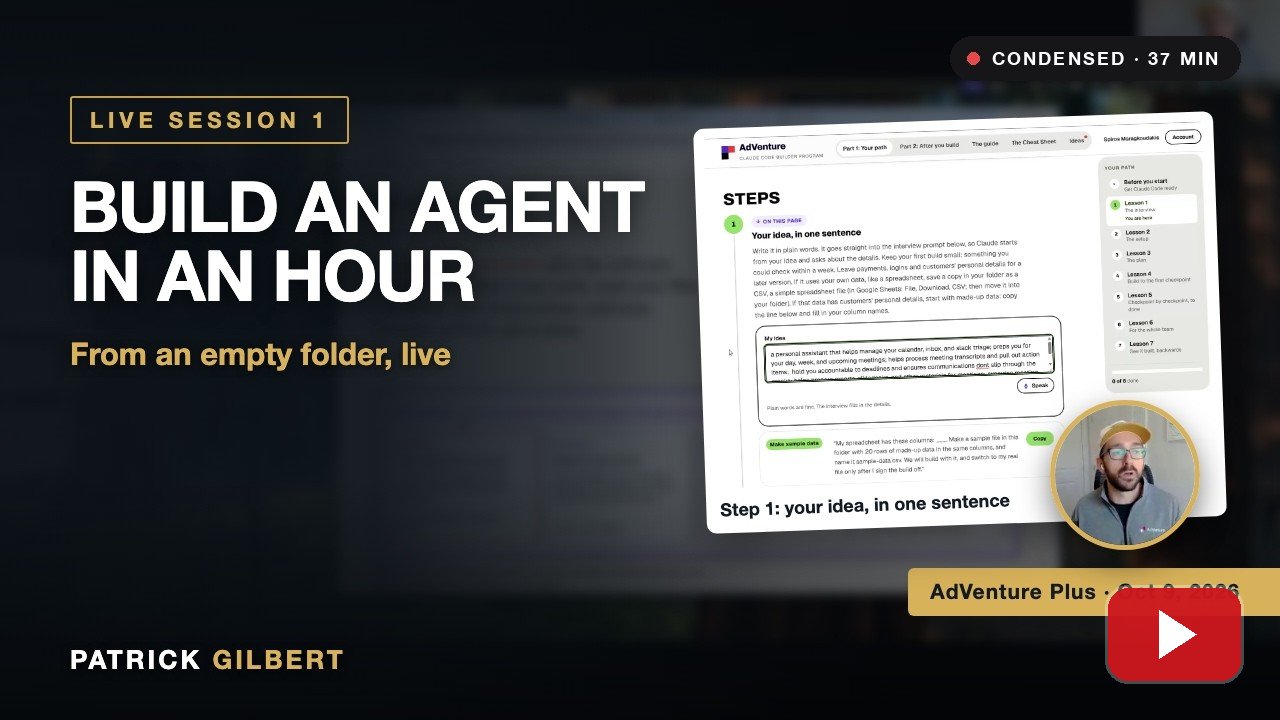
Build an AI Agent in an Hour · 37:51
I put new videos up on YouTube most weeks. Subscribing there helps more than you'd think.