
My Dad Is Learning AI
My dad attended one of our Claude workshops this week.
I wasn't supposed to lead it, but a last-minute schedule change put me in front of my father and 29 other people for 3.5 hours, teaching a tool that didn't exist a year ago, and techniques, models and features that didn't exist three months ago.
The people in that room are among the small percentage of the population taking AI seriously. They recognize that the technology is inevitable and will reshape their careers and their lives, and they had the discipline to carve out half a day to sit down and be students again. Most of them seemed optimistic, at least somewhat, about what AI could mean for them.
My father is in his mid 60s and is a seasoned retail executive. He spent most of his career at Duane Reade, the pharmacy and convenience chain that seems to sit on every corner in New York, and left after Walgreens acquired the company in 2010. The 16 years since have taken him through:
- A tech company that was later acquired by eBay, his first experience working for a digital company
- A software company that was pioneering mobile point-of-sale
- Vineyard Vines, where he was one of the few old guys in a sea of preppy 20-somethings
- A retail software startup that was acquired by Salesforce
Every one of those moves meant starting over with a new industry, new systems, new jargon and a new group of people to prove himself to, often as the oldest person in the room. He has had to reinvent himself time and again, through difficult stretches and uncomfortable experiences, often with his back up against the wall.
And he still has the humility to spend his Tuesday on a Zoom call, sitting at the same dining room table where he taught my siblings and me countless invaluable life lessons, listening to his youngest son teach him about tokenization and agents.
Most people in his situation would have given up, or at least resented that technology, young people or the establishment were turning his world upside down again, forcing him to change his ways and learn new things.
But as he has done time and again, he's leaning in with curiosity and optimism. Of all the lessons he's taught me at that dining room table, this might be the most valuable.
In Issue #16, I told the story of our Claude Code for Kids bootcamp, where a group of 12-year-olds with no formal background in coding became advanced game designers within 48 hours. The experience blew me away, and it left me feeling sorry for all the people who are actively avoiding AI.
I concluded that issue by saying:
Whatever you think of AI, your future with it is going to be decided by your attitude toward it. That is the one variable that is entirely up to you. Take responsibility for it, because no one else is going to.
I believe that more and more every day.
If you're reading this, good for you for taking an interest in your own future. The learning process never stops. Take it from my father: curiosity, optimism and humility are the secrets to sustained success and perseverance. The people who get too comfortable, who decide they already know everything they need to know, or who keep putting off their own education, are doomed.
So let's discuss a topic that is painfully misunderstood: AI agents.
We romanticize the idea of an agent because very few people actually know what the hell it is. The word conjures up an image of a digital robot, something close to sentient, quietly working away in the background of your life. The reality is much simpler than you think.
A client asked me about this on a call on Friday. She's been tasked with making her company more AI-native, and she's stuck on the vocabulary. When somebody says "agent," everyone pictures something different.
The way I define it, an agent is what you get when you give an AI model, like Claude or ChatGPT, access to tools and instructions, so it can work on a loop until it completes a goal.
That's all it is. You can build one in extremely simple or extremely complex ways, but at its core, an agent is just a model with instructions and access to tools.
In practice, that breaks down into four parts:
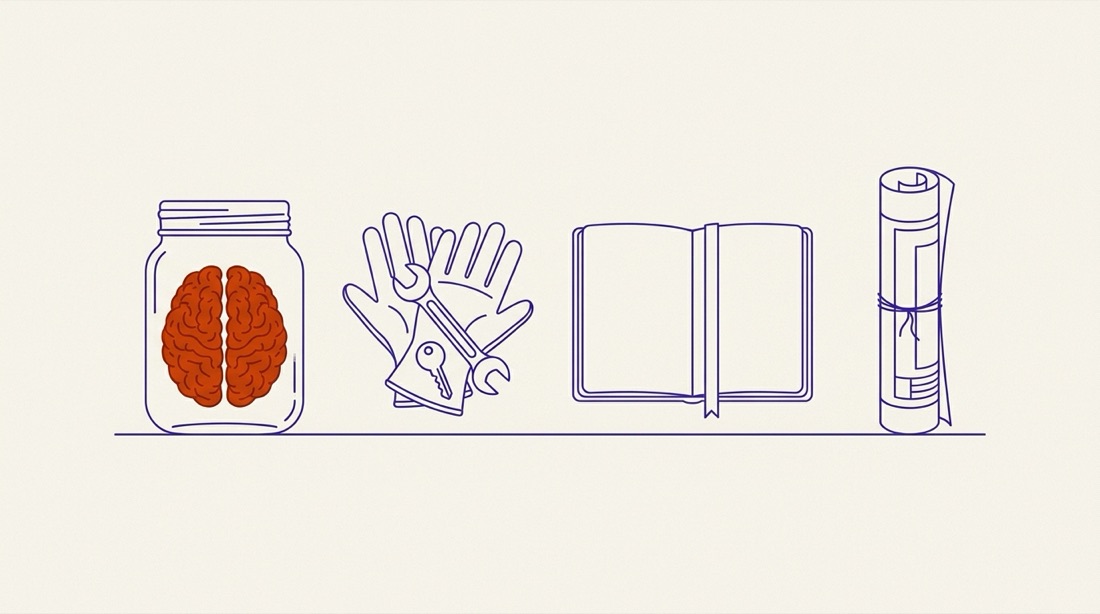
- The model is the brain that reasons: Claude, GPT, Gemini. It reads text and writes text back, and it's the only part of an agent that's actually AI.
- Tools are what it can touch: your email, your calendar, your files, a web browser, a calculator.
- Context is what it knows about you: your clients, your past work, your notes and meeting transcripts.
- Instructions are how you want things done, and what it has to ask you before doing anything.
A quick test: ask it to do something that takes more than one step. If it does the steps, it's an agent. If it tells you how to do the steps, it's a chatbot.
My client's vocabulary question is the one I hear more than any other, and it usually comes down to three terms people mix up:
An automation doesn't use AI at all. It's a script that runs the same steps every time something happens.
I have an automation running every day that saves my meeting transcripts to a folder on my desktop. That's not AI. It does the exact same thing every time, and if anything changes, it breaks.
A skill (in Claude, it's literally called a skill) is a set of instructions for one specific job. It may or may not use AI to do that job, but it does the job the same way every time. Think of it as a standard operating procedure (SOP) for Claude.
One example of a skill is a detailed set of brand guidelines that Claude follows whenever it creates content for your company. The purpose of the skill is that it uses the correct logo, typeface and colors every time.
An agent starts with a goal instead of a recipe. It decides which tools and skills to use, checks its own work and keeps going until the goal is met or it needs you.
Where a skill runs the same recipe every time, an agent's first question is closer to what do you need me for? A good agent will also use your skills, the same way a good employee follows your company's SOPs.
Most of the time, an agent isn't doing anything at all.
My own personal assistant agent, the one I use all day, is just a folder on my computer full of text files. There's an instructions file that Claude reads at the start of every session, notes on every client, meeting transcripts, guidelines on how I write, old proposals, and a list of the tools it's allowed to use. Nothing in that folder is running or thinking. It sits there, dormant, until something wakes it up.
What wakes it up is called a trigger, and it's usually one of three things:
- You ask it to do something. You use Claude to send a task or a question to your agent.
- Something happens, like a customer service ticket coming in, and the agent has instructions to handle a task every time that kind of request comes in.
- The clock says so. Every Monday at 9 AM: send me a review of my upcoming meetings for the week.
The real value of an agent is that when it needs to do something, it already has access to a ton of tools and context, so your prompt can be very short. Prep me for my Thursday afternoon meeting is enough to kick off an entire workflow: finding the meeting, reading the last few email threads with that client, pulling the notes from your last call and drafting an agenda. That's why agents are so attractive. They let you use AI in powerful ways without spending a lot of time prompting or adding context for each individual task.
To understand what happens once it wakes up, you need to understand two more concepts: the model and the harness.
The model is Claude Opus 5.5, Sonnet 5.5, GPT, whichever you use. It lives on Anthropic's or OpenAI's servers, not on your computer. It takes text in and sends text out, and that's all it does. It can't open your email, it can't do math, and it remembers nothing after it replies.
The harness is Claude Code, Claude Cowork, or Codex if you're in the ChatGPT family. It's an application that lives on your computer, the same way Photoshop or Excel does, and on its own it has no AI in it at all. But the harness is the part that has access to your tools: it can read your email, search your files, log in to QuickBooks and run a calculator.
Neither one is an agent by itself. An agent is the relationship between the two, a loop that passes the work back and forth until the job is done. That makes it a lot less like a sentient robot following you around and a lot more like a process running between two pieces of software.
Here's what that looks like on a real request. You type: Did Harbor Pointe pay their invoice this month?
- The harness (Claude Code) packs up your prompt with more information: a set of instructions, the relevant files from your project folder and a list of every tool this agent has access to. It sends all of it to Anthropic as text.
- The model (Sonnet 5.5) reads the whole package and makes a prediction for what needs to happen next (this is the reasoning). It replies to the harness with a request instead of an answer: search Gmail for the Harbor Pointe contract.
- The harness, running on your computer, connects to your email, runs the search, pulls out the contract terms and sends everything back to the model.
- The model reads the terms: 20% of the $62,000 project fee is due this month. Now it knows what it's looking for, so it asks for two more tools: calculate 20% of $62,000 and search QuickBooks for Harbor Pointe payments.
- The harness runs the math (exactly $12,400, calculated rather than guessed) and searches QuickBooks, which shows one payment of $10,000 on October 6. It sends both results back.
- The model compares the two and writes the final answer: they paid $10,000 on October 6, which is $2,400 short of the $12,400 due. The harness puts it on your screen. If the model wanted to email Harbor Pointe about the balance, the harness would stop and ask you first.
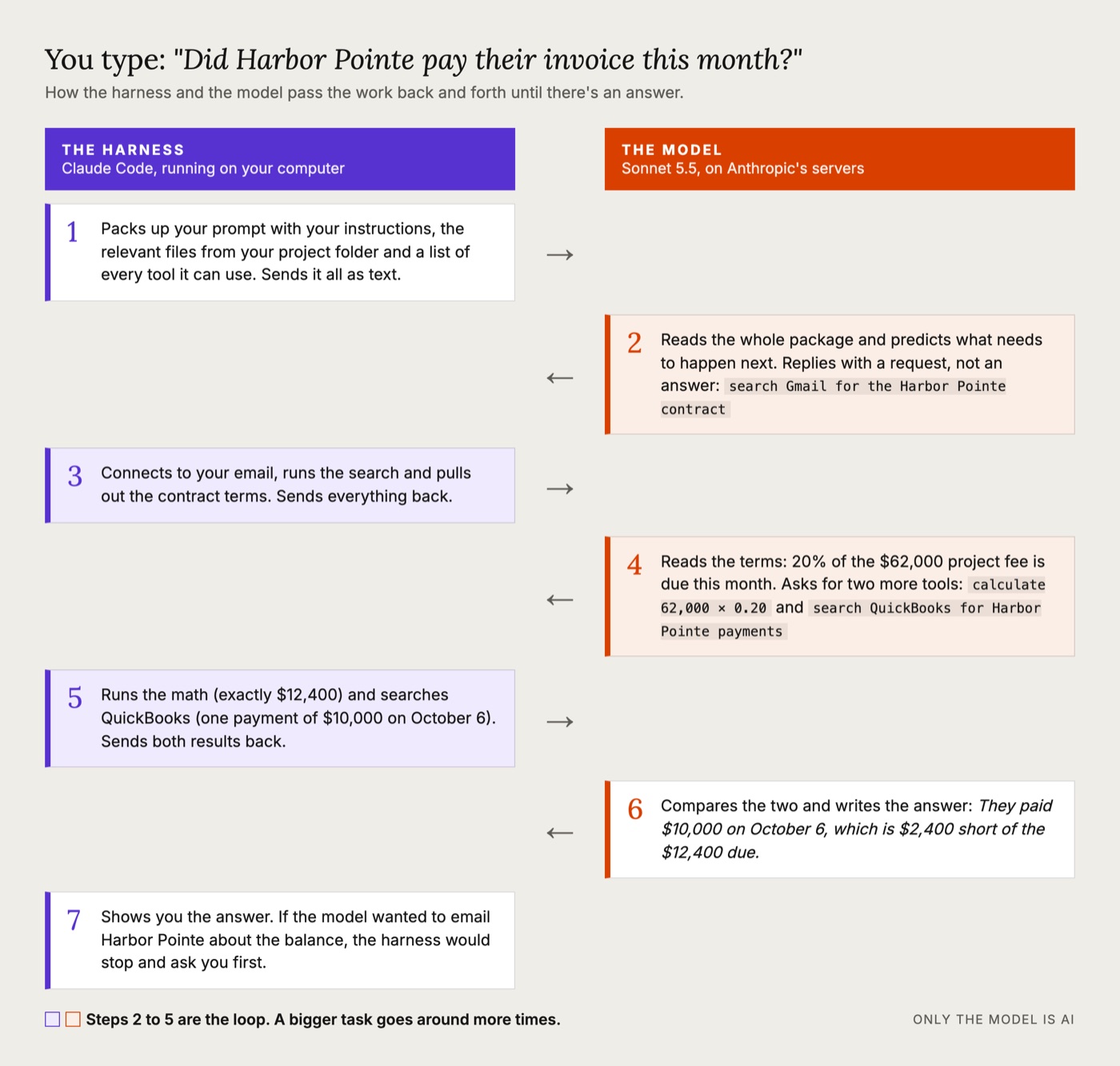
The model connected two different tools, figured out what actually needed to be done based on a one-line question, and handed the math to a calculator. The harness did every piece of work that touched your accounts. Steps 2 through 5 are the loop, and a bigger task just goes around it more times.
Your instructions and your context are just files in a folder, and the model is the only part of the whole system that's actually AI. The parts that make an agent good at your job, the instructions and the context, are the parts that belong to you.
It's likely that some or all of this went over your head. That's OK. If it were easy, it wouldn't be rewarding.
Few people would be willing to read this kind of newsletter on their weekend, and even fewer would be willing to read it a second time.
Again, follow my dad's lead. He texted me yesterday: "Great workshop this week. When are your next ones? I want to come back and go through it again."
That's the mentality all of us should embrace.
Introducing AdVenture Plus
On Friday we held the first live webinar of AdVenture Plus, our platform for ongoing AI training. The promise was to build and deploy a personal assistant agent in 60 minutes, live.
A member of our client services team volunteered to be the guinea pig, and Spiros Maragkoudakis, our Chief Growth Officer, walked him through it in Claude Code: describe the job, let Claude interview you about it, write the plan, then build. By the end of the hour he had an agent that reads the transcript from his most recent client call, matches it to the right client account, pulls out his action items and drafts the follow-up email.
That's the format we're building AdVenture Plus around: live sessions a couple of times a month where someone builds something real, start to finish, with the recording and the instructions in the Vault afterward so you can build it yourself. Our workshops teach the fundamentals. Plus is where we keep going as the tools change.
The full recording of Friday's build is in the Vault at adventuremedia.ai/dashboard, along with Spiros's step-by-step method and a one-page guide to everything in this issue. You can watch it for free between now and Halloween.
To everyone who has already joined AdVenture Plus, and to everyone who showed up for our first live session: thank you. It was our first time doing this, and the feedback you gave us is going straight into the next one.
Watch the session
Here's the full recording from Friday, where we built the agent live from an empty folder. It's in the AdVenture Plus Vault, free to watch through Halloween.
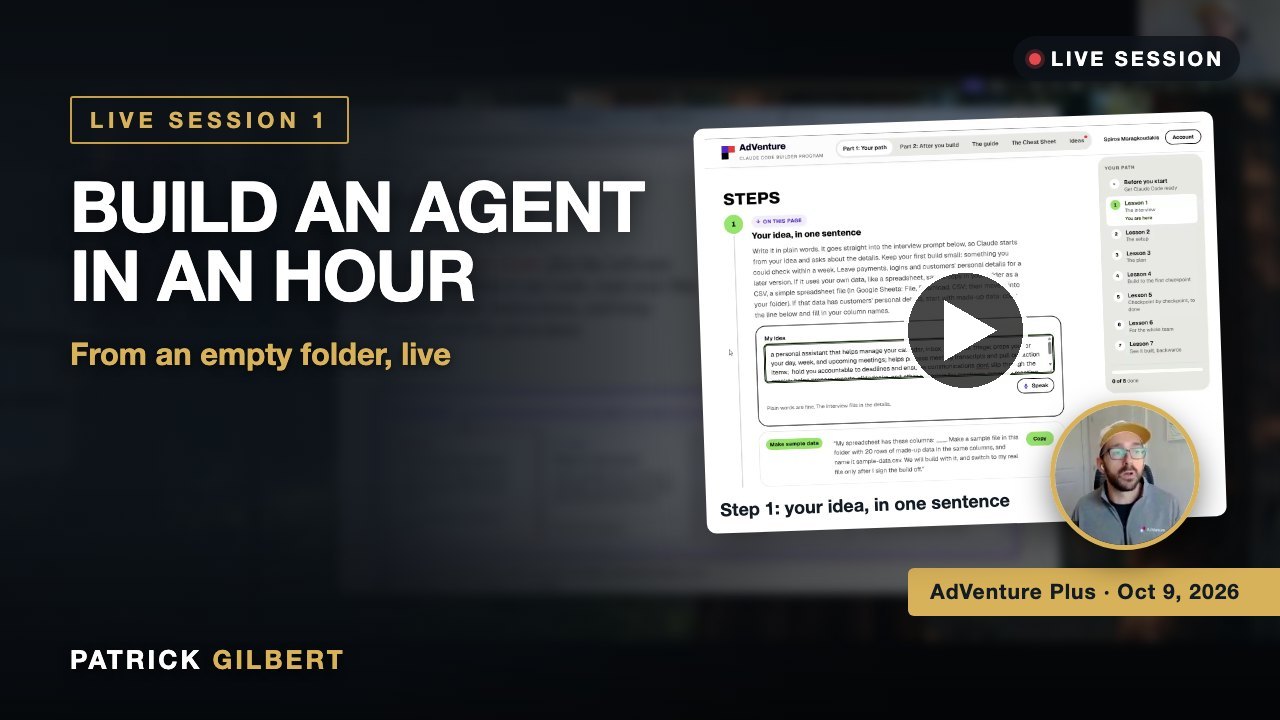
Build an Agent in an Hour: AdVenture Plus Live Session 1 · 73:43
I also put new videos up on YouTube most weeks. Subscribing there helps more than you'd think.