AI Marketing Strategy 2026: Beyond Tools to Transformation
Quick Answer: AI marketing strategy 2026
AI marketing strategy in 2026 requires moving beyond individual tools to building an AI-first culture based on the double helix model: internal efficiency and external value creation. This involves transitioning from solo work to a 4x2 model of copiloting and delegating across four modes: design, problem-solving, decision-making, and building. Success comes from treating AI as a copilot rather than an oracle, focusing on strategic amplification rather than replacement, and developing organizational maturity through the AI ladder framework from dabbler to strategist.
Watch
The State of AI in Marketing | 2024 Keynote
Definition
AI marketing strategy is the systematic integration of artificial intelligence technologies into marketing operations and decision-making, moving beyond individual tools to create competitive advantage through organizational transformation and strategic amplification.
The Great AI Scramble vs. Strategic Implementation
The AI revolution didn't arrive in November 2022 when ChatGPT launched. The technology had been quietly powering our daily lives for years, disguised as GPS navigation, music recommendations, and search algorithms. What arrived was awareness and with it, unprecedented pressure for immediate answers. As Patrick Gilbert argues in Never Always, Never Never, this created a dangerous scramble where companies rushed to rebrand existing tools as AI-driven rather than fundamentally rethinking their approach to marketing strategy.
The scramble mentality reveals itself in stark data: while AI and automation topped marketers' priority lists in 2024 surveys, the most popular tools in actual use were manual bidding and exact match keywords. The least popular? AI-driven features like Broad Match and Demand Gen campaigns. This disconnect between stated priorities and actual behavior highlights the fundamental challenge facing marketing organizations today.
The gap between AI hype and hands-on reality creates your opportunity. While others toy with tools and revert to familiar methods when frustrated, strategic organizations push through friction to find real competitive advantage.
AI as Copilot, Not Oracle
GitHub's transformation of their AI coding assistant from a frustrating experiment to the widely-adopted Copilot offers crucial lessons for marketing strategy. The breakthrough came when they reset user expectations from AI as an autonomous oracle to AI as an imperfect partner. Developers who treated the system like a junior employee became frustrated with inconsistent outputs. Those who approached it as a copilot for collaborative problem-solving saw productivity soar.
AI doesn't replace expertise. It gives expertise leverage it never had before.
Patrick Gilbert, Never Always, Never Never
This mindset shift proves essential for marketing applications. Performance Max campaigns don't fail because algorithms are broken. They underperform because marketers haven't provided sufficient guidance toward high-quality auctions. Similarly, ChatGPT doesn't deliver breakthrough strategies in first drafts because large language models are designed to provide statistically average responses, not exceptional ones. The competitive advantage belongs to those who bring above-average effort through better prompts, clearer context, and more strategic iteration.
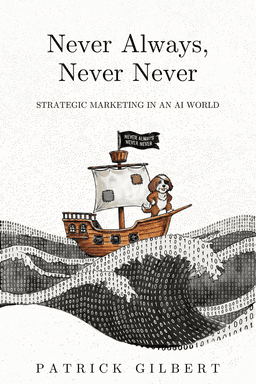
Enjoying this? Never Always, Never Never goes much deeper into the mental models and decision frameworks that shape how we think.
The AI Double Helix Model
Strategic AI implementation requires understanding the double helix structure of business transformation: internal efficiency and external value creation. These two strands must spiral upward together, each reinforcing the other in a compounding cycle that creates sustainable competitive advantage.
Strand 1: Internal Efficiency focuses on automating high-volume, low-impact tasks that consume valuable human attention without directly serving customers. This includes automated reporting, data cleaning, asset creation, and communication workflows. The primary goal is bandwidth creation, freeing strategic thinkers from digital lever-pulling to focus on problems that actually move the needle.
Strand 2: External Value leverages AI to accomplish what was previously impossible rather than just faster execution of familiar tasks. A mid-market brand can now conduct sophisticated analysis that once required seven-figure budgets and three-year contracts with global agencies. Creative teams can produce emotionally resonant campaigns without massive production houses. Solo strategists can monitor competitor movements and market signals with the speed and depth once exclusive to Fortune 500 companies.
The magic happens when efficiency creates bandwidth for experimentation, leading to new value that generates capital for better efficiency investments. This compounding loop separates organizations that race toward commoditization from those that become different species of business altogether.
The 4x2 Model of Work
Implementing AI strategy requires rethinking how work gets done across four distinct modes: Design (blank canvas visioning), Problem-Solving (detective work toward resolution), Decision-Making (converting analysis into action), and Building (execution and implementation). The traditional 4x3 matrix offered solo work, collaboration, or delegation as options for each mode.
AI-first culture collapses this into a 4x2 model where solo work becomes operationally negligent. Every task must be either Copiloted (human in driver's seat with AI as navigator) or Delegated (machine execution with human quality control). Design and Decision-Making typically require copiloting to maintain strategic human judgment. Building and repetitive Problem-Solving should be delegated wherever possible to free up cognitive resources.
- Copiloting: Collaborative process for Design and Decision-Making where humans maintain strategic control while AI accelerates analysis and exploration
- Delegating: Full machine execution for Building and routine Problem-Solving with humans providing oversight and quality assurance
- Mental audit requirement: Before starting any task, ask 'Can this be delegated? If not, can I copilot it?'
- Strategic reallocation: Move individuals away from technical lever-pulling toward uniquely human work of understanding people and building brands
The AI Maturity Ladder
Organizations must track their evolution through four levels of AI maturity. Dabblers use ChatGPT for email drafts and transcript summaries but haven't changed fundamental work approaches. Practitioners have adopted the 4x2 model, developed prompting skills, and use AI to solve daily friction points like broken tracking pixels or copy variations.
The transformation accelerates at the Architect level, where individuals stop looking at tasks and start building systems. Architects create the first strand of the double helix by designing automated workflows that generate strategic outputs for entire teams. At the Strategist level, professionals develop the second strand through bespoke applications, proprietary data models, and interactive tools that provide unique customer value.
In an industry where everyone has access to the same LLMs and ad platform algorithms, your advantage is not the software you buy, but the collective intelligence and maturity of your team.
Patrick Gilbert, Never Always, Never Never
Building AI-First Culture
Cultural transformation requires immense empathy for team members starting from different places. When highly vocal fractions move at light speed while others feel left behind, dangerous internal rifts emerge. People who feel intimidated by technology often shut out information that could help them progress, creating exponential learning gaps.
Success requires meeting people where they are and developing shared language around AI concepts and frameworks. A Level 2 Practitioner may not build custom agentic workflows, but should understand what those mean and discuss projects with Level 4 colleagues. Shared language removes magic from machines and replaces intimidation with clarity, giving everyone permission to engage with the technology.
AI proficiency must evolve from hiring bonus to non-negotiable prerequisite. Organizations can only move as fast as their collective intelligence allows, making team-wide capability development essential for competitive survival.
Key People & Works
Researchers & Authors
- Patrick Gilbert
- Isaac
- Sam Tomlinson
- Nat Friedman
- Dave Wehner
- Byron Sharp
Key Works
- Never Always, Never Never by Patrick Gilbert
- Join or Die by Patrick Gilbert
Practical Applications
- Building automated reporting workflows to free up strategic thinking time
- Using AI copilots for campaign optimization and creative development
- Implementing the 4x2 work model to eliminate solo execution
- Developing proprietary AI tools for client value creation
- Creating AI maturity assessment frameworks for team development
Frequently Asked Questions
What is the difference between AI tools and AI strategy?
AI tools are individual applications like ChatGPT or automated bidding features. AI strategy is the systematic transformation of how organizations operate, moving from tool adoption to culture change through the double helix of internal efficiency and external value creation.
How do you implement the 4x2 model of work?
The 4x2 model eliminates solo work across four modes: Design, Problem-Solving, Decision-Making, and Building. Every task must be either Copiloted (human-led collaboration with AI) or Delegated (AI execution with human oversight). Team members perform mental audits before starting tasks to determine the appropriate approach.
What are the levels of AI maturity for marketing teams?
The AI Maturity Ladder has four levels: Dabbler (basic tool usage), Practitioner (systematic 4x2 implementation), Architect (building automated systems), and Strategist (creating proprietary value-generating applications). Organizations must develop collective intelligence across these levels to remain competitive.
How does AI create competitive advantage in marketing?
AI creates advantage through the double helix model where internal efficiency generates bandwidth for experimentation, leading to external value creation that funds further efficiency investments. This compounding cycle allows smaller teams to compete with larger organizations while developing unique capabilities.
Why do many marketers struggle with AI adoption?
According to Patrick Gilbert, the disconnect between AI hype promising magic solutions and the reality of imperfect tools requiring guidance creates frustration. Many retreat to familiar methods when AI doesn't deliver immediate perfection, missing the opportunity for strategic competitive advantage.
What is the copilot mindset for AI in marketing?
The copilot mindset treats AI as an imperfect partner rather than an autonomous solution. Marketers stay in the driver's seat, providing strategic guidance and iteration while leveraging AI to accelerate analysis, creative development, and campaign optimization without expecting perfect first outputs.
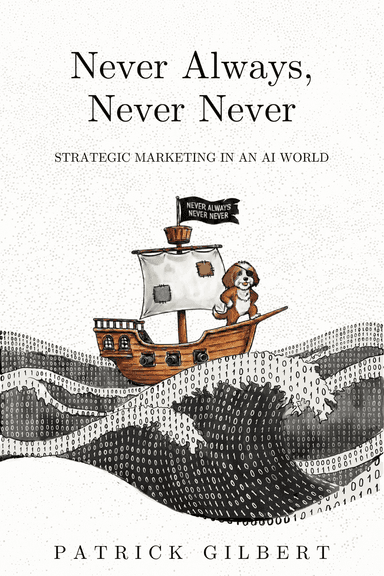
From the Book
Chapters 25 and 30 reveal the complete framework for building AI-first marketing organizations, including detailed implementation guides, team assessment tools, and case studies of successful transformations. Gilbert provides the operational blueprints for moving beyond the AI scramble to sustainable competitive advantage.
This is just a glimpse. The book explores dozens of cognitive biases and decision-making frameworks that change how you think, decide, and act.
Want to go deeper on this topic?
Chat with the AI companion to explore these concepts with the full context of the book.
Chat about this topicRelated Reading
AI Double Helix Framework: How to Transform Marketing with Two-Strand AI Strategy
Learn the AI double helix framework: using AI for internal efficiency (strand 1) and external value creation (strand 2) to build competitive advantage.
conceptHow AI Works for Marketers: Understanding Machine Learning Behind Marketing Tools
Learn how AI works in marketing through neural networks, training, and inference. Understand the machine learning behind your marketing tools.
conceptBuilding an AI-First Culture in Marketing: Beyond Tools to Transformation
Learn how to build an AI first culture that creates efficiency and value, not just faster horses. Strategic frameworks for marketing teams.
BlogAI Amplifies Whatever You Bring to the Table
AI isn't a shortcut. It's an amplifier. If you have strong strategy, AI makes you dramatically more effective. If you don't, it helps you execute mediocrity faster.
BlogWhy the Old Playbook Is Broken
The platform tricks and optimization shortcuts that built most digital marketing careers have been commoditized. Here's what actually changed and what to do about it.